• TalkBass has been independent since 1998. Add your voice.
    Create a free account to reply to discussions, view embedded media, and browse with fewer display ads.
    Join freeLog in
    Want zero display ads or expanded classifieds tools? Compare plans.

Victor Wooten's Groove Workshop: Help Understanding how to play without thinking.

my calculator is correct, its my damn fingers that have "operator Error" Ill go patch my post.. :laugh:

I'm a Physicist and Engineer - doing both for decades. Although it took a second or two for me to calculate exactly what 9 by 13 is, I do know instantly that it's not 177 - just like music, enough hours doing enough math in my brain, I can very quickly say "that's not right" when someone puts math that's not close to the right answer in front of me.
 
A really simple mnemonic for this is that 9x = 10x-x

So in our example, x=13 so 9*13 = 10*13-13 = 117.

Multiplying/dividing by 10 is really easy (simply move the decimal point), so leverage that whenever you can. A couple more examples:

11x = 10x+x
5x = 10x/2
I just did 9 x 10 (90), and 9 x 3 (27) and added them, but your way works as well.
 
  • Like
Reactions: ELG60
This September marks the 30th year of bass playing for me. I have no natural talent to speak of, and while I'm certainly competent, I'm no master of theory or technique. I have practiced music just about every day since I was a child, and studied really hard. At some point along the way, I stopped thinking about notes, scales and chords, and I just started playing from my heart instead of my mind. Vic's thing isn't a technique or philosophy, it's about putting in enough time with your instrument that you can play what you feel instead of musical formulas. For some people, that may be slamming low E on 8th notes. Or maybe UFOTOFU.
 
don't worry my fingers fail me on the Bass too. worst part is I purposely put the answer lower so folks (like you it seems) could try to work it out in their heads first!

anyhow I hope this illustrates that it takes practice on the instrument to get to that elusive 'unknown' and 'feeling' that VicWoo does so flawlessly and effortlessly.

If I had been paying bass from the tender age of 5 with older siblings to emulate and parents booking gigs for me with Curtis Mayfield or Sly Stone (one of those.. Ill edit when I find the vid) I may be virtuoso on the bass too.. but not just me, MANY people would be awesome if they put in the kind of work Vic did at as early an age as he did.

time for lunch.

Bass on Brothas and Sistas!
 
When jamming or creating music, I don't really think about the theory. Instead, I have an idea in my mind of what I want to come out, then I let it out! I usually get close the first time around, but rarely exactly. Sometimes it even turns out better than what I was shooting for! The good news is the next measure or phrase is right around the corner, so I have another opportunity to try again or reinforce what I did before.
As a fellow Engineer, think of creating music like iterations of a design. It's OK to have multiple iterations to tryout and build upon util you get what you get what you want.
 
  • Like
Reactions: Mushroo
So in short they expect you to know all the theory before you can just "Play" That makes sense, but the perspective I got from the video was "Stop thinking about theory, or notes, just play!" But I need that theory!

Here's my take on it, having been through the DVD and one of Vic's camps. They are talking to a lot of people on a lot of different levels. MOST of those people already have theory, have already practiced scales until their fingers bleed, and may even be trapped by it.

If there was one thing I could change going into his camp, I would have known every chord in every key, everywhere on my bass. I think for a lot of us, especially as adult learners, this is going to be a case of "you need to know the rules before you can break them".
 
Here's my take on it, having been through the DVD and one of Vic's camps. They are talking to a lot of people on a lot of different levels. MOST of those people already have theory, have already practiced scales until their fingers bleed, and may even be trapped by it.

If there was one thing I could change going into his camp, I would have known every chord in every key, everywhere on my bass. I think for a lot of us, especially as adult learners, this is going to be a case of "you need to know the rules before you can break them".

I want to be clear, however, that you don't NEED any theory to attend a Wooten Woods camp. Everyone will get something different, but I just feel that I would have gotten a lot more if I went in with that knowledge.
 
I'm an Engineer for a living, it's my job to overthink. :D

I feel your pain! A lot of good advice has been given, though.

Bottom line; you've got to put in the work to develop your ears AND learn your instrument well enough to play what your ears are telling you in the moment. That just takes a lot of time doing, and there's plenty of thought that goes into that process.
 
  • Like
Reactions: Bioflava
First, check out the Vic Wooten quotation in my sig, below. The “secret” you’re trying to suss out is how to get past your own mental roadblocks. In that, we (nearly) all have dealt with it; or should have done.

Keep in mind that we’re rhythm section and the groove is more important for us than the pitch (note) we play. Do you think about string, fret and finger when you play a scale? If you play a clam do you go back to “fix” it or do you keep moving? These two habits occupy brainpower that is better spent making people [including you] feel what the song wants them to feel.

Vic, Ant and your teacher are telling you to worry less about the particular notes and more about what makes you and everybody else bob your heads to the music. It’s a hard, self-imposed barrier to break through but the day you first do it is a day you’ll remember gladly.

Oh, yeah. The music theory can wait. Ignore it if it’s getting in the way of playing relaxed. You’re going to learn a lot of stuff that falls under the music theory umbrella but it’ll be easier to use if you don’t burden yourself with that ponderous and threatening name, “music theory.” If you’re on an orchestral path, ignore this paragraph.
 
Honestly, every instructional video or book that Victor Wooten releases needs to have his book "The Music Lesson" attached. It explains his views on learning and playing music perfectly. It comes across as a zen thought exercise, and might not be everyone's cup of tea, but it has some amazing insights on playing. In short, his whole philosophy is on not just playing the notes, but feeling them as well.

If it helps, here's what he thinks is the most important part of playing (or else he wouldn't write it):

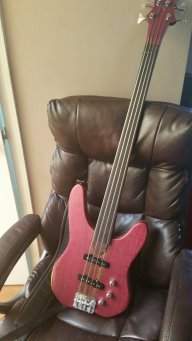
IMG_0699.JPG
 
So my Bass teacher is having me go through Victor Wooten's Groove Workshop DVD. I'm about half way through, and Victor talks a lot about playing what you feel. Not thinking about what you want to play, or playing the correct notes, or finding the key of the song. Just play what you feel. I'm having trouble understanding this though. I can feel a type of sound I want to play, but my issue is that...Where is that sound. I can't just randomly start hitting notes in hopes that what I feel comes out. In theory you need some kind of foundation right? Victor even mentions that he isn't a master of music theory, and I'm not a master as well.

I just have trouble wrapping my head around this concept of playing without thinking. I've practiced this a couple
of times where I either play to a backing track, or not play to anything at all. In both situations it either sounds
like garbage (Because I don't know what I'm playing) or I stay to patterns I know. (R, 3rd, 5th) or just minor pentatonics.

It's like there's a secret that everyone else knows but me.


When I am playing my best my mind is literally blank.
It took me a solid decade to get use to singing and talking while playing.
The only thing I can suggest is to sit down and get comfortable with some back ground music and just play around on the bass.
Your muscle memory and your not conscious mind already know what to do, it is the conscious mind that screws everything up.
 
Last edited:
So in short they expect you to know all the theory before you can just "Play" That makes sense, but the perspective I got from the video was "Stop thinking about theory, or notes, just play!" But I need that theory!

I know zero theory, I have to stop and think about what note I am playing when the guitarist ask "what note are you playing".
why because I am not thinking about what I am doing, I am listening to the band.
 
Last edited:
  • Like
Reactions: rufus.K
When I went to his camp he stated many times that he was in the rhythm section, not the notes section.

Then he made us solo over a pad using only the minor 2nd. We had to express ourselves with tone, dynamics, articulation, and rhythm alone. (There were actually 10 things in all beside pitch that make up music on the list we developed but I can’t remember them all.) It was a great exercise.
Funkiness isn’t about pitches.
 
  • Like
Reactions: Bioflava