• TalkBass has been independent since 1998. Add your voice.
    Create a free account to reply to discussions, view embedded media, and browse with fewer display ads.
    Join freeLog in
    Want zero display ads or expanded classifieds tools? Compare plans.

VVT tone pot going on PJ -- taking suggestions

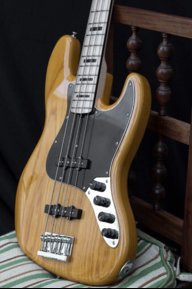
Squier PJ tone control replacement

  • Blend

    Votes: 12 25.5%
  • Varitone

    Votes: 8 17.0%
  • Switch

    Votes: 10 21.3%
  • Replace it all with EMGs

    Votes: 8 17.0%
  • Bypass the tone control

    Votes: 2 4.3%
  • Just Volumes

    Votes: 3 6.4%
  • No pots at all

    Votes: 2 4.3%
  • Orange caps are made with carrots

    Votes: 11 23.4%

  • Total voters
    47
  • Poll closed .
Hey all,

Tone pot on my PJ Squier goes in an out when I tap it, and, increasingly, does so on its own. I am taking this repair opportunity to completely rethink the wiring setup. I have read the threads, so I am making this a simple vote so you do not have to type if you do not want.

What do you recommend? Varitone? No ground blend? Switch? VV no T? No V or T whatsoever? Throw the whole thing out and start over with Geezers?

I am not going to active this bass up at the moment. So passive setups only. Otherwise, I do not care. I guarantee I will be happy just to have made a change and will probably throw it all out again in year.

BTW I am aware that the problem is probably fixable; I just don't like the tone control action with these pickups, it seems pointless, so I would like to try something differnt.

Vote early, vote often. Thanks!
 
  • Like
Reactions: Pbassmanca
two CTS 250/500 stacked pots vol/tone; one for each pickup. Kill switch in third hole. Different cap sizes ~.022 for neck and ~.047 for bridge
Interesting.

I think Tone is the most important knob on a bass. Take away my volume knob, I have volume on my amp. But please don’t take my Tone knob.

If it was originally V/V/T, I say just replace the offending pot. It’s perfect as is
 
Interesting.

I think Tone is the most important knob on a bass. Take away my volume knob, I have volume on my amp. But please don’t take my Tone knob.

If it was originally V/V/T, I say just replace the offending pot. It’s perfect as is
I'm giving you TWO tone knobs!
 
Interesting.

I think Tone is the most important knob on a bass. Take away my volume knob, I have volume on my amp. But please don’t take my Tone knob.

If it was originally V/V/T, I say just replace the offending pot. It’s perfect as is
If this was a Jazz, I would probably agree. But as a P/J this is just not doing it any favors. What I like about sissy kathy's response is the perverse suggestion that I solve the problem by doubling up on the tone contrl.
 
Without a pickup selector switch you'd need to wire the treble cut in such a position so that when you blend the volumes they can each have independence.
That typical LP/SG wiring people use doesn't do that, so I modified a S.D. drawing for that:


With this setup blending actually works & with one or both volumes dialed back there is some independence of the treble cut knobs. (even with both pickups selected)

If you want real independence, say neck treble on full & bridge dialed back a little, that's where the pickup selector switch comes in.
 
  • Like
Reactions: Old Garage-Bander
usually very small value caps are used instead of diodes to get a similar effect. Some guitar guys swear by volume knob caps, I can't hear a difference in bass at least.

For a passive PJ, VVT or BVT really is the best answer, just depends which you prefer. Wire it with a push/pull either to bypass the tone pot, or for two different cap values.
 
I have a P J with stacked volume control knobs and a the equivalent of a Varitone rotary six position tone control. I like that setup as much as anything else I have.

Another suggestion; You could put two sets of stack knob pots with the forward set as volume / volume, but the rear stack having the lower knob as a capacitor selector and the top knob as the tone control working with the cap selected on the lower pot. I have this setup on a different Pbass, which has only the P pup (and only a single volume control) that yields some interesting tones.
 
  • Like
Reactions: Usidore T Blue
usually very small value caps are used instead of diodes to get a similar effect. Some guitar guys swear by volume knob caps, I can't hear a difference in bass at least.

For a passive PJ, VVT or BVT really is the best answer, just depends which you prefer. Wire it with a push/pull either to bypass the tone pot, or for two different cap values.

Small caps affect higher frequencys, on a bass you need a larger cap. but putting a valve cap (essentially a resistor in parallel to the cap) on the vol won't prevent the volumes from affecting one another, The signal from the bridge output is connected to the neck output, so you get the signal from each pickup split. Part of the signal goes to the jack and part goes to the other volume (so you have current flowing in both directions on the same wire.) So now either volume affects the output of each pickup. To stop that and have independent control you can place a diode after each volume and before the common feed to the jack. That stops the signal being split and sends all the signal from each pickup to the output. A diode allows current flow in only one direction, away from the volume and to the output. It will also gives you independent tone control for each pickup.
 
Last edited:
  • Like
Reactions: cheechi
79F0B29E-5CF0-42CF-858A-9EE9214E2942.jpeg
THIS is IT!

And don’t forget to swap out what you’ve got for these!

25EA20D8-67EA-41F5-B5B0-870360247F24.jpeg
 
  • Like
Reactions: Usidore T Blue
After years of experiments I stuck with a 5 position switch. The two inbetween settings are combinations of one pu 100% and the other at approx 80%. This in combination with a vol and tone.

All other double tone and blend options and what nots were only of use for tone tinkering at home, but were in the way on stage.
 
  • Like
Reactions: Usidore T Blue
Also on the two tone pot issue. I also have an active pj with a two channel buffering pre. This allows for completely independend passive tone controls. After trying it all I ended up with one control using a stereo pot with identical caps on both pu’s.

A more usefull feature was a series parallel switch.
 
  • Like
Reactions: Usidore T Blue