• TalkBass has been independent since 1998. Add your voice.
    Create a free account to reply to discussions, view embedded media, and browse with fewer display ads.
    Join freeLog in
    Want zero display ads or expanded classifieds tools? Compare plans.

VVT tone pot going on PJ -- taking suggestions

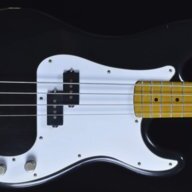
Squier PJ tone control replacement

  • Blend

    Votes: 12 25.5%
  • Varitone

    Votes: 8 17.0%
  • Switch

    Votes: 10 21.3%
  • Replace it all with EMGs

    Votes: 8 17.0%
  • Bypass the tone control

    Votes: 2 4.3%
  • Just Volumes

    Votes: 3 6.4%
  • No pots at all

    Votes: 2 4.3%
  • Orange caps are made with carrots

    Votes: 11 23.4%

  • Total voters
    47
  • Poll closed .
I wired my PJ different than most for the purposes of how it interacts with distortion.

Three-way switch wired Neck/Series/Bridge.

I have a 500k Volume knob for increased treble output and to give better range to my Tonestyler.

The Volume push /pull I use to switch my Jazz pickup from series to parallel for its dual coil.

I have a Stellartone Tonestyler as my only "Tone" knob.

Generally I have an overdrive pedal set just on the edge of break up with my Jazz pickup solo in parallel. I can then switch just that pickup to series for a touch more output, which gives me more dirt.
I can then use my pickup selector to select my neck pick up for me dirt.
Finally I still have the Series option on my pickup selector for even more dirt.

Then if I'm really being anal I can use my Tonestyler for a number of different resonant humps in the midrange to give me a wide variety of flavors in my distortion.

Been very happy with this setup and my Dimarzio Model PJ pickups. Kinda want to have this available on all my instruments.
Stellartone.
Great addition to any passive bass.
 
Small caps affect higher frequencys, on a bass you need a larger cap. but putting a valve cap (essentially a resistor in parallel to the cap) on the vol won't prevent the volumes from affecting one another, The signal from the bridge output is connected to the neck output, so you get the signal from each pickup split. Part of the signal goes to the jack and part goes to the other volume (so you have current flowing in both directions on the same wire.) So now either volume affects the output of each pickup. To stop that and have independent control you can place a diode after each volume and before the common feed to the jack. That stops the signal being split and sends all the signal from each pickup to the output. A diode allows current flow in only one direction, away from the volume and to the output. It will also gives you independent tone control for each pickup.

rereading, I see what you are getting at. I thought at first you were not agreeing with the les paul wiring suggestion.

I still say BVT or VVT and do however many switches for tone, series/parallel, etc you want or can fit in the control cavity.
 
I’ve got two P/Js. One is wired VVT and the other is VBT. Both work great. If you tend to turn your volume all the way down on stage a lot, the blend is the way to go, since it only has one volume knob. If you’re used to dealing with two-pickup basses, with two volume controls, then VVT is fine.
 
Hey all,

Tone pot on my PJ Squier goes in an out when I tap it, and, increasingly, does so on its own. I am taking this repair opportunity to completely rethink the wiring setup. I have read the threads, so I am making this a simple vote so you do not have to type if you do not want.

What do you recommend? Varitone? No ground blend? Switch? VV no T? No V or T whatsoever? Throw the whole thing out and start over with Geezers?

I am not going to active this bass up at the moment. So passive setups only. Otherwise, I do not care. I guarantee I will be happy just to have made a change and will probably throw it all out again in year.

BTW I am aware that the problem is probably fixable; I just don't like the tone control action with these pickups, it seems pointless, so I would like to try something differnt.

Vote early, vote often. Thanks!

I have a set of GZR's in one of my PJs and I absolutely love them. They are one of the best sets of pups I've ever played. I plan on getting a P set for my P. I can't say they blend the best but what PJ set does? They still arent bad though. And the tone sweep is great too. I really really like them for what that's worth.
 
  • Like
Reactions: Usidore T Blue
rereading, I see what you are getting at. I thought at first you were not agreeing with the les paul wiring suggestion.

I still say BVT or VVT and do however many switches for tone, series/parallel, etc you want or can fit in the control cavity.

You may well be endorsing a superior system to my suggestion. I have have NEVER heard, or seen, an instrument wired as I suggested (with the diodes,) so until someone wires one that way we'll never know. The OP asked for ideas, and that one has been floating around in my head for years; thought I'd give it some air.
 
Last edited:
  • Like
Reactions: Usidore T Blue
I guess diodes after the volume won't help? Is the current even high enough for that?
Hadn't thought of that, but a diode on each volume should stop the opposing volume from draining it's output.
I'd be interested in reading an AC networks [classroom] description of how the diodes would be connected and how the circuit would work. Diodes drop the applied voltage across the PN junction when forward biased and block current flow completely when reverse biased. I'm sure that isn't going to do what you want.
 
I'd be interested in reading an AC networks [classroom] description of how the diodes would be connected and how the circuit would work. Diodes drop the applied voltage across the PN junction when forward biased and block current flow completely when reverse biased. I'm sure that isn't going to do what you want.

See post #17 this thread.
 
To stop that and have independent control you can place a diode after each volume and before the common feed to the jack. That stops the signal being split and sends all the signal from each pickup to the output. A diode allows current flow in only one direction, away from the volume and to the output. It will also gives you independent tone control for each pickup.
Nope. While you are correct that diodes allow current flow in only one direction, the signals in our basses are AC. You would be implementing a half-wave rectifier. It will not work as you seem to think it would.

- John
 
Hadn't thought of that, but a diode on each volume should stop the opposing volume from draining it's output.

Don't you have to exceed the forward voltage drop of the diode before it conducts?
.7v for Silly-cones .3v for Deutscheiums?

And even if the signal from a pickup (probably needs to be an active?) gets that high, isn't it's still blocked in the reverse direction?

IDK for sure. I could be wrong about this. If someone thinks I am, give me the tech please.
 
Their ranges aren't high enough for the application.
I also think the higher the range, the larger they get. The last time I saw a variable capacitor it was huge:

cav-apl20-111_lg.jpg


This one only goes to 38 pF, that's 0.000038 uF
 
  • Like
Reactions: Usidore T Blue
Their ranges aren't high enough for the application.
I also think the higher the range, the larger they get. The last time I saw a variable capacitor it was huge:

View attachment 3009560

This one only goes to 38 pF, that's 0.000038 uF
Yup! These are made for radio applications. I got some big ones in a cool antenna tuner for my ham station.
Operation for that beastie is about 1 MHz to about 30 MHz.
When your grandpa, or GGPaw was tuning in a station on his big old radio, he was likely crankin on something like this.
 
testing the limits of the J control cavity
I started out with the same questions about using a varitone vs other options for tone values. Varitone I think is a poor choice for bass because many basses I play sound best to me at neither full on or off tone, nor at full vol, but somewhere in between. I do prefer tone fully rolled off for some cap values but not others. I personally like to pick cap values that complements the strings I am using (I like darker for flats brighter for rounds). I settled on two cap values, and the option to bypass the tone knob completely.

As a veteran of tens of component upgrades I can say with absolute 'internet expertise' VVT is the best kind of wiring for passive instruments. Strats should be VVVT, LP should be VVT, It's just the best. From there, add whatever switching you want, like a push/push on/off on each vol knob, series/parallel, tone bypass, basically you can do almost everything while adding minimal extra switches and knobs on most instruments. No need to overcome the limits of the selector switches on the strat (no neck/bridge) or LP (both vol knobs have to be on) it would simplify everything.

In all seriousness, VVT is the king of KISS. Start with that, or BVT if that's your liking, and then complicate it from there.
 
testing the limits of the J control cavity
I started out with the same questions about using a varitone vs other options for tone values. Varitone I think is a poor choice for bass because many basses I play sound best to me at neither full on or off tone, nor at full vol, but somewhere in between. I do prefer tone fully rolled off for some cap values but not others. I personally like to pick cap values that complements the strings I am using (I like darker for flats brighter for rounds). I settled on two cap values, and the option to bypass the tone knob completely.

As a veteran of tens of component upgrades I can say with absolute 'internet expertise' VVT is the best kind of wiring for passive instruments. Strats should be VVVT, LP should be VVT, It's just the best. From there, add whatever switching you want, like a push/push on/off on each vol knob, series/parallel, tone bypass, basically you can do almost everything while adding minimal extra switches and knobs on most instruments. No need to overcome the limits of the selector switches on the strat (no neck/bridge) or LP (both vol knobs have to be on) it would simplify everything.

In all seriousness, VVT is the king of KISS. Start with that, or BVT if that's your liking, and then complicate it from there.
I too have found it easy to go overboard with bass mods. Just about every time I bow to the creeping featurism, I find myself eventually going back to less complicated arrangements.
 

Latest posts