

Enjoy the benefits of a premium membership!
Upgrade Account
-
TalkBass has been independent since 1998. Add your voice.
Create a free account to reply to discussions, view embedded media, and browse with fewer display ads.
Join free Log in
Want zero display ads or expanded classifieds tools? Compare plans.
You are using an out of date browser. It may not display this or other websites correctly.
You should upgrade or use an alternative browser.
You should upgrade or use an alternative browser.
What are you reading Chapter 4
- Thread starter slobake
- Start date
More options
Who Replied?

Will be listening to on Audible and possibly reading on the iPad The Black Elfstone by Terry Brooks next week. Book 1 of the Fall of Shannara series. The Shannara story has been going on since 1977 and he wants to write the ending on his own terms.


Best Supplements for Men: For More Muscle, Higher Testosterone, Longer Life, and Better Looks: P. D. Mangan: 9781546307211: Amazon.com: Books
Good reference material at 61 years old(don't feel like it most of the time) although disagree on a few points(i.e. L-glutamine).
Example: started a post-gig drink experiment a few months ago using L-glutamine powder mixed in1/3 bottle of water.
Felt much less tired and less aches after the 1-1/2 hour drive home compared to normal "worn out" feeling.
Current post-gig drink is the following.
1/3 bottle of water+ 2/3 spoons each of powdered: L-glutamine, BCAA(branched chain amino acids), magnesium citrate. Can add more water when you get done the 1/3 bottle to get ALL of the powder down.
By the time I get home, body feels like it was a no gig day!
The magnesium citrate alone can provide a LOT of benefits(read the reviews of users).
Sources:
Amazon.com: BulkSupplements Pure L-Glutamine Powder (500 grams): Health & Personal Care
Amazon.com: BCAA Branched Chain Essential Amino Acids Powder by BulkSupplements (250 grams) | 100% Pure 2:1:1 Instantized Formula | Pre/Post Workout Bodybuilding Supplement | Boost Muscle Growth: Health & Personal Care
Amazon.com: BulkSupplements Pure Magnesium Citrate Powder (1 Kilogram): Health & Personal Care
PS: If you have a really LONG day(two gigs in one day or similar), add some citrulline and arginine to the mix about every 4 hours.
These work for JC:
Amazon.com: NOW Foods L-Citrulline 750 mg, 180 Capsules (2 Pack): Health & Personal Care
Amazon.com: NOW Sports Arginine & Citrulline, 120 Veg Capsules: Health & Personal Care
After 50+ years of tinkering with supplements and "non-standard" eating habits, my brother and I both are thankful to our Grandmother for her direction in nutrition and taking care of ourselves even if it meant ignoring "experts". Quote from the internets:
"If you like to trust experts and figures of authority instead of thinking for yourself, the future is not going to be fun for you."
Good reference material at 61 years old(don't feel like it most of the time) although disagree on a few points(i.e. L-glutamine).
Example: started a post-gig drink experiment a few months ago using L-glutamine powder mixed in1/3 bottle of water.
Felt much less tired and less aches after the 1-1/2 hour drive home compared to normal "worn out" feeling.
Current post-gig drink is the following.
1/3 bottle of water+ 2/3 spoons each of powdered: L-glutamine, BCAA(branched chain amino acids), magnesium citrate. Can add more water when you get done the 1/3 bottle to get ALL of the powder down.
By the time I get home, body feels like it was a no gig day!
The magnesium citrate alone can provide a LOT of benefits(read the reviews of users).
Sources:
Amazon.com: BulkSupplements Pure L-Glutamine Powder (500 grams): Health & Personal Care
Amazon.com: BCAA Branched Chain Essential Amino Acids Powder by BulkSupplements (250 grams) | 100% Pure 2:1:1 Instantized Formula | Pre/Post Workout Bodybuilding Supplement | Boost Muscle Growth: Health & Personal Care
Amazon.com: BulkSupplements Pure Magnesium Citrate Powder (1 Kilogram): Health & Personal Care
PS: If you have a really LONG day(two gigs in one day or similar), add some citrulline and arginine to the mix about every 4 hours.
These work for JC:
Amazon.com: NOW Foods L-Citrulline 750 mg, 180 Capsules (2 Pack): Health & Personal Care
Amazon.com: NOW Sports Arginine & Citrulline, 120 Veg Capsules: Health & Personal Care
After 50+ years of tinkering with supplements and "non-standard" eating habits, my brother and I both are thankful to our Grandmother for her direction in nutrition and taking care of ourselves even if it meant ignoring "experts". Quote from the internets:
"If you like to trust experts and figures of authority instead of thinking for yourself, the future is not going to be fun for you."
Last edited:
As an Amazon Associate, TalkBass may receive commissions from qualifying purchases made via links on this site.



If you're after a surefire remedy to the we_sell_words.confabulation commonly getting the post truth lyin's share of our attention, there's this.

I'm just getting 'round to reading it (properly) but it's already had a big impact, and not just upon my awareness. The ripples from this one have, it seems, been gently and steadily lapping at the murkier shores of many of the world's more vociferous realms, helping to reclaim some of our more precious real estate, and mapping many an uncharted coast, rendered swampy by so much wanton weaseling.
Here's a little grab from the introduction, published on Don's site, in a [Invalid or Expired Link Removed],
I'm just getting 'round to reading it (properly) but it's already had a big impact, and not just upon my awareness. The ripples from this one have, it seems, been gently and steadily lapping at the murkier shores of many of the world's more vociferous realms, helping to reclaim some of our more precious real estate, and mapping many an uncharted coast, rendered swampy by so much wanton weaseling.
Here's a little grab from the introduction, published on Don's site, in a [Invalid or Expired Link Removed],
Weasel words are the words of the powerful, the treacherous and the unfaithful, spies, assassins and thieves. Bureaucrats and ideologues love them. Tyrants cannot do without them. The Newspeak of Orwell’s 1984 is an invention, but also a satire on real states such as the Soviet Union where death from starvation and abuse in slave camps was recorded by officials as ‘failure of the heart muscle’. Were any five words ever more melancholy than this?
Totalitarian states use weasel words to hide truth and slew or complicate meaning. They use them, as they use clichés and other dead forms, to exercise and maintain power. Language, as Stalin knew, is an essential instrument of terror. For all the people who were killed or imprisoned as ‘enemies of the revolution’ in the empire he ruled, or as ‘enemies of the Reich’ in Hitler’s Germany, a great many more were cowed, gulled or anaesthetised into dull-witted obedience by the bastardised and depleted language of those regimes. To speak the words the powerful speak is to obey them, or at least to give up all outward signs of freedom. Stalin was not the first tyrant to be so feared that those around him preferred to imitate even his malapropisms than give him any reason to think they were not in awe of his authority.
The same mimicry can be expected wherever the official language is a kind of code that we must at least appear to understand, or be excluded. It happens in democracies, and in businesses and government departments. Today it is found everywhere the language of the information age is (compulsorily) spoken; everywhere the management revolution has been; everywhere marketing goes. This is language without possibility. It cannot convey humour, fancy, feelings, nuance or the varieties of experience. It is cut off and cuts us off from provenance – it has no past. This dead, depleted, verbless jargon is becoming the language of daily life. The death of language is not being brought about by absent commas and misplaced apostrophes, or even by neglected grammar. Foolish as that neglect is, the real disease is in the system: in the new models of business organisation, in the triumph of economics. It is there in the cant of competitive advantage and human resources management, transparency, accountability: in the clichés, consumer, client, key, core, going forwards, at the end of the day, outcomes-based. It is there in the pompous lunacy of management jargon which reaches from the world’s biggest corporations and government agencies, including military and intelligence agencies, to primary schools where children now use PowerPoint in English presentations and are taught to call the conclusions of their History essays product. Language has been made the machine of business and politics in the information age. But it cannot survive the experience and maintain its power to amuse, enchant, invent, comfort. It can’t carry ideas and sentiments, bear the culture and be the culture’s chief glory. It can’t be machinery first and language second. It can’t live with the new tyranny.
It is in a democracy that the term ‘weasel word’ first appears: in the United States, around the end of the nineteenth century. In 1916 Theodore Roosevelt declared that the ‘tendency to use what have been called weasel words was “one of the defects of our nation”.’ You can have universal training or you can have voluntary training, but when you use the word “voluntary” to qualify the word “universal”, you are using a weasel word,’ he said: ‘it has sucked all the meaning out of “universal”.’ Teddy’s Presidential cousin, Franklin, later complained about the same tendency in speeches sent him from the State Department, a place where one should expect to find it. The affairs of states make for weasely professions, and none more so than diplomacy. But diplomacy, along with fullblown espionage, may be the only ones where weasel words have a claim to being justified. […]
People may use the Dictionary for the practical purposes of discovering what these new-fangled words and phrases mean, but they should be warned that it does not provide this enlightenment in every case. Without wishing to escape my obligations, I would say that most often it fails because the words in fact have no meaning, or at least not one that can be described. Moreover, it is possible that no meaning has ever been intended for them. Readers are more likely to see this if they read the entries aloud, either to themselves or to a group. This is also the most amusing – if not the only bearable – way to read this Dictionary. It is, as well, the best way to appreciate what life is like for people who must speak, read and hear this language every day of their working lives.
By this I mean, people in private and government employment, people who teach and nurse and provide other forms of care, unemployed people, schoolchildren. Increasing numbers of people. Most people. People who work in organisations that have taken on this language as earlier organisations took on assembly lines and Taylorism. Death Sentence can be called successful insofar as it sold well; but also because hundreds of people wrote thankful, angry and amusing letters. Of these, a large proportion contained examples they had encountered at work; or in their children’s school reports; in correspondence with their bank, insurance company, their parents’ nursing home, a government department or some recently privatised public utility. These people confirmed for me that Death Sentence was a small assault on a large but not impregnable enemy. This Dictionary may be seen as another charge against the walls – or, rather, into the swamp. Many of the seven hundred or so entries are drawn from the letters I received after the publication of Death Sentence. Others I have picked up at seminars and talks for companies, government agencies and departments. The frustration of the people who work in them, the sense they have that this language is stupid and oppressive and that it denies them a fundamental right, was one inspiration for this second book. The other was the way our leaders imitate the emptiness of management jargon to weasel their way past our better instincts.
I hope this Dictionary proves useful in an ever-widening campaign of mockery and other forms of resistance. Translate it into a tool of derision. Migrate it to a satirical skill set. The Dictionary nurtures the subversive hope that the next edition will be smaller, and the one following smaller still, until this original edition becomes a relic of a brief age when the language slipped from our grasp. But we took it back. We made de-weaseling a key competency and began to see that not only had our leaders and our institutions mugged us, we had mugged ourselves. We decided to fight back. So we could move on.
Totalitarian states use weasel words to hide truth and slew or complicate meaning. They use them, as they use clichés and other dead forms, to exercise and maintain power. Language, as Stalin knew, is an essential instrument of terror. For all the people who were killed or imprisoned as ‘enemies of the revolution’ in the empire he ruled, or as ‘enemies of the Reich’ in Hitler’s Germany, a great many more were cowed, gulled or anaesthetised into dull-witted obedience by the bastardised and depleted language of those regimes. To speak the words the powerful speak is to obey them, or at least to give up all outward signs of freedom. Stalin was not the first tyrant to be so feared that those around him preferred to imitate even his malapropisms than give him any reason to think they were not in awe of his authority.
The same mimicry can be expected wherever the official language is a kind of code that we must at least appear to understand, or be excluded. It happens in democracies, and in businesses and government departments. Today it is found everywhere the language of the information age is (compulsorily) spoken; everywhere the management revolution has been; everywhere marketing goes. This is language without possibility. It cannot convey humour, fancy, feelings, nuance or the varieties of experience. It is cut off and cuts us off from provenance – it has no past. This dead, depleted, verbless jargon is becoming the language of daily life. The death of language is not being brought about by absent commas and misplaced apostrophes, or even by neglected grammar. Foolish as that neglect is, the real disease is in the system: in the new models of business organisation, in the triumph of economics. It is there in the cant of competitive advantage and human resources management, transparency, accountability: in the clichés, consumer, client, key, core, going forwards, at the end of the day, outcomes-based. It is there in the pompous lunacy of management jargon which reaches from the world’s biggest corporations and government agencies, including military and intelligence agencies, to primary schools where children now use PowerPoint in English presentations and are taught to call the conclusions of their History essays product. Language has been made the machine of business and politics in the information age. But it cannot survive the experience and maintain its power to amuse, enchant, invent, comfort. It can’t carry ideas and sentiments, bear the culture and be the culture’s chief glory. It can’t be machinery first and language second. It can’t live with the new tyranny.
It is in a democracy that the term ‘weasel word’ first appears: in the United States, around the end of the nineteenth century. In 1916 Theodore Roosevelt declared that the ‘tendency to use what have been called weasel words was “one of the defects of our nation”.’ You can have universal training or you can have voluntary training, but when you use the word “voluntary” to qualify the word “universal”, you are using a weasel word,’ he said: ‘it has sucked all the meaning out of “universal”.’ Teddy’s Presidential cousin, Franklin, later complained about the same tendency in speeches sent him from the State Department, a place where one should expect to find it. The affairs of states make for weasely professions, and none more so than diplomacy. But diplomacy, along with fullblown espionage, may be the only ones where weasel words have a claim to being justified. […]
People may use the Dictionary for the practical purposes of discovering what these new-fangled words and phrases mean, but they should be warned that it does not provide this enlightenment in every case. Without wishing to escape my obligations, I would say that most often it fails because the words in fact have no meaning, or at least not one that can be described. Moreover, it is possible that no meaning has ever been intended for them. Readers are more likely to see this if they read the entries aloud, either to themselves or to a group. This is also the most amusing – if not the only bearable – way to read this Dictionary. It is, as well, the best way to appreciate what life is like for people who must speak, read and hear this language every day of their working lives.
By this I mean, people in private and government employment, people who teach and nurse and provide other forms of care, unemployed people, schoolchildren. Increasing numbers of people. Most people. People who work in organisations that have taken on this language as earlier organisations took on assembly lines and Taylorism. Death Sentence can be called successful insofar as it sold well; but also because hundreds of people wrote thankful, angry and amusing letters. Of these, a large proportion contained examples they had encountered at work; or in their children’s school reports; in correspondence with their bank, insurance company, their parents’ nursing home, a government department or some recently privatised public utility. These people confirmed for me that Death Sentence was a small assault on a large but not impregnable enemy. This Dictionary may be seen as another charge against the walls – or, rather, into the swamp. Many of the seven hundred or so entries are drawn from the letters I received after the publication of Death Sentence. Others I have picked up at seminars and talks for companies, government agencies and departments. The frustration of the people who work in them, the sense they have that this language is stupid and oppressive and that it denies them a fundamental right, was one inspiration for this second book. The other was the way our leaders imitate the emptiness of management jargon to weasel their way past our better instincts.
I hope this Dictionary proves useful in an ever-widening campaign of mockery and other forms of resistance. Translate it into a tool of derision. Migrate it to a satirical skill set. The Dictionary nurtures the subversive hope that the next edition will be smaller, and the one following smaller still, until this original edition becomes a relic of a brief age when the language slipped from our grasp. But we took it back. We made de-weaseling a key competency and began to see that not only had our leaders and our institutions mugged us, we had mugged ourselves. We decided to fight back. So we could move on.

If you're after a surefire remedy to the we_sell_words.confabulation commonly getting the post truth lyin's share of our attention, there's this.

I'm just getting 'round to reading it (properly) but it's already had a big impact, and not just upon my awareness. The ripples from this one have, it seems, been gently and steadily lapping at the murkier shores of many of the world's more vociferous realms, helping to reclaim some of our more precious real estate, and mapping many an uncharted coast, rendered swampy by so much wanton weaseling.
Here's a little grab from the introduction, published on Don's site, in a [Invalid or Expired Link Removed],
Weasel words are the words of the powerful, the treacherous and the unfaithful, spies, assassins and thieves. Bureaucrats and ideologues love them. Tyrants cannot do without them. The Newspeak of Orwell’s 1984 is an invention, but also a satire on real states such as the Soviet Union where death from starvation and abuse in slave camps was recorded by officials as ‘failure of the heart muscle’. Were any five words ever more melancholy than this?
Totalitarian states use weasel words to hide truth and slew or complicate meaning. They use them, as they use clichés and other dead forms, to exercise and maintain power. Language, as Stalin knew, is an essential instrument of terror. For all the people who were killed or imprisoned as ‘enemies of the revolution’ in the empire he ruled, or as ‘enemies of the Reich’ in Hitler’s Germany, a great many more were cowed, gulled or anaesthetised into dull-witted obedience by the bastardised and depleted language of those regimes. To speak the words the powerful speak is to obey them, or at least to give up all outward signs of freedom. Stalin was not the first tyrant to be so feared that those around him preferred to imitate even his malapropisms than give him any reason to think they were not in awe of his authority.
The same mimicry can be expected wherever the official language is a kind of code that we must at least appear to understand, or be excluded. It happens in democracies, and in businesses and government departments. Today it is found everywhere the language of the information age is (compulsorily) spoken; everywhere the management revolution has been; everywhere marketing goes. This is language without possibility. It cannot convey humour, fancy, feelings, nuance or the varieties of experience. It is cut off and cuts us off from provenance – it has no past. This dead, depleted, verbless jargon is becoming the language of daily life. The death of language is not being brought about by absent commas and misplaced apostrophes, or even by neglected grammar. Foolish as that neglect is, the real disease is in the system: in the new models of business organisation, in the triumph of economics. It is there in the cant of competitive advantage and human resources management, transparency, accountability: in the clichés, consumer, client, key, core, going forwards, at the end of the day, outcomes-based. It is there in the pompous lunacy of management jargon which reaches from the world’s biggest corporations and government agencies, including military and intelligence agencies, to primary schools where children now use PowerPoint in English presentations and are taught to call the conclusions of their History essays product. Language has been made the machine of business and politics in the information age. But it cannot survive the experience and maintain its power to amuse, enchant, invent, comfort. It can’t carry ideas and sentiments, bear the culture and be the culture’s chief glory. It can’t be machinery first and language second. It can’t live with the new tyranny.
It is in a democracy that the term ‘weasel word’ first appears: in the United States, around the end of the nineteenth century. In 1916 Theodore Roosevelt declared that the ‘tendency to use what have been called weasel words was “one of the defects of our nation”.’ You can have universal training or you can have voluntary training, but when you use the word “voluntary” to qualify the word “universal”, you are using a weasel word,’ he said: ‘it has sucked all the meaning out of “universal”.’ Teddy’s Presidential cousin, Franklin, later complained about the same tendency in speeches sent him from the State Department, a place where one should expect to find it. The affairs of states make for weasely professions, and none more so than diplomacy. But diplomacy, along with fullblown espionage, may be the only ones where weasel words have a claim to being justified. […]
People may use the Dictionary for the practical purposes of discovering what these new-fangled words and phrases mean, but they should be warned that it does not provide this enlightenment in every case. Without wishing to escape my obligations, I would say that most often it fails because the words in fact have no meaning, or at least not one that can be described. Moreover, it is possible that no meaning has ever been intended for them. Readers are more likely to see this if they read the entries aloud, either to themselves or to a group. This is also the most amusing – if not the only bearable – way to read this Dictionary. It is, as well, the best way to appreciate what life is like for people who must speak, read and hear this language every day of their working lives.
By this I mean, people in private and government employment, people who teach and nurse and provide other forms of care, unemployed people, schoolchildren. Increasing numbers of people. Most people. People who work in organisations that have taken on this language as earlier organisations took on assembly lines and Taylorism. Death Sentence can be called successful insofar as it sold well; but also because hundreds of people wrote thankful, angry and amusing letters. Of these, a large proportion contained examples they had encountered at work; or in their children’s school reports; in correspondence with their bank, insurance company, their parents’ nursing home, a government department or some recently privatised public utility. These people confirmed for me that Death Sentence was a small assault on a large but not impregnable enemy. This Dictionary may be seen as another charge against the walls – or, rather, into the swamp. Many of the seven hundred or so entries are drawn from the letters I received after the publication of Death Sentence. Others I have picked up at seminars and talks for companies, government agencies and departments. The frustration of the people who work in them, the sense they have that this language is stupid and oppressive and that it denies them a fundamental right, was one inspiration for this second book. The other was the way our leaders imitate the emptiness of management jargon to weasel their way past our better instincts.
I hope this Dictionary proves useful in an ever-widening campaign of mockery and other forms of resistance. Translate it into a tool of derision. Migrate it to a satirical skill set. The Dictionary nurtures the subversive hope that the next edition will be smaller, and the one following smaller still, until this original edition becomes a relic of a brief age when the language slipped from our grasp. But we took it back. We made de-weaseling a key competency and began to see that not only had our leaders and our institutions mugged us, we had mugged ourselves. We decided to fight back. So we could move on.
WOW! (Is that a weasel word?
 ) Thanks Tom, I will be reading this one soon.

I just finished reading Philip K. Dick's Do Androids Dream Of Electric Sheep? (amazingly, for the first time). Three things struck me:
1) It's not really that good of a story. I suspect the reason it commands any respect amongst sci-fi aficianados is because it conveys what a denizen of this particular dystopian future would think and feel...but the actual plot and dramatic arc is weak and directionless.
2) The movie Bladerunner really has almost nothing to do with this book.
3) I was most struck by the anachronisms that peppered Dick's vision of what 2017 would be like from his 1968 perspective. Yes, as Bill Maher pointed out, we have "flying cars and robots who f**k us." But we also have payphones that require coins, to start the (flying) car still requires an ignition key, and type-written documents are duplicated via carbon-copy. Makes me think the hardest part of being a sci-fi writer is being able to completely free your imagination for which paradigms change.
1) It's not really that good of a story. I suspect the reason it commands any respect amongst sci-fi aficianados is because it conveys what a denizen of this particular dystopian future would think and feel...but the actual plot and dramatic arc is weak and directionless.
2) The movie Bladerunner really has almost nothing to do with this book.
3) I was most struck by the anachronisms that peppered Dick's vision of what 2017 would be like from his 1968 perspective. Yes, as Bill Maher pointed out, we have "flying cars and robots who f**k us." But we also have payphones that require coins, to start the (flying) car still requires an ignition key, and type-written documents are duplicated via carbon-copy. Makes me think the hardest part of being a sci-fi writer is being able to completely free your imagination for which paradigms change.


I am FINALLY getting around to finishing the book by our very own @Joe Nerve ....took another chunk out of it last night. It's a GREAT read. (I'll do a full review later.) It is NOT a finger wagging book. It's more a list of 50 things you can TRY on your own journey to simply "feel better" (my term, not his). It covers emotions, physical health, diet, etc. No, he doesn't imply that you should wake up tomorrow morning and do pretty much EVERYTHING in your life differently. He doesn't even suggest that everything in the book will work for everyone. It's written from Joe's own perspective of battling depression. But the vast majority of it (so far) could apply to literally anyone. Each section is very concise, but leaves you with more resources you can use to do your own research if a particular topic grabs you. I'm less than halfway through. I am already making plans to try several things in the book myself. I understand that Joe was trying to reach a target audience near and dear to his own heart. But much of this book could easily fit into the life of the "Average Joe".  It covers very serious topics in a casual way. It's pretty much "What the heck? Whataya got to lose? Give this one a shot and see if it works. And if it doesn't, there's 49 other things in here you can try until you find something that does."
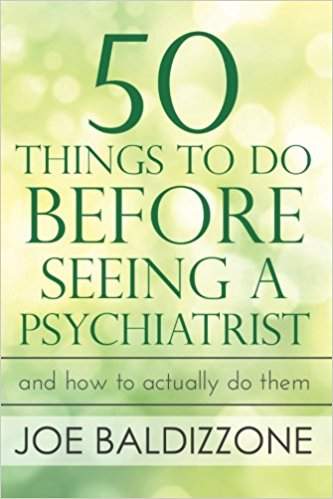
It covers very serious topics in a casual way. It's pretty much "What the heck? Whataya got to lose? Give this one a shot and see if it works. And if it doesn't, there's 49 other things in here you can try until you find something that does."
Last edited:
My copy is still sitting on my side table.....I am FINALLY getting around to finishing the book by our very own @Joe Nerve ....took another chuck out of it last night. It's a GREAT read. (I'll do a full review later.) It is NOT a finger wagging book. It's more a list of 50 things you can TRY on your own journey to simply "feel better" (my term, not his). It covers emotions, physical health, diet, etc. No, he doesn't imply that you should wake up tomorrow morning and do pretty much EVERYTHING in your life differently. He doesn't even suggest that everything in the book will work for everyone. It's written from Joe's own perspective of battling depression. But the vast majority of it (so far) could apply to literally anyone. Each section is very concise, but leaves you with more resources you can use to do your own research if a particular topic grabs you. I'm less than halfway through. I am already making plans to try several things in the book myself. I understand that Joe was trying to reach a target audience near and dear to his own heart. But much of this book could easily fit into the life of the "Average Joe".
View attachment 1176820
Staring at me......

My copy is still sitting on my side table.....
Staring at me......
Yeah I have had mine for months. I started reading it before my vacation weeks ago. We're just too busy, Fred!
Crack it open. Joe really can write. Even if the subject matter doesn't apply directly to you it's a good read anyway.

I just finished Star Trek Memories by Shatner & it was good, but eye-opening 
now I'm onto the final book of the Dune prequels:

next I'll probably read Children of Dune
now I'm onto the final book of the Dune prequels:
next I'll probably read Children of Dune

I am FINALLY getting around to finishing the book by our very own @Joe Nerve ....took another chunk out of it last night. It's a GREAT read. (I'll do a full review later.) It is NOT a finger wagging book. It's more a list of 50 things you can TRY on your own journey to simply "feel better" (my term, not his). It covers emotions, physical health, diet, etc. No, he doesn't imply that you should wake up tomorrow morning and do pretty much EVERYTHING in your life differently. He doesn't even suggest that everything in the book will work for everyone. It's written from Joe's own perspective of battling depression. But the vast majority of it (so far) could apply to literally anyone. Each section is very concise, but leaves you with more resources you can use to do your own research if a particular topic grabs you. I'm less than halfway through. I am already making plans to try several things in the book myself. I understand that Joe was trying to reach a target audience near and dear to his own heart. But much of this book could easily fit into the life of the "Average Joe".
View attachment 1176820
Another recommendation for this...
Happily I've no depression issues, but I do have some stuff in my life I'd like to manage better...my weight, and a nagging almost-dependency on painkillers for back pain.
@Joe Nerve doesn't preach, but gives some very fine advice and suggestions about life and how to get through it.
To be honest, there was very little in it I didn't already know...but hey, lets face it, we all know what's good/bad for us, it just sometimes needs someone laying it out in front of us to actually do something about it, right?
This book does that.
I got it on Kindle, and have read it through quickly once, and plan on coming back to the bits I need to focus on, just as he suggests.
I'm not giving up pizza, though, sorry Joe!

- Oct 7, 2000
- 18,619
- 38,939
- Disclosures
- Endorsing artist: Musicman basses
I'm not giving up pizza, though, sorry Joe!
Neither am I
.Nor Taco Bell.
Thanks to you and @two fingers for the kind reviews. I'm flattered, and happy you're both enjoying the book.
Neither am I
Nor Taco Bell.
Thanks to you and @two fingers for the kind reviews. I'm flattered, and happy you're both enjoying the book.
I will finish it this week! Family drama (grandmother broke her hip and bumped her head) got in the way this week. By the time I hit the sack I was out all week. I did get a little further and maintain what I said before.
You know how some people give a speech to thousands of people and it's like they are talking to their wife or buddy in a coffee shop? That's this book. It was written for the masses but it's "just Joe trying to help a pal". And I mean that in a good way.
(The grandmother who fell is the one quoted in my sig. And she's doing much better.)


