• TalkBass has been independent since 1998. Add your voice.
    Create a free account to reply to discussions, view embedded media, and browse with fewer display ads.
    Join freeLog in
    Want zero display ads or expanded classifieds tools? Compare plans.

Double Bass What is it with Bluegrass players?

To chime in on this tread; isn't it also about presentation/expectation (of the audience)?
As a band you like to present yourself in a certain way, and the audience expects a certain type of performance.. that they associate with this style of music (blue grass).

For example, we once did the support act for Herman Brock Jr. He had this one condenser look and feel stage look. But if you looked closely, you’d see that every instrument is in fact hooked up. Behind their band logo (mike stand is dressed up old school) are 2 extra mic’s on hip height to catch the instruments as well. They have a whole geography/dance thing going on, it looks the part. But in fact they’re plugged in, having their sound under control. No amps on stage though, they properly use the monitors.

In my experience folk musicians surely expect ‘magic’ from a sound engineer, because they bring along an acoustic instrument and expect him to amplify it without a hitch. That’s just plain ignorant.. And they always end up blaming the sound tech.
Not sure if hard core blue grass musicians are alike? I know they can be puritans and shy away from technology.
 
  • Like
Reactions: Max George
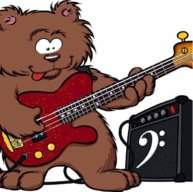
The inspiration behind my next bluegrass ensemble:

images?q=tbn:ANd9GcSkC8NcGu7eWw1b6l5khGnNtYEWH4okgNgtHJ7Xq_kTn9oC0amL.jpg
c2274435d3514e2c6d0dbb51980a2d1e--vintage-cartoons-classic-comics.jpg
deathtongue4.jpg


You should see how the chamber quartet is to be attired...
 
Old thread, but timeless foible. A group that wants to replicate something, is trying to replicate something. The group decides - not the individual. And despite all efforts and expense, there are no bass guitars that sound like an upright, including an EUS. What confuses me, are folks that can't accept a group decision, and huff away because their one vote doesn't override a majority.
 
In my experience folk musicians surely expect ‘magic’ from a sound engineer, because they bring along an acoustic instrument and expect him to amplify it without a hitch. That’s just plain ignorant.. And they always end up blaming the sound tech.

Then your experience must be limited. I've played a million gigs with acoustic musicians, and that attitude is rarely present because the musicians are well aware of the challenges that exist in amplifying acoustic instruments (seeing as how they deal with every night).
 
Then your experience must be limited. I've played a million gigs with acoustic musicians, and that attitude is rarely present because the musicians are well aware of the challenges that exist in amplifying acoustic instruments (seeing as how they deal with every night).

agreed.....maybe in rookie musicians that is true....they have no idea about amplification. anyone who has played more than about 10 gigs realizes that the onus is on the musician more than the sound guy.

luckily, that's why these forums exist! a great group of knowledge working together to help solve the "acoustic amplification" problem.
 
There's very much a similar 'Trad Police' deal in Ireland with our celtic music.
At least with bluegrass there's the option of Double Bass...

That said, bands like Moving Hearts and TV series like The Transatlantic Sessions have gone a huge way towards bringing a decent low-end to the genre...:)


Hey @Oddly - what was the bloke in the first video playing? It looked like a kinda sorta bagpipes without the mouth pipe... ????
 
They are Uileann Pipes. Uilleann pipes - Wikipedia
In my admittedly biased opinion, a much cooler sound than bagpipes.
Yeah, and much louder as well ;)


Then your experience must be limited. I've played a million gigs with acoustic musicians, and that attitude is rarely present because the musicians are well aware of the challenges that exist in amplifying acoustic instruments (seeing as how they deal with every night).
That's great :-)
Musicians i've encountered shy away from amplification.. which doesn't make it easier if they're on a stage instead of a session. They have the opinion that the sound tech is resonsible for all the amplification. I think that each musician should be responsible to deliver a usable signal to the sound tech. What happens with the signal.. is all in their hands ;)
 
  • Like
Reactions: Oddly
I think that each musician should be responsible to deliver a usable signal to the sound tech. What happens with the signal.. is all in their hands ;)

My trio usually does their own sound but awhile back we were at a venue that had a house system and sound guy. We were setting up and he was amazed and super happy that everything plugged in!! Guitars, banjo, fiddle, bass, everything had a pickup, di, etc. He said it made everything 100% easier and the sound was great. So much better than trying to run all these mics, especially since the guitar and banjo players switch off and play both. Hats off to those who can do it with one condenser mic but IMHO technology in sound reinforcement is a good thing and should be embraced and used. If you were a real traditionalist you would run your one condenser into a 1930's era PA and speakers, not a digital ipad controlled board and powered QSC's. Maybe not.
 
I'm sure there are groups that gather around one condenser mic. I believe a lot of upper level BG groups use pickups to make life a little easier at festivals. A lot of mid level groups do real good with 58's for the vocals, 57's for the instruments, and a decent mic for the bass, like an ATM350. I have a pickup on my bass that I use sometimes for convenience through a Rumble 40. I only know a few super traditionalist. Most of us are not against modern sound reinforcement. However we are acoustic musicians, and like the way our instruments sound acoustically. And it's not difficult for us to step up to the mic and pick. So, I don't think we're against technology. And we are one of the worlds largest users of clip on tuners.
 
I guess that could be it.
But why can't we all just be players of varing skill and learn from each other instead of wanting to show your better by knocking someone else?
We went to a festival last Saturday that had 8 different acts from all over the state and while most of the music was not my style the groups were very tight and polished and I picked up a few things.
Sorry if this is a little off topic it just hit a note with me.
I think snobs are insecure. They're afraid something's gonna make them look bad..
 
In my experience folk musicians surely expect ‘magic’ from a sound engineer, because they bring along an acoustic instrument and expect him to amplify it without a hitch. That’s just plain ignorant.. And they always end up blaming the sound tech.
Not sure if hard core blue grass musicians are alike? I know they can be puritans and shy away from technology.
. It goes both ways
In my experience I’ve seen a lot of sound people totally screw up an acoustic concert because they were ignorant.
 
I've been playing in pop, rock, & blues bands for about 37 years. For the last 15 or so, I've also been playing in a bluegrass band & have also been regularly attending a couple very traditional festivals a year

If anyone thinks BG bands or players have an aversion to technology, you've been in a different circle than I have. I see use of all kinds of new technology in mics, in ear monitors, EQ / feedback control gear, etc. Digital recorders of all varieties are as also common as cell phones at BG festivals.

7 years down nailed some great points in post 207 & 224; BG players often don't use any monitors, or just put vocals only in the monitors.

As for BG players or acoustic instrument players expecting some kind of magic from a sound man; that's nothing I've seen before. What is expected is acoustic sound knowledge and experience. I've seen a sound man do a festival with 10 bands a day for 3 and 1/2 days with nobody plugging in except the bassist, and even some of the bassists don't plug in. The sound will be from good to excellent and the bands that want a monitor mix are pleased with what they get. It's not magic, its knowledge, experience, and the proper gear for the job. If you want to see a sound production train wreck, hire a sound company that only has experience with miking amplifiers or using DI's, and miking drums, to do an all acoustic show. Messy, with a double order of feedback.

As for single, large-diaphragm condenser mic performances; there are a few bands that still do that for the show, but not for the sound. Some of the bigger names in BG will use large diaphragm condensers, but will use a half dozen or so. One of the more common setups is one or two large diaphragm condenser mics at center stage, with smaller unidirectional condensers or dynamic mics on other instruments across the stage, and wireless in-ear monitors for all.

There is the occasional guitarist that will use a pickup, but those usually sound very different than a mic'd guitar. I'm seeing more resonator guitars (aka Dobros) with pickups in the past few years. A good amplified acoustic sound is apparently easier to achieve with pickup in a resonator, because they seem to sound natural.

The best sound I hear watching bands or when my own band is performing is with NO condenser mics; all dynamic for every instrument (except bass) and a dynamics for all vocals. That is the cleanest sound and the most manageable monitor mix if using floor monitors. A sound man that did BG festivals once told me his single objective was to make every band sound like they were playing purely acoustic, but louder....
 
Last edited:
If you want to see a sound production train wreck, hire a sound company that only has experience with miking amplifiers or using DI's, and miking drums, to do an all acoustic show. Messy, with a double order of feedback.

I live a lot in this world, and you are 100% correct. Take your acoustic instruments into a rock club, with a rock sound guy, subs and the whole nine yards.......it's typically a nightmare. To the average sound guy, an upright bass gets the faders set the same as a fender bass, then madness ensues. The sad fact is that a lot of them don't actually understand anything about frequencies, gain, etc. They know how to stick a '57 in front of a Marshall cab though.
 
...
The best sound I hear watching bands or when my own band is performing is with NO condenser mics; all dynamic for every instrument (except bass) and a dynamics for all vocals. That is the cleanest sound and the most manageable monitor mix if using floor monitors. A sound man that did BG festivals once told me his single objective was to make every band sound like they were playing purely acoustic, but louder....

I'd agree 100% with this. Personally, I see LDCs as being much more useful in the studio where there is no background or backstage noise to contend with.

Our band typically goes without monitors on stage unless we know and trust the sound people -- if used, we want the balances that we hear in the monitors to exactly match the balance that is coming out the speakers, and if we cannot trust that to happen, we won't use monitors...

That is where bluegrass people are a little different; in a good bluegrass band, instrument players will practice how to dynamically moderate their acoustic instruments' volume so the singer(s) singing the lyrics and the instrument(s) taking the breaks can be heard over everything else without changing the sound settings. In theory that means the sound people should make their settings and not change them during the set, so the band always knows what balance of amplification they're working with.

Recently we did a set at a local TV studio where we had experienced a history of sub-optimal sound mixes. This time we took our own LDC and did the set only with it, allowing us to work out the balance ourselves. The sound came out right, although the sound guy wasn't pleased because he had lost control of individual instruments and voices.
 
Last edited:
I'd agree 100% with this. Personally, I see LDCs as being much more useful in the studio where there is no background or backstage noise to contend with.

Our band typically goes without monitors on stage unless we know and trust the sound people -- if used, we want the balances that we hear in the monitors to exactly match the balance that is coming out the speakers, and if we cannot trust that to happen, we won't use monitors...

That is where bluegrass people are a little different; in a good bluegrass band, instrument players will practice how to dynamically moderate their acoustic instruments' volume so the singer(s) singing the lyrics and the instrument(s) taking the breaks can be heard over everything else without changing the sound settings. In theory that means the sound people should make their settings and not change them during the set, so the band always knows what balance of amplification they're working with.

Recently we did a set at a local TV studio where we had experienced a history of sub-optimal sound mixes. This time we took our own LDC and did the set only with it, allowing us to work out the balance ourselves. The sound came out right, although the sound guy wasn't pleased because he had lost control of individual instruments and voices.
I'd agree 100% with this. Personally, I see LDCs as being much more useful in the studio where there is no background or backstage noise to contend with.

Our band typically goes without monitors on stage unless we know and trust the sound people -- if used, we want the balances that we hear in the monitors to exactly match the balance that is coming out the speakers, and if we cannot trust that to happen, we won't use monitors...

That is where bluegrass people are a little different; in a good bluegrass band, instrument players will practice how to dynamically moderate their acoustic instruments' volume so the singer(s) singing the lyrics and the instrument(s) taking the breaks can be heard over everything else without changing the sound settings. In theory that means the sound people should make their settings and not change them during the set, so the band always knows what balance of amplification they're working with.

Recently we did a set at a local TV studio where we had experienced a history of sub-optimal sound mixes. This time we took our own LDC and did the set only with it, allowing us to work out the balance ourselves. The sound came out right, although the sound guy wasn't pleased because he had lost control of individual instruments and voices.
I agree totally, being able to dynamically control our volume on our instruments is one of the things I enjoy most about Bluegrass, or other acoustic music.
 
I play primarily bluegrass on double bass and find this argument over played. Honestly, I would much rather listen to an electric bassist play at a pick using good tone and intonation than a DB who may be new and struggles with playing the instrument. A person should not be discouraged from getting together with others because they play electric bass. As long as the player is tasteful and lays down a solid groove for the pickers it shouldn't matter. Boone Creek is a cool band to check out for electric bass in bluegrass. Some of the tightest grooves. Virtually all the greats had an electric bassists at some point on their recordings. I can see if you're playing in a bluegrass band and you want to have the look and sound of an upright then that makes sense. A pick should be fun though and open to all levels and electric bass should be accepted.