

Enjoy the benefits of a premium membership!
Upgrade Account
-
TalkBass has been independent since 1998. Add your voice.
Create a free account to reply to discussions, view embedded media, and browse with fewer display ads.
Join free Log in
Want zero display ads or expanded classifieds tools? Compare plans.
You are using an out of date browser. It may not display this or other websites correctly.
You should upgrade or use an alternative browser.
You should upgrade or use an alternative browser.
What makes a P a P?
- Thread starter Wallygator
- Start date
More options
Who Replied?It's a P bass when I hear it sound like a P bass, independently of body shape and pup position... Does not even need to be a Fender.
A P Bass is:
A big fat neck!
One "P" Pup where it oughta be!
One Volume and one tone!
Says Fender on the headstock!
Cranks, growls and jams with the best of them!
Nuff Sed!
A big fat neck!
One "P" Pup where it oughta be!
One Volume and one tone!
Says Fender on the headstock!
Cranks, growls and jams with the best of them!
Nuff Sed!
Down & Outman said:A P Bass is:
A big fat neck!
One "P" Pup where it oughta be!
One Volume and one tone!
Says Fender on the headstock!
Cranks, growls and jams with the best of them!
Nuff Sed!
Exactly. It's the pickups AND the body.

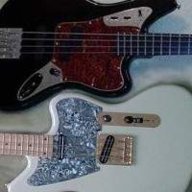
Happy Thanksgiving everyone. I happened to take a pic today of my two P's. Everyone talks about the PUPs being key but there are two kinds, the original single coil and then the split, which came in around '57 I believe.
The bass on the left is a '51 reissue that I picked up a few years ago. The stock PUP hummed too much for my taste so I replaced it with a Seymour Duncan single coil. Sounds great now, especially with the tone knob rolled off. The bass on the right is a '78 fretless P with a very awesome neck.


The bass on the left is a '51 reissue that I picked up a few years ago. The stock PUP hummed too much for my taste so I replaced it with a Seymour Duncan single coil. Sounds great now, especially with the tone knob rolled off. The bass on the right is a '78 fretless P with a very awesome neck.

- Feb 16, 2008
- 21,240
- 23,638
- Disclosures
- John K Custom Basses
A P Bass is:
A big fat neck!
One "P" Pup where it oughta be!
One Volume and one tone!
Says Fender on the headstock!
Cranks, growls and jams with the best of them!
Nuff Sed!
just an FYI, all genuine fender p basses didn't come with 'a big neck'. many of them were offered as a custom order with the "A" neck (jazz bass profile) that was 1.5" at the nut, and they still sounded like, and were true precision basses.
JakeAndAirwaves said:The best part? His mids are boosted in his EQing.
So you are saying that with that pickup placement, a reversed p does absolutely nothing except make the D and G more bassy?
You can't get what ain't there, as John say, different harmonics and overtones. If it saw just EQing then a good amp will be able to make every bass sound like any desired bass.

johnk_10 said:i actually do believe that the body's shape has an impact on the sound (let alone the wood). a jazz bass has a different shape and routing, and the slab bodied '66 p's sounded a little bit different than the contoured ones (i had one). my jaguar bass with two jazz bass pickups (in the 70's locations) doesn't sound exactly like a 70's jazz bass either. it can get pretty close, but i think it's the result of the different shape and routing. it's the same reason that my Gibson EB-1 doesn't sound exactly like my EBO (they use the same woods, pickup, pickup location and scale length).
I totally agree, the shape and the wood does have some effect as well. Even though the pup type and position have probably most effect.
GlennW said:It's on the bench getting a mudbucker, but here's a Double P aka PP Bass.
That is an interesting combination, never seen this before

One last time, it's the body.
A sheep is a sheep. Closing your eyes isn't going to change that, no matter what you believe.
One last time GlennW. That's your OPINION and I have mine. OPINIONS aren't wrong which is why they call them OPINIONS, not facts. Does this make my stance any clearer to you?

As you wanna start doing my thinking for me would you like to take over paying my bills too.

Looking at the Fender website, the only things I can find in common on all their Precision basses is the body shape, the number of frets and the "precision bass" decal on the headstock.
I know a lot of people (myself included) would like the split precision pickups to be the defining thing but for some crazy reason Fender didn't think it that important to limit "precision basses" to one pickup type. The new Fender Blacktop Precision has dual humbuckers, the Fender Deluxe Precision has a PJ layout, the Fender '51 Precision has a single coil, and so on...
Some have tele headstocks some have the ball and flag headstock, some are active, some are passive, some have very different control layouts, pickguards, bridge covers, pickup locations and on and on.
I guess in the purest sense, the first model to be called the "Precision Bass" by Fender would be the only true P bass, all others are just newer adaptations and improvements on the original idea. Did the original P bass body style ever come in a fretless version prior to the move to the new body style and split pickups? If so, that might be where it all went south, especially considering that it was called the "Precision Bass" because it had frets.
PS - I am aware of one Fender Precision bass (P Bass Plus) that did have a different body style but it's no longer in production, so technically body style may not even be the deciding factor as far as Fender is concerned.
I know a lot of people (myself included) would like the split precision pickups to be the defining thing but for some crazy reason Fender didn't think it that important to limit "precision basses" to one pickup type. The new Fender Blacktop Precision has dual humbuckers, the Fender Deluxe Precision has a PJ layout, the Fender '51 Precision has a single coil, and so on...
Some have tele headstocks some have the ball and flag headstock, some are active, some are passive, some have very different control layouts, pickguards, bridge covers, pickup locations and on and on.
I guess in the purest sense, the first model to be called the "Precision Bass" by Fender would be the only true P bass, all others are just newer adaptations and improvements on the original idea. Did the original P bass body style ever come in a fretless version prior to the move to the new body style and split pickups? If so, that might be where it all went south, especially considering that it was called the "Precision Bass" because it had frets.
PS - I am aware of one Fender Precision bass (P Bass Plus) that did have a different body style but it's no longer in production, so technically body style may not even be the deciding factor as far as Fender is concerned.



Looking at the Fender website, the only things I can find in common on all their Precision basses is the body shape, the number of frets and the "precision bass" decal on the headstock.
Actually the American Deluxe Precision Bass has 21 frets while all the others have 20. So according to Fender the # of frets isn't that crucial. The older Am Deluxes had 22 frets IIRC.


