• TalkBass has been independent since 1998. Add your voice.
    Create a free account to reply to discussions, view embedded media, and browse with fewer display ads.
    Join freeLog in
    Want zero display ads or expanded classifieds tools? Compare plans.

What makes a P a P?

Actually the American Deluxe Precision Bass has 21 frets while all the others have 20. So according to Fender the # of frets isn't that crucial. The older Am Deluxes had 22 frets IIRC.

OK, that settles it then (even body and frets aren't consistant). As evidenced by Fender's own brand management techniques over the years the only thing that makes a Fender Precision Bass a "Precision Bass" are the words "Precision Bass" on the headstock. It looks like Fender has over the years fiddled around with every aspect of the Precision Bass except for the words in the logo.

So to sum it up, not all Fender P basses have the same body, neck width or pickguard style; nor do they all have the same pickup configuration or number of pickups or location of pickups; nor do they all have the same control options, and they aren't necessarily all passive or all active; they don't have the same number of frets, and they don't all sound the same. What they all have in common is the words "Precision Bass" on the headstock.

Good grief, not the best equity management strategy I've ever seen.
 
OK, that settles it then (even body and frets aren't consistant). As evidenced by Fender's own brand management techniques over the years the only thing that makes a Fender Precision Bass a "Precision Bass" are the words "Precision Bass" on the headstock.

I think you're right, and I was wrong about the body being the determining factor.

If it was the body the Tele basses would really be P Basses. It's all in the decal (maybe).

Tsk, tsk, tsk.
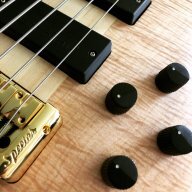
 
hey, these two both have the decal ... and just about nothing else in common:

IMG-20111124-001321-1.jpg


but, marketing aside, I think most people take "P bass" to mean a 1.625 nut width, that split bucker in the middle, and two nice slabs of wood, preferably strung with flats. :bassist:

By the way, one thing the P proves is that two knobs are enough. The more I play them, the more I like that.
 
I think you're right, and I was wrong about the body being the determining factor.

If it was the body the Tele basses would really be P Basses. It's all in the decal (maybe).

Tsk, tsk, tsk.

Hey, GlennW - thanks again for the cap education on the other thread. I've been experimenting with it on some existing pickups in advance of buying the lipstick humbucker and the results are very interesting.
 
Here's my take:

A P body + a lone P pickup = a P bass. If it's a P body with J pickups, it isn't a P. If it's a P pickup in another body, it isn't a P. If it has a P and a J pickup, then it's a P/J rather than a P.
 
Ok maybe a stupid question, but what makes a P bass a P bass? I know the difference between a fender p and a fender jazz, neck and body differences, pick ups etc.

Moving away from fender, is any bass with just a P style pickup condidered a p bass?

Beyond that what exactly are "soapbar" pickups and how do they relate?

pickup and pickup position.
Alder or ash body
maple neck
4 strings
rosewood or maple board.
I think that's about it
 
Simple: if you ever get your hands on one of the first batch of P basses ever made... that's the ultimate, the only, the truly P bass! How more genuinely "Precision" could you get? Anything else is the Precision Jr and Precision descendants.

Maybe a replica would do it too, like the 51's reissue.

 
Simple: if you ever get your hands on one of the first batch of P basses ever made... that's the ultimate, the only, the truly P bass! How more genuinely "Precision" could you get? Anything else is the Precision Jr and Precision descendants.

Maybe a replica would do it too, like the 51's reissue.

I've always said that Leo got it right the first time. The later versions had some improvements but to me the first version is special.