• TalkBass has been independent since 1998. Add your voice.
    Create a free account to reply to discussions, view embedded media, and browse with fewer display ads.
    Join freeLog in
    Want zero display ads or expanded classifieds tools? Compare plans.

Who REALLY makes your bass?

Guild: SPG Factory, South Korea
Guild: Guild Factory, Westerly R.I.-USA
Fender: FujiGen Gakki Factory, Japan
DeArmond: Samick Factory, South Korea
Reverend: Mirr Musical Instrument Factory, South Korea
 
Last edited:
I know exactly who made my bass and where it was made. I’ve been there. I talked to the builder. I picked out the wood. It was worth every penny.
48EEAF35-8D15-476A-9230-0775ED3A38F7.jpeg
 
The explanation is very easy. Invented by greedy bean counters in corporations. "Global Economy." Think of the whole world as a cookie cutter factory. Sure, there are complications of duties and import/export in the food chain, but everything is made everywhere. Not a whole lot is truly made in America anymore. And some of the material is manufactured overseas then sent back to the U.S. to be "built" here. In little Sitka, Alaska, the ALPS pulp mill corporation knew of the impending closure of their pulp mill. So they bought up HUGE amounts of logs and had them coated and sunk offshore. Before they closed, they retrieved the sunken lumber and sent it to Japan, where it is still being used in manufacturing. And that was over 25 years ago.

The world has shrunk and as already stated, it's hard to guarantee that anything built was 100% built in the USA or even by one company. Having said that, I like Cort and Ibanez, and own Ibanez basses and guitars. They are very well made and are sturdy and sound excellent. My next purchases will probably be the new Fender lefty basses that just came out. Where were they made? I don't know..



You seem to be confusing two separate issues:

a) Gibson instruments ARE and have always been spec'd and QC'd in the USA.

b) The QC aspect of the story got shaky in the second half of King Henry's reign and they did release quite a few pieces that should've never left the factory. The new management seems to be on its way to getting things under control, although it's still too early to tell.

In all fairness, if one builds a guitar/bass/whatever in TN - even using certain foreign parts - where would you think that their QC department resides?[/QUOTE]

point taken. but then, Gibson is still at fault big time. I was just wondering if their Outsourcing got out of control? seems like it, and caused their down fall.
 
  • Like
Reactions: alaskaleftybass
You seem to be confusing two separate issues:

a) Gibson instruments ARE and have always been spec'd and QC'd in the USA.

b) The QC aspect of the story got shaky in the second half of King Henry's reign and they did release quite a few pieces that should've never left the factory. The new management seems to be on its way to getting things under control, although it's still too early to tell.

In all fairness, if one builds a guitar/bass/whatever in TN - even using certain foreign parts - where would you think that their QC department resides?

point taken. but then, Gibson is still at fault big time. I was just wondering if their Outsourcing got out of control? seems like it, and caused their down fall.[/QUOTE]

I believe we're having an unrelated discussion here. Earlier i disclosed that I use Ibanez basses--which is the brand I refer to for global economy/production. The last time I owned a Gibson bass was in 1971--an EBO bass that I foolishly sold a couple years later-- for a Fender Precision. Back then all the Fenders were made in the USA.
 
  • Like
Reactions: ajkula66
point taken. but then, Gibson is still at fault big time. I was just wondering if their Outsourcing got out of control? seems like it, and caused their down fall.
Well, Epiphone was "outsourced" to Japan back in 1970 or so. I doubt that fact had anything to do with some of the less-than-stellar moments that Norlin who owned Gibson at the time had.

King Henry's idea of creating "a lifestyle brand" by going around and buying zillion other companies and then not utilizing their potential was caustic and destructive. During that bout of insanity, QC was pushed far down on the list of priorities and yeah...that did NOT end well. Sadly enough, it was Henry J. who brought up the Gibson QC back to par in the late 80s and early 90s.

There's no doubt in my mind that the current management is intent on bringing the QC back where it should be, but given the fact that their marching orders come from KKR, they will be looking for the quickest possible ROI route, whatever that might mean IRL.

And make no mistake, even on my 50+ year old - I refuse to call them "vintage" since they're younger than myself - Gibsons and Guilds there are parts that came from elsewhere, most notably Germany and likely Sweden...
 
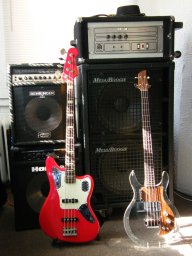
(Laughing) I've two 'Ampeg' Big Stud basses! (made by Tokai & was also marketed under 'Baldwin' - the only diff was the name on the headstock) I didn't care back in '77 when I bought my first one! The fact I now have two testifies to my like/love of this axe (or is proof of needing intense medication)!
 
(Laughing) I've two 'Ampeg' Big Stud basses! (made by Tokai & was also marketed under 'Baldwin' - the only diff was the name on the headstock) I didn't care back in '77 when I bought my first one! The fact I now have two testifies to my like/love of this axe (or is proof of needing intense medication)!

I had an Ampeg Big Stud and an Armstrong Lucite (like in your avatar). The both worked well and they were both very heavy so I eventually let them go.
 
Good points. We know that the Cort factory in Indonesia makes guitars and basses for around a dozen different companies. Squier, Epiphone, SBMM, Ibanez etc...Im not saying all the parts are interchangeable, because they clearly are not. Ive never been to the factory so I can't say for certain, but it seems pretty obvious that the same person who puts together a Squier is most likely the same person who also puts together SBMM, Epiphone, Ibanez etc...Most people would like to believe that either Fender or Squier had something to do with the building of their Squier instrument (especially since it says both their names on the headstock), but aside from the design, it doesn't appear they are involved at all.

I will say that I like what SBMM does though. The guitars and basses are shipped from Indonesia to Praxis over here in Orange, CA where they are inspected again and setup. So every SBMM I have ever owned or played in store has been consistent in its quality and setup, even on the entry level SUB series. Im not sure if any of the other companies do this, that might explain why Squier and Epiphone were either hit or miss from my experience.
I think Squier and Epiphone guitars are inspected, they just don't do the detailed stuff like open the shipping box.

I would think that the different products made in these factories would often be completely different building techniques, but with a reasonably common level of build quality. I'm reminded of the first Golden Age of guitars back in the sixties. Matsumoku or Fugi Gen Gakki built large numbers of guitar models for a large number of wholesalers, anything from entry level to pro level. An entry level Matsumoku would be built to a very high quality but with entry level guitar techniques and materials, whereas a pro level would be as high quality as any American competitor. Other factories like Kawai might build anything from sub-entry level department store models lacking even truss rods to reasonably high quality models, but none were built to the quality of Matsumoku or Hoshino because they didn't have the skilled luthiers to build pro level instruments. Still other, smaller manufacturers would build only sub-entry level department store models, many of which would warp or crack before they even reached America or Europe, because they lacked basic knowledge of fine instrument building and indeed, often basic knowledge of woodworking period.

I say all that to muse that perhaps it's not enough to say two instruments were made by Cort in Indonesia, you'd still find a lot of build quality variation due to different techniques.
 
  • Like
Reactions: R Briere
I think Squier and Epiphone guitars are inspected, they just don't do the detailed stuff like open the shipping box.

I would think that the different products made in these factories would often be completely different building techniques, but with a reasonably common level of build quality. I'm reminded of the first Golden Age of guitars back in the sixties. Matsumoku or Fugi Gen Gakki built large numbers of guitar models for a large number of wholesalers, anything from entry level to pro level. An entry level Matsumoku would be built to a very high quality but with entry level guitar techniques and materials, whereas a pro level would be as high quality as any American competitor. Other factories like Kawai might build anything from sub-entry level department store models lacking even truss rods to reasonably high quality models, but none were built to the quality of Matsumoku or Hoshino because they didn't have the skilled luthiers to build pro level instruments. Still other, smaller manufacturers would build only sub-entry level department store models, many of which would warp or crack before they even reached America or Europe, because they lacked basic knowledge of fine instrument building and indeed, often basic knowledge of woodworking period.

I say all that to muse that perhaps it's not enough to say two instruments were made by Cort in Indonesia, you'd still find a lot of build quality variation due to different techniques.

Right by it’s not like they have 12 separate teams of people making guitars for 12 different brands. The same people are working on multiple guitars. That’s how you end up with the Sterling tag on the Squier bass that I posted earlier in this thread.
 
I had an Ampeg Big Stud and an Armstrong Lucite (like in your avatar). The both worked well and they were both very heavy so I eventually let them go.
The "Danny" was so heavy it eventually cracked the handle anchor, which I fortified. But the GEB 750 was (IMHO) quite light; laminated plywood? I gave my 1st Big Stud to a good friend as a wedding gift to share bass with his wife, who divorced him, threw him out, and kept the bass out of spite! She was a pastor...make your own comment(s).
 
This was posted in another thread here but thought it deserved its own. Very informative video that had me thinking and just reinforcing my belief that you are mostly paying for the name on the headstock. Some of you may know this but there are a lot here who don't. Thoughts?


I've known all the people involved with making my currently owned basses personally and have raised at least a few pints with all but one. So the name on the headstock has very real value to me. One has a CNC made OEM neck but was substantially reworked by hand. Three of the four have pickups made in house, so metalwork is about the only outsourced part, beyond paint. And two of my basses even have proprietary custom finishes blended in house. So yeah, I think I really do have a handle on this.
Yel_wink.gif
 
Well, that would depend on which bass we're talking about.
My P-Bass? CBS/Fender factory, in Fullerton, CA.
My post-Baldwin, pre-Fender Gretsch Broadkaster? The Terada factory, in Japan; where all the "professional" model Gretsches are still made.
My Alembic Epic? That's a silly question...;)
My Rickenbackers? Another silly question...
My Carvin? At the Carvin/ Keisel factory...
My '70s Epiphones? The Matsumoku factory in Japan...
My Warmoth mini-P bass? Made in Puyallup, Washington; assembled here in Vegas...
My Kramers? Neptune, New Jersey...
My Gibson T-Birds? Nashville, I imagine...
As for all the rest of them? Japan, Korea, and China. I'm reasonably happy with all of those, regardless of exactly where they're made. And, AFAIC, that's all that counts... :whistle:
 
I didn't read the thread. Here's who made my bass:

1. WHERE ARE REVEREND INSTRUMENTS MADE?
Reverend guitars are built in South Korea by Mirr Music Co. This company is owned by Hank Cho, a third generation guitar builder who’s attention to detail, high quality control, and ability to accurately produce our unique designs (as opposed to the same old knock-offs) made Mirr a perfect partner for Reverend. These guitars are top-notch in every way… the wood is properly cured, the finishes are thin, the neck pockets are tight, the frets are polished, the components are high quality, and the overall fit and finish are first rate.

Every guitar model is designed by award-winning luthier and Reverend founder Joe Naylor. All components, woods, dimensions and materials have been specified by Joe for maximum performance and serviceability.

Our goal is not to build the cheapest Korean guitar, but rather to raise the bar for performance. It costs a little more to do that, but the result is a pro level guitar that is gig ready right out of the box.

Invalid Link Removed
 
My main bass was made mostly by Joe Russo and Kelvin Daly overseen by Carl Thompson in a tiny shop in the basement of a brownstone in brooklyn. My other was made mostly by Pete Hilton in that same space. These were painstakingly sanded from end to end by hand for hours and hours. I really like playing an instrument that was made with that level of attention to detail. Its a shame that some "handmade" instruments are merely inspected and final sanding by hand.
 
  • Like
Reactions: ajkula66
Good points. We know that the Cort factory in Indonesia makes guitars and basses for around a dozen different companies. Squier, Epiphone, SBMM, Ibanez etc...Im not saying all the parts are interchangeable, because they clearly are not. Ive never been to the factory so I can't say for certain, but it seems pretty obvious that the same person who puts together a Squier is most likely the same person who also puts together SBMM, Epiphone, Ibanez etc...Most people would like to believe that either Fender or Squier had something to do with the building of their Squier instrument (especially since it says both their names on the headstock), but aside from the design, it doesn't appear they are involved at all.

I will say that I like what SBMM does though. The guitars and basses are shipped from Indonesia to Praxis over here in Orange, CA where they are inspected again and setup. So every SBMM I have ever owned or played in store has been consistent in its quality and setup, even on the entry level SUB series. Im not sure if any of the other companies do this, that might explain why Squier and Epiphone were either hit or miss from my experience.

Once you know for sure how the Musical Instrument industry runs you’ll think that Used Car Salesmen are Saints sent from Heaven.