The Sklar Frankenstein or whatever he calls it has the neck P pickup close to the neck....closer then a J bass neck pickup.Interestingly, lots of famous Sklar tracks are actually his 60's Jazz (the "Hippy" bass he did all the carving on, but stock electronics). Tracks like "Doctor My Eyes", etc. He has said in interviews that he never cared for pbasses, so it makes sense that the Franken bass is more Jazz-ish in it's pu placement. Even now with his Dingwall he seems to be going for something Jazz-leaning tone wise (to my ears at least). Kinda funny actually, that one of the most revered and recorded session bassists of all time has typically gone with some variation on a Jazz sound, vs a P. Go figure

Enjoy the benefits of a premium membership!
Upgrade Account
-
TalkBass has been independent since 1998. Add your voice.
Create a free account to reply to discussions, view embedded media, and browse with fewer display ads.
Join free Log in
Want zero display ads or expanded classifieds tools? Compare plans.
You are using an out of date browser. It may not display this or other websites correctly.
You should upgrade or use an alternative browser.
You should upgrade or use an alternative browser.
Why Do We Keep Coming Back to the P-Bass?
- Thread starter Paleet
- Start date
-
- Tags
- p bass 5 string
More options
Who Replied?


The P is just a classic tone. Whether it is your personal preference or not almost does not matter. Its a sound that gets demanded in some circumstances. You better be able to produce it if you want that gig.
My lead guitar player brought his brand new Ibanez 5 string bass with a neck through yesterday in order I give it a try during our rehearsal.
His instrument is extremely nice with a green marble maple top and quite honestly, a real pleasure to play. You can really feel the robustness when you have it in your hands.
So we played 5 songs ending with Mustang Sally which is one of our forever songs. Then we did that same last song but using my p bass with quater pounder pickups without changing anything.
At the end of the song he said to me : "If I buy a used MIM Fender p bass, would you be able to change the pickups for me ? "
Anyway, he will end up keeping both and use his future p bass for the "vintage" songs.
His instrument is extremely nice with a green marble maple top and quite honestly, a real pleasure to play. You can really feel the robustness when you have it in your hands.
So we played 5 songs ending with Mustang Sally which is one of our forever songs. Then we did that same last song but using my p bass with quater pounder pickups without changing anything.
At the end of the song he said to me : "If I buy a used MIM Fender p bass, would you be able to change the pickups for me ? "
Anyway, he will end up keeping both and use his future p bass for the "vintage" songs.


A good P with rounds and a HipShot extender will play well in most cover gigs. At that point, it’s up to the player.
There are now a variety of great pedal board preamps, which also contribute to any number of kinds of basses to sound great.
Side comment, I remain surprised by the popularity of distortion pedals. Zero of my gigs benefit in the least from distorting the bass sounds. Yes, Pappalardi and Casady etc did interesting things with distortion. None of my gigs cover that particular thing. Anyhow YMMV.
There are now a variety of great pedal board preamps, which also contribute to any number of kinds of basses to sound great.
Side comment, I remain surprised by the popularity of distortion pedals. Zero of my gigs benefit in the least from distorting the bass sounds. Yes, Pappalardi and Casady etc did interesting things with distortion. None of my gigs cover that particular thing. Anyhow YMMV.

I started on a P because that's all the tiny music store near me had and was in my budget. I stray from them every few years but always go back.
The sound, the look, the feel, the simplicity, easy to customize, easy to repair. They look great new or old. I just play and write better on them than other basses. They feel like home.
The P bass is iconic.
The sound, the look, the feel, the simplicity, easy to customize, easy to repair. They look great new or old. I just play and write better on them than other basses. They feel like home.
The P bass is iconic.
I have flats on my P currently. That's a classic tone. I may try a 50-110 set of rounds to see if that is a little more flexible in terms of sounds with out losing the big low end of the flats. Actually, I may try that on the Jazz first as it will need strings shortly anyway. It does not have flats which should really highlight the differences in just the gauge change.
The low end is the same. Rounds just have more treble overtones. It's a more complex tone but it doesn't lack bass. Use foam and turn the tone down to get rid of some of those overtones. Still far from a flat wound tone but usable on stage when you need to go to the dark side.I have flats on my P currently. That's a classic tone. I may try a 50-110 set of rounds to see if that is a little more flexible in terms of sounds with out losing the big low end of the flats. Actually, I may try that on the Jazz first as it will need strings shortly anyway. It does not have flats which should really highlight the differences in just the gauge change.
And no, old rounds don't sound like flats unless they are literally filled with gunk but then ewwww
I have flats on my P currently. That's a classic tone. I may try a 50-110 set of rounds to see if that is a little more flexible in terms of sounds with out losing the big low end of the flats. Actually, I may try that on the Jazz first as it will need strings shortly anyway. It does not have flats which should really highlight the differences in just the gauge change.
I use 50-110 DR Pure Blues. Being roundcore they feel as flexible to me as typical hexcore 45-105, but with more meat on the bone. Great strings.
Heavier gauge strings certainly do have more low endThe low end is the same. Rounds just have more treble overtones. It's a more complex tone but it doesn't lack bass. Use foam and turn the tone down to get rid of some of those overtones. Still far from a flat wound tone but usable on stage when you need to go to the dark side.
And no, old rounds don't sound like flats unless they are literally filled with gunk but then ewwww

And more volume, hitting the pickup with more everything. I am running the La Bella flat wound 1954 strings 52-110, the James Jamerson strings. I see how his bass drove the Motown mixer into overdrive. When I use that bass I have to switch to the active setting on my amp if I want a clean soundHeavier gauge strings certainly do have more low end

Yes but many people who play flats play regular gaugeHeavier gauge strings certainly do have more low end
I have the same flats. They absolutely made my bass bassier and louder buy it's still quieter than my other P with ceramic pickups.And more volume, hitting the pickup with more everything. I am running the La Bella flat wound 1954 strings 52-110, the James Jamerson strings. I see how his bass drove the Motown mixer into overdrive. When I use that bass I have to switch to the active setting on my amp if I want a clean sound


Basses are tools.
Some bassists are tools as well, but that's another thread.
Although you can come up with a bunch of ideas that you think will make a better hammer, a decent handle and a tough steel head of the right shape are all that's necessary to make a decent hammer. Leo stepped into a world where a lot of things were actually figured out for him - lots of guitars had been made, so people had a pretty good idea of how to make a neck that would work in people's hands. Pickups were already in use on a lot of guitars - nothing really to invent there, we'll just tweak it for fewer strings.
What did Leo invent? He used a lot of previous ideas, pasted them together, and tweaked them a bit. Solid bodies were something others figured out on guitars first, so that wasn't his idea. Pickups? Pre-existing. Tone and volume controls? Same. Truss rods? Gibson had been making those for decades.
Leo was a tinkerer. He decided that he'd apply those ideas to a bass range instrument. He picked a scale length - that worked, and exists to this day. He designed a shape for a solid body. That lasted a few years, and then got changed. He designed a pickup. That lasted half a dozen years, and then he decided he needed to fix the hum. So, he borrowed Seth Lover's idea, and put it in two housings to get around the patent. Gibson decided not to sue, so he got away with it. The bridge evolved a bit from the original design to one where intonating all the strings individually was possible.
Despite not actually inventing any new ideas, Leo didn't get it all right the first time. By the third time, though, he had it pretty close, and that design lives to this day, with only minor tweaks here and there. Leo designed the basic formula around which many basses are still made. He wasn't a genius, but he was a very effective tinkerer.
Let me condense all that for you. Fender came up with the right "recipe" for bass guitar, where the whole was greater than the sum of the parts, at a time when there was a need for it, and no one else had figured it out yet. He saw a real opportunity, made protos, then marketed a completed product. He was there, it was his recipe, he worked it out and built it.

The dead chromes on my P bass take me about as far as you can get from classic tone.... more kinda Jaco territory. P basses are so versatile.I have flats on my P currently. That's a classic tone

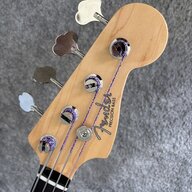
It's the best bass, simple as that.
Oh no, now you've really done it.
Battle Stations....brace yourself for impact!


