A rare speciesI would take this one here before many F….. basses having seen and heard one in person !

TalkBass has been independent since 1998. Add your voice.
Create a free account to reply to discussions, view embedded media, and browse with fewer display ads.
Join free Log in
Want zero display ads or expanded classifieds tools? Compare plans.
A rare speciesI would take this one here before many F….. basses having seen and heard one in person !
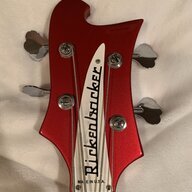
Chris Squire (RIP) is one of the greatest bassists to ever clank! There's no denying that.There was a guy a million years ago called .... Chris Squire.

You have no idea what you're talking about.

I think if more bass players tried a 1.75 nut width bass neck that was thin front to back they would be surprised how comfortable they are.
There was a guy a million years ago called .... Chris Squire.
The EMG active P pickup was released in 1979. Lots of players started using them before 1988.I'm talking about a specific bass tone that comes from active EMG P pickups (that's why I brought it up in this thread). The tone can be done with EMG J pickups too, but this is a P Bass thread.
This tone was first pioneered by DD Verni in 1988 when he switched from his Rickenbacker 4001 to his BC Rich with two active P pickups. "The Clank", as DD invented, is like a Rickenbacker 4003's bridge pickup on steroids. It's next level aggressive and nobody sounded like that before him in metal. It also influenced a plethora of metal bassists to come.
I guess what I should have said was... I found out that small hands don't all need to play toothpick necks.this can be true for some, but not others. I can't stand thin necks. I can stand every nut width, from 45mm of my Aria SB1000 to the 38mm of a Jazz, but the neck profile must be huge, because my hands don't work well with thin profiles, it creates an uncomfortable position between the thumb and the other fingers.
guess what I should have said was... I found out that small hands don't all need to play toothpick necks.
 I'm on your side!
I think your Attitude II has the wide nut but is also a thick front to back baseball bat neck. Billy's original Fender "wife" Precision had a Telecaster Bass neck on it which I think was a wide/thick neck. Billy is 6' 2" with tall guy fingers/hands. Not sure why the Attitude Custom had a shallower front to back profile, they only made that version in 1990-1991 before discontinuing it. Same deal with the Attitude Deluxe.I'm sorry, I read the inches measurements in a wrong way
Hey everyone,
First-time poster here, long-time lurker. I’ve been playing for a while, tried a bunch of different basses over the years, active, passive, 5-string, short scale, modern boutique builds, but somehow, I always find myself coming back to a plain old Precision Bass.
There’s something about that simplicity. One pickup. One tone knob. But the sound? Massive. Sits in the mix like it was born there. No frills, just punch.
So here’s my question for you all:
What is it about the P-Bass that keeps it relevant decade after decade — even with so many high-tech options out there?
Thanks,
Paleet

I have one of these I'm 'resto-modding' with Hipshot hardware as the original bridge was damaged and 3 of the tuners failed.Are we talking coming back to a Fender Precision bass here, or any bass with just one V and T knob and the iconic split coil pickup?
Chasing the sound right? Not the look I guess.
So you’d be coming back to a pbass sound, despite the obvious design differences compared to a Fender Precision with one of these. Correcto Mundo?View attachment 7342767
Well I certainly would if I were going to do this cover-
but is also a thick front to back baseball bat neck.

PJ setup absolutely does not count. Once you add a second pickup to a Precision, it has changed.
Well on a PJ you can bypass the J pickup if you want and just use the P pickup.

Good eye, a bit of both! Just did that pickup swap, looks like the string was laid across the saddle a little off after the swap. Readjusted and back to normal, thanks for noticing!Is there really an unusually wide gap between the A and D strings or is than just the lense messing with the image?
Interestingly, lots of famous Sklar tracks are actually his 60's Jazz (the "Hippy" bass he did all the carving on, but stock electronics). Tracks like "Doctor My Eyes", etc. He has said in interviews that he never cared for pbasses, so it makes sense that the Franken bass is more Jazz-ish in it's pu placement. Even now with his Dingwall he seems to be going for something Jazz-leaning tone wise (to my ears at least). Kinda funny actually, that one of the most revered and recorded session bassists of all time has typically gone with some variation on a Jazz sound, vs a P. Go figureSweet spot, by backside. One of the most recorded basses in history is Lee Sklar's Frankenstein and both P's are reversed active EMGs and neither is where Leo designated it should be. Obviously all those recording engineers had no problem getting it to fit into the mixes.

The bridge PU, sort of for E/A at least, but the neck, no.so it makes sense that the Franken bass is more Jazz-ish in it's pu placement.
I sure would love to know what he used to record "Your Smilin Face" on.Interestingly, lots of famous Sklar tracks are actually his 60's Jazz