• TalkBass has been independent since 1998. Add your voice.
    Create a free account to reply to discussions, view embedded media, and browse with fewer display ads.
    Join freeLog in
    Want zero display ads or expanded classifieds tools? Compare plans.

why do we lock to the kick drum?

ROFL! I love TB. I've been playing guitar for the past 2 years and haven't been on TB too much. Picked up the bass last night to lay down some tracks and "I got blisters on me fingas!" John Lennon.
Anyway, as a Black guy that plays rock music I never worry about staying with the kick drum unless I'm playing bass in an R&B band where staying with the kick is a thang (humor intended). Believe me, I tried playing my Chris Squire runs a few times with some R&B dudes and the look on their faces was one of total CONFUSION mixed with a little what the hell?
It all depends on the music. James Jamerson is a good example of the best of both worlds but he played bass at a time when music wasn't as compartmentalized as it is now.
Edit - and locking with the kick is soooo funky
 
I don’t interpret any of those as him rolling over the drummer. Jamerson and the Motown drummers (esp. Uriel Jones) complemented one another’s playing exceptionally well. If he’d been stepping on their parts they’d have called him out.
Who said he was stepping on their parts? That's a whole different ball of wax than not slavishly devoting yourself to following the bass drum and playing whatever feels and sounds good.
 
why do we lock to the kick drum?
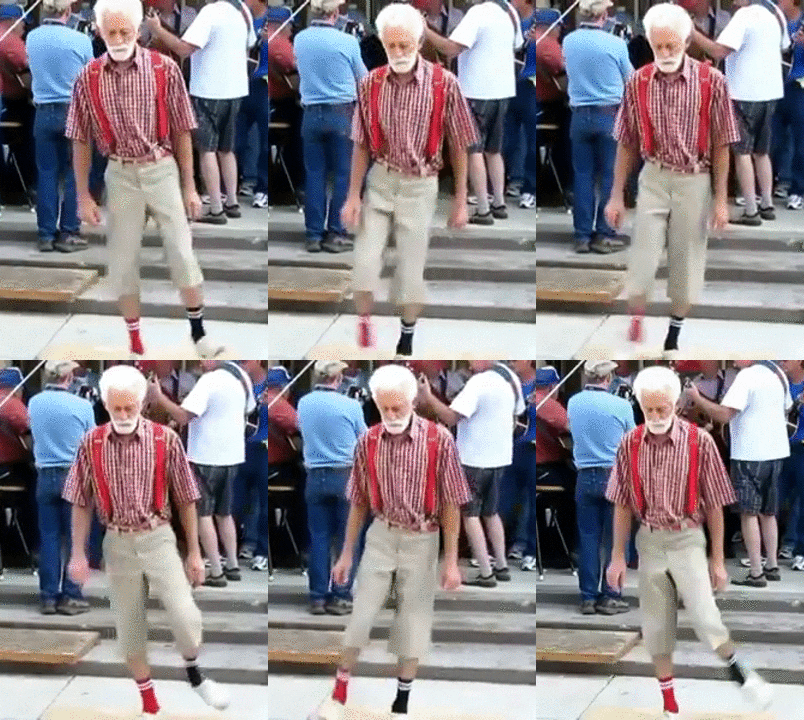
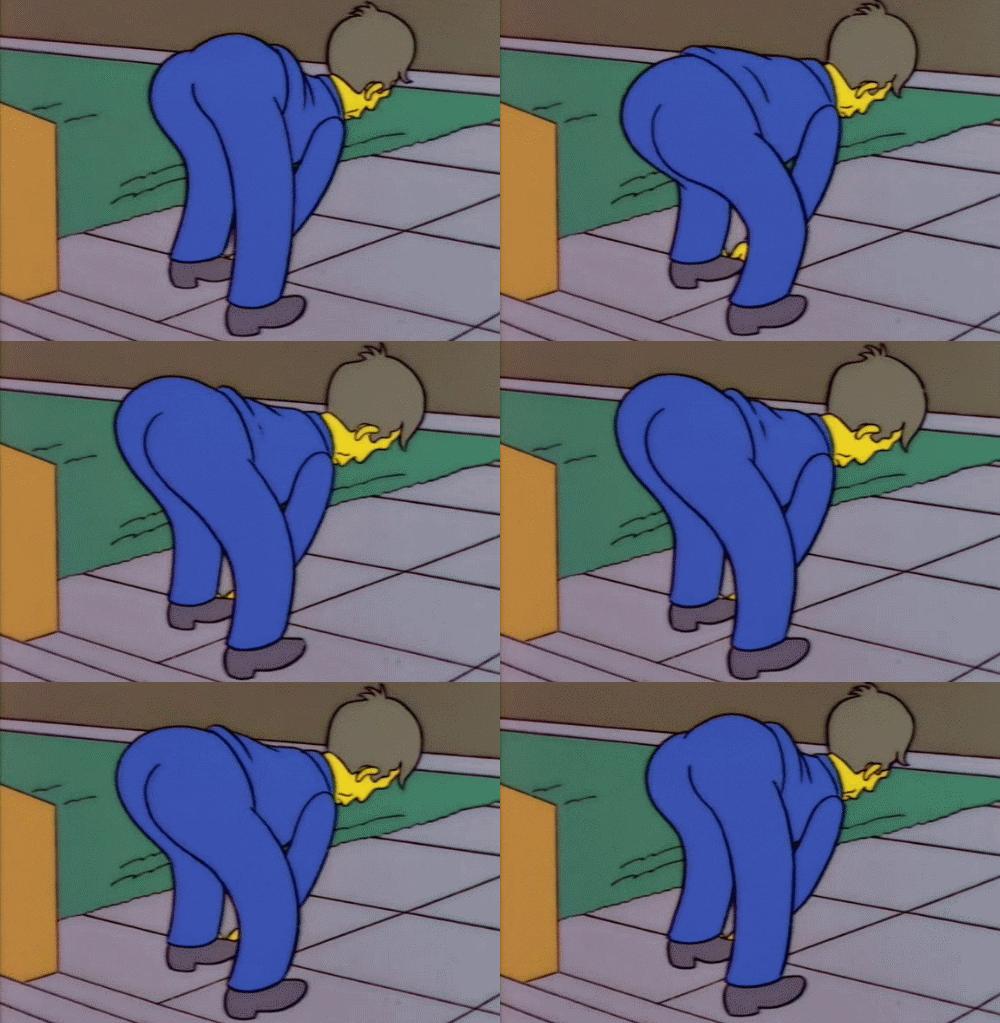
Because when we lock-in, this happens:
tenor.gif

tenor.gif

giphy.gif

source.gif

giphy.gif

giphy.gif

giphy.gif


The movement of the gluteus maximus!

That's why (or at least that's why I do)

:)
Hahaha! You just made my day. The old man threw his canes away and GOT DOWWWN!
 
  • Like
Reactions: DJ Bebop
Depends on the music. Sometimes it's great to lock with the kick and other times it's more interesting to play off the kick.
I think the snare is more important than the kick when it comes to the whole drum set, you need that back beat but I'll play what fits the song.
Of course you need to lock into the groove but not necessarily the kick.
 
  • Like
Reactions: JimmyM
Depends on the music. Sometimes it's great to lock with the kick and other times it's more interesting to play off the kick.
I think the snare is more important than the kick when it comes to the whole drum set, you need that back beat but I'll play what fits the song.
Of course you need to lock into the groove but not necessarily the kick.
Everyone should be locked into the time. But I just call that "keeping good time"...no need to lock myself down for that :D
 
Everyone should be locked into the time. But I just call that "keeping good time"...no need to lock myself down for that :D
You should definitely always be aware of the time, but know that you can push it or pull it as well. If you have a good drummer, it's a fun game to see how far ahead or behind the beat you can get before you lose the sense of where it actually falls.
 
  • Like
Reactions: JimmyM
You should definitely always be aware of the time, but know that you can push it or pull it as well. If you have a good drummer, it's a fun game to see how far ahead or behind the beat you can get before you lose the sense of where it actually falls.
Ya, that's the stuff you should do at practices. Unfortunately, it happens unintentionally on gigs sometimes :D I used to play in a band where the drummer always played ahead of the beat and refused to play behind the beat because he was the bandleader, what he says goes, and even though he'd say you're free to speak your opinion, he'd whine and yell like a big old crybaby if you did. God did he suck when we tried to play funk. I miss that band like I miss the salmonella poisoning I got when I was 6, although I do miss the catering at arenas and big theaters :D
 
Last edited:
Why would it make you late to the downbeat? You don't have to hear the downbeat to play it.
Well maybe not you, but if I am consciously trying to follow the kick as my primary focus on the kit, I wind up late, sort of guessing my way through a tune. If I am jamming a groove or song with someone I don’t even listen to the kick unless it is very repetitive and relatively simple, and only then would I consider trying to play right on the kick.

Now if we’re in a band and we rehearse stuff, and we each have parts worked out that lock together, then no problem. I play my part locked to the overall rhythm of the kit and rhythm guitar/keys, focusing on feeling the subdivisions the same as the drummer, it works like a charm.
 
  • Like
Reactions: JimmyM
locking up with the bass drum is definitely not a rule of thumb (like all general rules in music) but it's a common practice and that's for a good reason.
Low frequencies of sound have a very unique quality in that they can create a sense of grounding in a very effective manner.

From a rhythmic standpoint, in the majority of popular styles the bass drum is played in the beginning of the rhythmic phrase (aka beat 1, downbeat) and the recurrence of it effectively creates a line separating one rhythmic phrase from the other. That in turn allows us to get a strong orientation and feel the groove of the song. Now, of course there's Samba, Regea, Swing music and others that use the weak beats (aka 2 and 4) as the indicator for orienting ourselves within the rhythm, but that's also what makes those styles so unique.

From a harmonic point of view, chords in root position tend to have a stronger sense of groundness and clarity (that is not to say they are always beautiful or the best choice) because the root of the chord is also the lowest note. Again, our ear gravitates towards the lower note seeking a point of reference that the rest of the music can then be built on top of.

When we align those two starting points (the rhythmic and the harmonic) we get a stronger sense of ground to the music, and it's generally speaking easier for us to feel the direction in which the music is headed. In other words - aligning all the low range instruments tends to make the music more comfortable to listen to and easier to pay attention to the rest of the musical content that's being played. That is of course not to say it is the only or the best way to make music comfortable, it is just a very effective one.
 
The idea that the kick drum and bass guitar should always or almost always play the same rhythm is clearly nonsense, as can be demonstrated by noting how many great songs and well-respected bassists from each decade since bass guitars were invented do not follow this "rule", even in genres like rock where it seems to be most commonly taught and can, arguably, be used to best effect. We don't even have to agree on which songs and bassists are "great", because I'm sure we can all find examples in our own music libraries.

But for some songs it certainly does sound great, especially where the song is driven by a specific riff. Also, as a default for a beginner who doesn't know what else to play it is at least a reasonable starting point.

For those who have been defining "locking in with the drummer" as keeping the same tempo and playing a complementary rhythm that may or may not overlap with the kick drum, isn't that kind of too obvious to even state as a "rule" - might as well just say "play something that sounds good". And apply to every instrument.
 
And while we're at it, what's all this about the one? That is for playing James Brown-style funk, and not for every kind of music. Plenty of great songs don't always emphasize the one. Some like the one emphasized so little, like in a lot of reggae, they made up a new name for it..."one drop." You guys need to stop taking things celebrity musicians tell you as gospel throughout the entire music spectrum, because it's not.
The important thing when you're playing is to know where one is. You don't have to emphasize it, or even play it. But you need to be in tune with it, every single measure. This sounds really fundamental but I know players who cannot stay in time with recorded music because they do not listen well enough to repeatedly orient themselves to the count.

But yeah, emphasizing the one is a funk thing.
 
  • Like
Reactions: DJ Bebop
I keep it simple when I create bass lines this is how think it through.... Make sure I hit the one when appropriate (band insists on this so i wanna keep them happy). Make sure I am off on the snare maybe even a slightly percussive mute on the snare hit. Then I make sure to accent another part of the measure. Then provide some movement. Do you hear anything about the kicik drum? Well no but.... I have a very good feeling that the drummer is thinking of very similar things when coming up with his drum lines. So the net result should sound like us "locking together".

In my limited experience the most important thing other than hitting the one is leaving that space for the snare. There is just something about the bass rest that locks a band together. I find this strategy even more important when I am not playing with a drummer.

MTA:being very accurate with the ending of your notes is just as important as striking them in time.
 
After I'd been playing bass for about 10 years, a good friend and great musician wanted to start a band with me, with his cousin on drums. He was a killer drummer. Our first get-together, we were jamming, and when we stopped, the drummer looked at me with the biggest smile and said "I've never had anyone do that before." I had no idea what he meant, so he clarified "The way you were playing along to my kick drum pattern. That was so awesome!" I was very confused, as I just assumed anyone would surely do the same. But he'd been playing almost as long as me, in a number of bands. I suddenly had a new outlook on the non-universality of the whole thing, and a lower opinion of the bass players he'd played with before. haha

It sounds so much tighter when the bass and drums are working together to build a foundation.
One of the best drummers I work with has a couple of original songs that we do. He's got a few little rhythmic accents that he plays in those, which I picked up on and played along with. He said the same thing to me. In all these years, no other bass player has ever picked up that little nuanced stuff and played it with him. To me, those little details are what make music fun and what makes an arrangement work.
 
That's a nice racist sentiment.
I knew somebody would call that one, and skip over the humour (and the word "us").
Technically, yes. And technically, it's equally racist when I make cracks about white people dancing, too.
But I was hoping it would be taken as gentle teasing that plays against a stereotype, from within it.

So, um, sue Jerry Garcia. I swiped it from him and paraphrased.
 
  • Like
Reactions: Mike Whitfield
Who said he was stepping on their parts? That's a whole different ball of wax than not slavishly devoting yourself to following the bass drum and playing whatever feels and sounds good.
In the first of your posts that I replied to you used the phrase “ride roughshod” which means “to act without caring how you will affect someone or something.” That’s why I replied as I did. I understand now that roughshod isn’t what you meant.