• TalkBass has been independent since 1998. Add your voice.
    Create a free account to reply to discussions, view embedded media, and browse with fewer display ads.
    Join freeLog in
    Want zero display ads or expanded classifieds tools? Compare plans.

why do we lock to the kick drum?

Look way back to little trap sets and doghouses and follow the evolution of a rhythm section from the 1920's on.

I dunno about you guys but we had a bunch of written homework middle school-college music classes along with playing.
 
Sorry, but it does not meet the definition of racist. A derogatory statement about white people said by a white person does not meet the definition.

- John
"the belief that all members of each race possess characteristics or abilities specific to that race, especially so as to distinguish it as inferior or superior to another race or races."

" a belief that Invalid Link Removed is the primary Invalid Link Removed of human traits and capacities and that racial differences produce an inherent superiority of a particular race."
 
"the belief that all members of each race possess characteristics or abilities specific to that race, especially so as to distinguish it as inferior or superior to another race or races."

" a belief that Invalid Link Removed is the primary Invalid Link Removed of human traits and capacities and that racial differences produce an inherent superiority of a particular race."
All humans are African. Culture is real; race is not. Can we move along now?
 
I pretty much don’t even pay attention to the kick drum. And further, I perfectly loathe this modern Beater Honda Civic Subwoofer concept of a live mix that is emphasizing the kick. Miles would have simply growled, “that don’t swing.”

Swing and Groove come off of the back beat.
I can see that the answers differ on a scale from 'always with the kick' to 'what kick?', seems to me mostly style dependent. I guess my original question came from the fact that I also pay attention to 2&4 most. I play jazz from swing to rnb. 2&4 are always there, not on the kick, mostly (not always) on the snare. Yet, I was taught (and I'm teaching) that the bass should lock with the kick. That's lesson #1 and there are more lessons than that (don't worry).

In the video @OptimalOptimus mentioned, Howard Goodall explains something like 'in classical music, the natural pulse was not accented much. Jazz came with accents on weird places, to make the music more dancing and funny.' In my experience, swing jazz drummers don't accent the kick much (compared to rockers or funkers).

To conclude what answers to my questions I learned here so far (in my words):
- bass gives kick a pitch and sustain, kick gives bass more punch
- bass synced with the kick can be a good start for a bass line
- bass with a kick / bass alone / kick alone are three building blocks of a lowest voice in a (common instruments) band

Sorry if my questions or statements made somebody upset. I'm just sorting my thoughts and hope that somebody else learns something useful, like I do.
 
  • Like
Reactions: DJ Bebop
9 pages already. Tl;dr

We dont always lock with the kick. I think theres a western music majority who listen to rock music and the pop dance derivatives (incl. modern country) and they tend to.
If youre into music from more traditional latin, african, indian, or some forms of jazz, youd find that statement to be untrue .

However, if youre in a funk band....
 
I like that thinking. White music? In samba, as far as I know, it's similar, the biggest accent is on the biggest drum beat on beat 3.
In jazz, the ride gives the beats, but the bass don't play with it as strictly. Kick drum in jazz is usually played way less loud than in rock or funk.

Clarification - Sambas are traditionally written in 2/2 time, the Samba equivalent to clave is a two-bar pattern, and most Samba rhythms span two bars of 2/2. Given the note density, 2/2 makes the music a whole lot easier to write, and to read! That big, fat whomp from the lowest surdo drum is on 2.
 
  • Like
Reactions: DJ Bebop and equill
Clarification - Sambas are traditionally written in 2/2 time, the Samba equivalent to clave is a two-bar pattern, and most Samba rhythms span two bars of 2/2. Given the note density, 2/2 makes the music a whole lot easier to write, and to read! That big, fat whomp from the lowest surdo drum is on 2

Thanks! My bad. I'm used to think four, thumping on 1 & 3, 3 harder. That would be 2 in 2/2, but in 2/2 definitely way less brain would be spent on reading a sheet.
 
I can see that the answers differ on a scale from 'always with the kick' to 'what kick?', seems to me mostly style dependent. I guess my original question came from the fact that I also pay attention to 2&4 most. I play jazz from swing to rnb. 2&4 are always there, not on the kick, mostly (not always) on the snare. Yet, I was taught (and I'm teaching) that the bass should lock with the kick. That's lesson #1 and there are more lessons than that (don't worry).

In the video @OptimalOptimus mentioned, Howard Goodall explains something like 'in classical music, the natural pulse was not accented much. Jazz came with accents on weird places, to make the music more dancing and funny.' In my experience, swing jazz drummers don't accent the kick much (compared to rockers or funkers).

To conclude what answers to my questions I learned here so far (in my words):
- bass gives kick a pitch and sustain, kick gives bass more punch
- bass synced with the kick can be a good start for a bass line
- bass with a kick / bass alone / kick alone are three building blocks of a lowest voice in a (common instruments) band

Sorry if my questions or statements made somebody upset. I'm just sorting my thoughts and hope that somebody else learns something useful, like I do.

It's a great point. The bass locking in to 1 & 3 combined with the rest of the ensemble accenting 2 & 4 is a large part of what makes swing swing. I don't have nearly as much experience with jazz as you seem to, really just two years at university back in the late 80s preceded by 3 years in high school band (which doesn't really count), but counting in 2&4 was one of our first lessons, and feeling 1&3 for bass was expected to flow out of that, not the kick. It's a lesson that has served me well in everything I've played since, including blues, rock, and country. They have a different feel, they don't swing, but the lesson still applies. 2 & 4 are the holy sacred ground, and are essential to any kind of groove in each of those styles also. One of my frustrations with many guitar players in each of these genres is that they seem to have no recognition of where 2&4 are or how to subdivide beats - telling someone to "comp a chord on the & of 1 and on the 4" is met with a confused, stunned, and sometimes slightly hurt look, or even on just asking them to play on 2&4 versus whanging away on every beat or steady 1/8th notes. Every genre has a groove, whether it's called swing, funk, tic-tac, whatever, and in 4/4 they all rely on 2&4. For the bass to emphasize 2&4, we typically do it by emphasizing 1&3. Like I said above though, our role is to provide rhythmic weight to the harmony, to give it a sense of propelled motion - or groove, and in 4/4 in jazz, country, blues, rock, or bluegrass, that's done by spelling out either simply or more fancily one-TWO-three-FOUR.

Metal IMO tends to be more like classical, where the rhythmic weight of the harmony is unaccented and carried more by motifs - or riffs.
 
But seriously, mirroring the kick is what you do when you aren’t sure what to do. It’s a failsafe.

If you have sheet music, you read it.
If you know the tune, you recite it.
If you wrote the tune, it’s your show, man.
If you are an expert in the genre, rely on your expertise.

Dogged adherence is counterproductive. I can cite plenty of examples where the bass plays long notes while the set tears it up, and a few where the set lays back while the bass grooves.

 
But seriously, mirroring the kick is what you do when you aren’t sure what to do. It’s a failsafe.

If you have sheet music, you read it.
If you know the tune, you recite it.
If you wrote the tune, it’s your show, man.
If you are an expert in the genre, rely on your expertise.

Dogged adherence is counterproductive. I can cite plenty of examples where the bass plays long notes while the set tears it up, and a few where the set lays back while the bass grooves.

It depends, but isn't just what you do when you aren't sure what to do, it's the default and the standard from which anything else derives. Playing *just* behind the kick is a staple of good blues and good country bass playing, playing on the beat is the more rock thing to do. Here's a cool video (except it's for drummers, so when it says "IN FRONT" think behind the beat, and vice versa:
 
  • Like
Reactions: DJ Bebop and moles
How about Love Child? What's Goin' On? I Was Made To Love Her? Standing In The Shadows Of Love? Ain't No Mountain (both versions)? Ain't Too Proud To Beg? Back In My Arms Again? Gladys Knight's version of Grapevine? Or Boogie Fever by The Sylvers or the Theme From SWAT? :D I can go on, too, but I think that's enough to prove my point.

And that ability is held by MANY people, even Gene Simmons, as long as they're not too scared to not play by the "rules."

Damn Jimmy, you just made a decent set list right there! (Ok, we'll probably leave out the SWAT theme...)
 
  • Like
Reactions: LBS-bass and JimmyM
Thanks! My bad. I'm used to think four, thumping on 1 & 3, 3 harder. That would be 2 in 2/2, but in 2/2 definitely way less brain would be spent on reading a sheet.

Not a "bad" - I had the experience of reading on Carnival gigs in NYC in the mid-80's, on trombone. The important thing is that you are hip to this most wonderful music! Samba in Prague - can it get much better than that?
 
  • Like
Reactions: jj.833 and equill
Why lock with the kick drum? I remember being in a band several years ago with a very good drummer who kept wanting me to lock with the kick drum. I didn't like the idea of "having" to lock with the kick, like if the drummer kicks I have to play a note. All the other band members told me I was supposed to lock with the kick. I never really play like I'm trying to lock with the kick drum, I just try to groove. It occured to me recently that although I don't lock to the kick, my current drummer locks his kick to me. I try to play so the music I'm making sounds good, and everyone playing has fun.
 
  • Like
Reactions: LBS-bass and JimmyM
"the belief that all members of each race possess characteristics or abilities specific to that race, especially so as to distinguish it as inferior or superior to another race or races."

" a belief that Invalid Link Removed is the primary Invalid Link Removed of human traits and capacities and that racial differences produce an inherent superiority of a particular race."

You're still going on about that? Man, you're determined to win the internet! OK, you win. Now can we move on?
 
why do we lock to the kick drum?
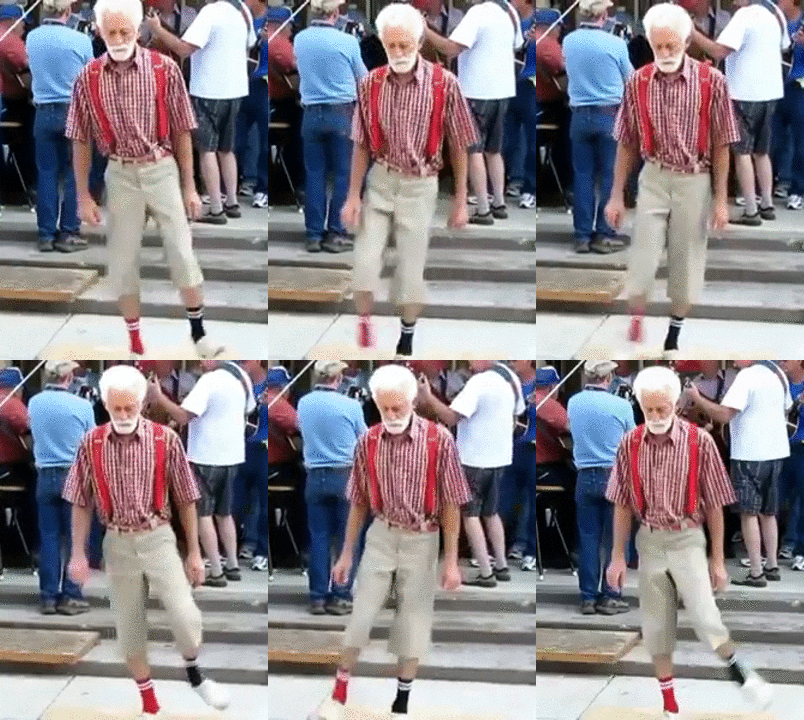
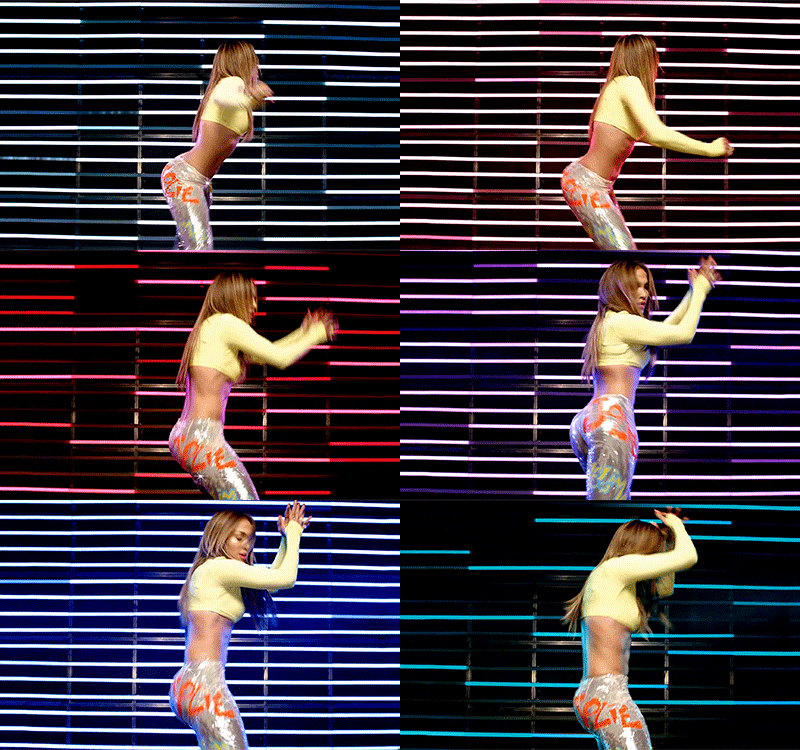
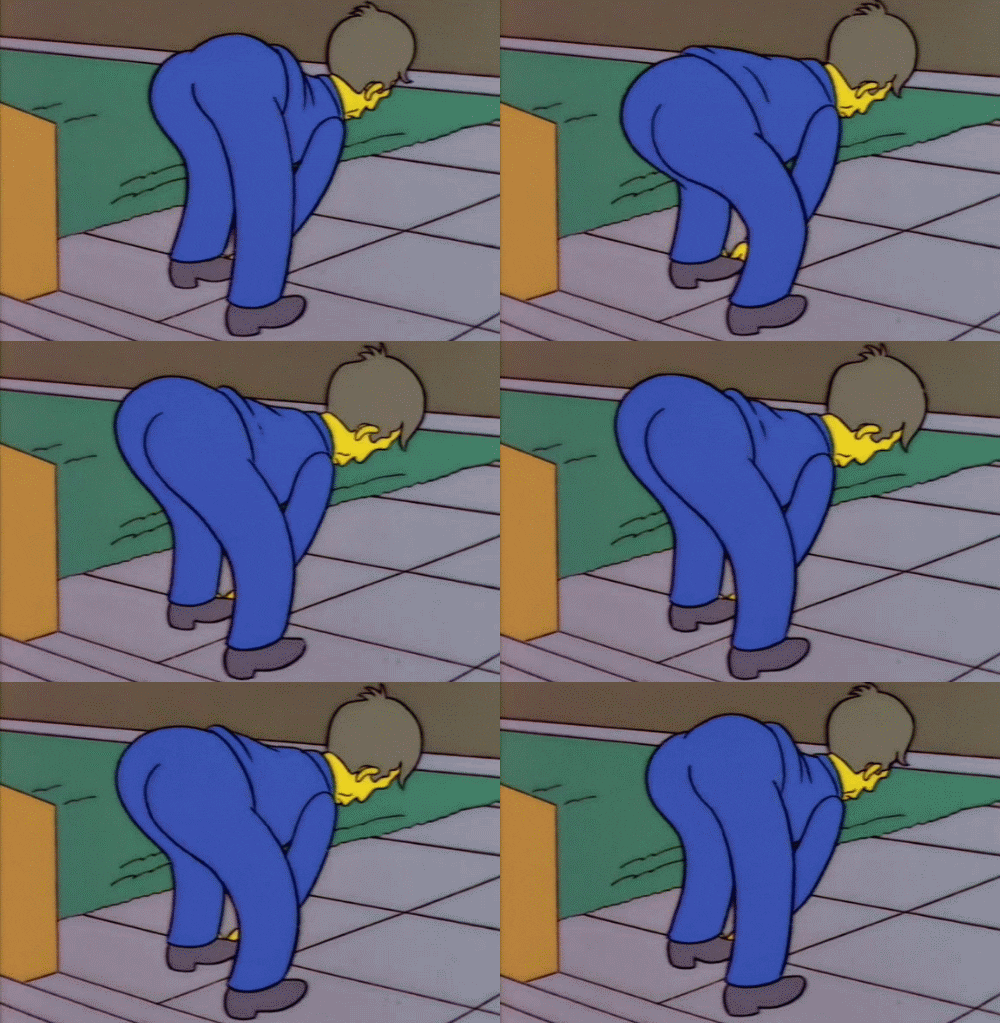
Because when we lock-in, this happens:
tenor.gif

tenor.gif

giphy.gif

source.gif

giphy.gif

giphy.gif

giphy.gif


The movement of the gluteus maximus!

That's why (or at least that's why I do)

:)
Me as well :thumbsup: :):):)
 

Latest posts