• TalkBass has been independent since 1998. Add your voice.
    Create a free account to reply to discussions, view embedded media, and browse with fewer display ads.
    Join freeLog in
    Want zero display ads or expanded classifieds tools? Compare plans.

Why don't more builders use fanned frets / multi-scale?

Don't put words in my mouth and I won't put them in yours, fair enough, sport? If you think I was talking to you, the point may have hit to close to home. But I was juat making an observation. I could not care less if anyone agrees with my gear choices, I make them for me, not ya'll.

Sport?

I owned a fanned fret for 6 months before I came to my conclusions about the technology, so your point was inapplicable to this bassist. ;)
 
Fair enough, and 6 months is a fair trial. I played, and still play parallel frets, played them since 1968 as a matter of fact. But Dingwall FF basses solve a number of problems FOR ME, I don't care what anyone else plays, to each their own.
 
Ibanez, ESP/LTD, Dingwall, Mayones, Brice, Keisel/Carvin, Strandberg and numerous other smaller luthiers are all putting out fanned fret guitars. Sure, Fender and Rickenbacker aren't...but I'd be utterly shocked if they ever did.

Actually Rickenbacker had put out a guitar it was either the model 480 or 481 that was a fanned fretted instrument back in the 70's & early 80's.
I'm going to do a slight correction of myself before any Talkbass folks on here want correct me, I researched the Rickenbacker 481 and it has slanted frets not fanned frets that is being talked about on this thread so my screw-up, so sorry.
 
Last edited:
Ibanez, ESP/LTD, Dingwall, Mayones, Brice, Keisel/Carvin, Strandberg and numerous other smaller luthiers are all putting out fanned fret guitars. Sure, Fender and Rickenbacker aren't...but I'd be utterly shocked if they ever did.


In a field of what is hundreds of builders, maybe 8? 9? And most of those are very, very small shops. Of the big shops, fanned frets are a minor part of their business.
 
It would be difficult for Jaco to play what didn't exist when he was alive. One must keep in mind that his basses were lined because they were defretted. They were defretted because fretless basses weren't readily available at the time. The bass community puts a lot of stock in what Jaco didn't use and a lot of that was simply due to a lack of availability.

Strings can only do so much. Grand pianos would be extinct if one could simply substitute strings for scale length.

I would have assumed that acoustic guitarists are very curmudgeonly. The guys who utilize deep and/or open tunings have been gladly embracing fanned frets. The labor intensive nature of building acoustics generally means they're also spending more money than bassists.

I'll rephrase so you follow my meaning. If "a very popular and well known bassist" comes along and also plays a fan fret bass, some builders might move toward manufacturing fan fret basses to cash in on the popularity. I'm aware fan fret electric basses didn't exist while Jaco was alive (although fan fret instruments predate his birth).

My use of Jaco & others mentioned were just examples of very popular bassists, which is why I said "a" Jaco, Flea, Trujillo, Sting, etc. I didn't inferred Jaco, Flea, Trujillo, or Sting chose not to play fan fret basses. Those names were used in place of the phrase "a very popular bassist' because I thought it might be clear how such bassist influence markets. I was obviously wrong in my assumption.
 
It's ok if folks don't see a point in them for what they do - there probably isn't one. String technology has come far enough to make this ancient practice unnecessary for most. This discussion happens on guitar forums a lot too, where multiscale has a way more obvious effect, or is outright required for extended range.

I can completely see how unnecessary it is to traditional 4 string bassists and 6 string guitarists who tune standard. We'd all have different opinions if we were using 1700s era strings and instruments :p
 
Ibanez, ESP/LTD, Dingwall, Mayones, Brice, Keisel/Carvin, Strandberg and numerous other smaller luthiers are all putting out fanned fret guitars. Sure, Fender and Rickenbacker aren't...but I'd be utterly shocked if they ever did.

1973-rickenbacker-481-electric-guitar-03.jpg


Surprisingly, Rickenbacker did a slanted fret guitar many moons ago. They thought it might be ideal for guitarists who played very fast. It was all the same scale length.
 
  • Like
Reactions: bdgotoh
I didn't read the whole thread, but a while back, I pondered this same thing.

I wanted a nice full B string and a non-twangy G (or maybe C) string - a multi-scale bass only made sense. Then someone made a very good point that in order to really get the benefits of it, you really need to move up and down the strings perpendicular to the crazy angle of the bridge, to keep your point of attack an equal distance from the bridge:

View attachment 2470520

If you went just straight up and down like you do on a single-scale bass, then you'll be much closer to the bridge on highest pitched string than where you'd be on the lowest pitched string, and you would lose some of the benefits of a multi-scale bass.

I didn't want to have to think about plucking-hand placement every time I crossed the strings, plus I preferred to keep a single-scale bass to keep my muscle memory intact for fretless playing. So I began stringing my bass with a sort of reverse tension philosophy - the string with the highest tension would be the B string and the tension would slightly decrease with every string, and the G (or C) string would have the lowest tension. This has helped produce a much more even tone on each string, and isn't that noticeable if each string is gradual... Now I've only done this with a 4 string tuned either to BEAD or EADG, but I could still hear the difference.

One thing to note about the reverse tension idea is that depending on your pickups and fretboard radius, after you select the appropriate tensions for a gradual decrease, you may need to slightly increase the tension of the strings in the middle. If you have a five string Jazz with a 9.5" radius and flat Jazz pickups, your A string will be the furthest string from the pickups and will then have a lower volume output, if you add mass to the string (higher tension/gauge), it will help normalize it.

Yes, it may take a while to find the right strings for each bass, but thankfully a new set of strings is much cheaper than a new multi-scale bass.


Plucking dissymmetry is what's behind my reservation toward FF. Wondering if there are now specific string sets engineered to address the twangy G, like higher diameter but low mass/density for that string.
 
  • Like
Reactions: wmmj
I found this an interesting read, especially as most of it's >6yo and referencing it to shat I see today.
I'm agnostic to FF, but would like to try one one of these days, especially one of the longer scale versions to see if I find I need it enough to buy or build one.
 
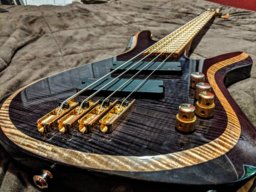
Scrolling through TB, and I see this threadsurrection after about 6 years. I had known of multiscale basses at that time, and even had a little GAS for a Combustion. Later in that same year Kiesel launches their first multiscale bass. I fell in love with the aesthetic and appointments and ordered one shortly thereafter. I was blown away. So much so that I ordered another multiscale from Kiesel a few years later, this time of the headless variety. It's fun to look at the Talkbass time capsule of posts, photos, and gear trends on here. I'm glad I discovered multiscale and took a chance. I play them almost exclusively now.
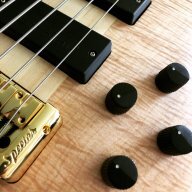
PXL_20210323_193419864.MP~2.jpg


PXL_20210323_193226197.MP.jpg
 
Bass players are a conservative lot. Just look at the trouble Fender has trying to bring anything bar a Precision or a Jazz to market! And the push back on, "Do I need a 5 string bass" threads, even after 40+ years.

The lack of interest in fanned frets from the majority of bass players is why there are very few models around.
 
  • Like
Reactions: Snert