• TalkBass has been independent since 1998. Add your voice.
    Create a free account to reply to discussions, view embedded media, and browse with fewer display ads.
    Join freeLog in
    Want zero display ads or expanded classifieds tools? Compare plans.

Winter Build Off 2020 - Malefactor 5

Ebony is plenty stiff on its own....
Yes I know. I was more concerned about movement over time but my five string hasn't had any issue since completion in 2013. The five bass strings have enough oooomph to put relief in it though and I think I need to tweak the truss rod a bit. I haven't touched the set-up since it was finished.
 

Attachments

  • IMG_6094.JPG
    IMG_6094.JPG
    664.3 KB · Views: 131
  • IMG_6095.JPG
    IMG_6095.JPG
    741.5 KB · Views: 140
  • Like
Reactions: Beej and Reedt2000
@ctmullins that made me laugh out loud, but also feel sad for your predicament. :D :(

A lot of people build and restore sailboats around here so I'm pretty blessed with a local selection of a wide range of exotic and domestic woods. A few years ago, I built a neck with "tubi" aka "queen ebony", which is a jet black timber from the Solomon Islands. I bought enough to do two fingerboards and some neck stringers. I built a 7 string neck through, mostly Jatoba, with 1/4" tubi stringers and a tubi fretboard. That neck was hardly able to move. :D It had a two-way truss rod which took a colossal effort to turn and I always thought it would break. I won't touch that stuff any longer due to the sustainability implications (also primarily why I stick to domestics), but it was lovely stuff.

@Slidlow those ebony babies are really pretty and I'm sure don't move. :D A while back, I sort of got into using "crap" to build. It's a weird obsession, but I'm pursuing recycled materials, re-purposed and found items, etc. I've built a bunch of stuff out of found driftwood, an old dresser, coffee tables, etc. :D The centre neck stringer in this build is from a bedpost, the walnut sides from a coffee table, and the hard maple top is from a board that was being used as dunnage at a local wood supplier and he gave it to me for free. I commented to him because it was 4/4, 8.5" wide x 4' long and one end had some mild figuring... and he laughed and told me to make a guitar out of it. :D I'm also using all repurposed hardware, but I may use new knobs and a new straplock. Pickups and preamp are new too.

I've got a wild and crazy plan coming up that I've not yet prototyped, and I'm sure it will require some serious stiffening rods in order to even make it work. And it may not even work then... Some of the necks I've built have not survived, but in my defense, I pushed them to the edge in construction...and then some. :D
 
@Beej I've built using reclaimed bowling alley floor before. I usually hunt around for off cuts and stuff others bypass for instruments. The body for my newest six string is from a block of rengas that I will also get several fingerboards from to try. I have another body of ancient douglas fir that is rock hard. I'll get to that eventually.
Searching for reusable bits is a lot of fun.
 
I love the whole "reclaimed wood" movement personally. When we moved into our new house I did a few accent walls with reclaimed pallet wood -
Living Room (tv hangs centered on this wall too) -
Living Room After.jpg
My "Music Room" -
The Wall - Current.jpg
And our Master Bedroom (my wife's favorite wall) -
Bedroom Wall.jpg
I also built a bench and table for the back porch -
Pallet Bench.jpg
And my wife wanted a "mud room" area so I built a bench and a coat rack by the front door (we don't have a separate room, so this had to do) -
Coat Rack-Bench.jpg
Probably the most used spot in our house! :roflmao:
 
Used to be a time when we often got Mahogany and some Teak in pallets, not so much anymore..
Yeah, I used to regularly receive fiberglass fan blades at an old warehouse job, and they always came in crates made of white oak.o_O There were many quartersawn and highly figured pieces that made their way into furniture in my house... :D
 
I love the whole "reclaimed wood" movement personally. When we moved into our new house I did a few accent walls with reclaimed pallet wood -
Living Room (tv hangs centered on this wall too) -
View attachment 3678066
My "Music Room" -
View attachment 3678068
And our Master Bedroom (my wife's favorite wall) -
View attachment 3678065
I also built a bench and table for the back porch -
View attachment 3678075
And my wife wanted a "mud room" area so I built a bench and a coat rack by the front door (we don't have a separate room, so this had to do) -
View attachment 3678071
Probably the most used spot in our house! :roflmao:
Wow, you guys have it light and easy. My wife is into decorative concrete.
 
Used to be a time when we often got Mahogany and some Teak in pallets, not so much anymore..

I read a history of the modern violin/viola/cello/double bass bow, which is made of pernambuco. The creator/it's designer/luthier had experimented with many bow shapes and woods looking for the optimal bow material and design. He finally landed on the current design we all recognize made of pernambuco. He found access to hundreds of discarded pallets made of pernambuco that he bought for very little and went through every single piece setting the choice planks aside for his bows. Needless to say - everyone since then agreed with his design and the wood it was made of. More recently it has become an endangered/restricted wood variety because of its use to make bows. Yo Yo Ma is quoted as saying 80% of a stringed instruments sound comes from the bow! Because of the shortage/ban, a group of concerned players formed an alliance many years ago to plant pernambuco trees specifically for future bow-making.
 
Since I'm getting closer to mounting the top, I gave the interior chambers a slather of the same finish that will be on the sides and rear of the body.

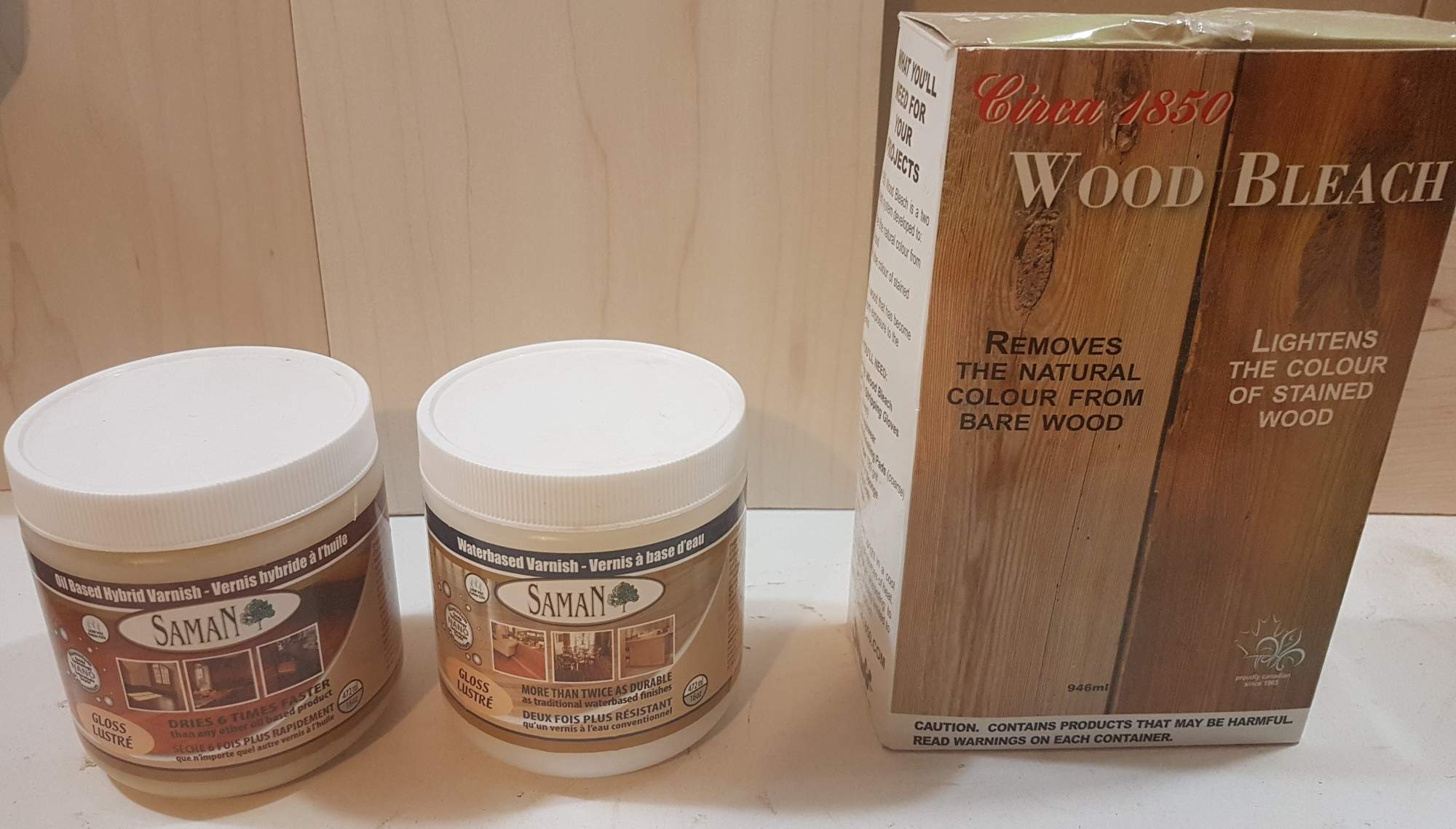
These are the finishes I'll be using on this build.
The test pieces I've done have been good so far. I'm using Saman Oil Based Hybrid Varnish on the walnut back and sides, plus the neck (minus the fretboard and headstock face). You can see what it looks like on the un-grain-filled walnut inside the chambers above. I think it sufficiently pops the grain as it lends a touch of ambering.

The Saman Waterbased Varnish is water clear and dries quite hard. I'm using it on the plain maple top and headstock face. The top (and headstock face) has been lightened using the Circa 1850 Wood Bleach, which is neutralized with white vinegar after the lightening process. I was shooting for holly white, and my test items are waving in that direction, although grain lines don't entirely disappear from the maple.

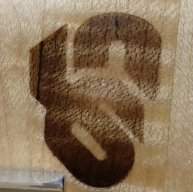
Lastly, as I get further on the neck, I couldn't resist a mockup of the burnt walnut fretboard over the neck. :D
 
I don't know if I can remember seeing someone use wood bleach on an instrument before in here. Now I'm interested to learn more.

I'm interested to see more with that wood bleach. I want to explore more color options on future instruments.

I think we need more pics of this bleached maple! I've thought about using Holly on an instrument but it's so expensive and hard to find big pieces. I never would have thought to just bleach maple.
I've used it lots in the past in order to help match a replacement piece in an existing piece of furniture during repair, but this is my first use as a "colourant" in a new build. :D This all started when I decided I wanted a white bass. The idea started with paint, then morphed to a translucent white, then to a white dyed wood finish, and then the test of the bleach solidified the plan. :)

Google oxalic acid and it's use in lutherie.
Bingo. :thumbsup:

Here is one of my test pieces. From right to left on this piece are: no bleach, 1x application, 2x application, 3x application. I landed on 4x on my next piece. There was no real difference between 4 and 5 coats.
It's sensitive to sanding (bleaching is only probably 0.5mm deep), and seriously raises the grain, so the process was: sand up to 320, starting to grain raise with water between sandings at 220. I raised the grain and sanded back 4x before applying the bleach, and it still raised it a tiny bit more. I don't think I'd do this on poplar. :smug: Bleach gets applied 4x fully drying between each application, so it takes a couple of days to do this. Then two applications of white vinegar to neutralize and voila.

I'm also planning to darken my walnut pickup covers with a ferric acetate solution (iron filings dissolved in white vinegar) but I'll get into that when I get there. :D
 
  • Like
Reactions: Dadagoboi
You can also use Potassium Permanganate to darken wood. Again google its use related to lutherie. If you go too dark with it the oxalic acid will counteract and vice versa. If you have uneven coloration across a board you may even be able to use one or both to even it out.
P.S. you can also use some steel wool to dissolve into vinegar to make ferric acetate.
 
Last edited:
  • Like
Reactions: Beej and wraub