Let's set up your reference marks by actual pitch rather than by mathematics, starting with no visual references whatsoever. Get out the pencil and bottle of Wite-Out or whatever nonpermanent marking technology you prefer.
First, let's assume a 30-inch scale. Move the bridge so that the nut-to-bridge distance on the A-string is 30 inches. If that's too close to the string holes, I guess you don't really have a 30-inch scale, but pick a length anyway. Now put the bass in open-string tune (EADG, I'm assuming) using a tuner. Let's work on one of the inner strings, say, the A. Locate the octave by playing a harmonic note and confirming by 'fretting' at position XII. Mark that spot on the fingerboard edge with your pencil.
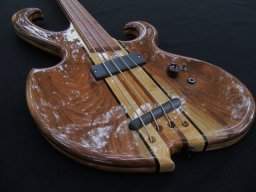
Using this point on the fingerboard as our true octave reference, now we work on the bridge angle. Your picture looks like the bridge is perfectly perpendicular to the strings right now. In reality, since the bass E is thicker than the top G, most likely you need to turn the bridge so that the E is a little longer and the G is a little shorter. Put a pencil mark on the top of the bass under where the A string is right now (locking down our reference point), then rotate the bridge to scoot the G end maybe 1/4" closer to the nut, keeping the A the same length.
Re-check the A with the tuner. It _shouldn't_ have drifted much, but check to be sure. Now using the octave pencil mark as a guide, check the G string at this XII mark using your tuner. See if it's playing the octave G sharp or flat, and move the G end of the bridge northward or southward to get the octave-G dead-on as well. If the A and G are both good, odds are D and E are as well.
Now that you've got the intonation pretty close, use your tuner and the A string to find III, V, VII, and IX, and mark with the pencil.
Finally, use the Wite-Out to make your marks more visible, and play around with it for a week

. Once you're REALLY sure, you can make the marks more permanent, with Wishy-nails, or maybe by drilling little holes and filling them with contrasting wood putty, etc.
I set my Krappy Twig up this way, and it's working out pretty well. Let us know!