• TalkBass has been independent since 1998. Add your voice.
    Create a free account to reply to discussions, view embedded media, and browse with fewer display ads.
    Join freeLog in
    Want zero display ads or expanded classifieds tools? Compare plans.

Wood Matters Club!!!

I've never had the pleasure of owning a Ric but have played a few and can say from first hand experience that not only do the electronics on those monsters deliver a unique sound but the wood also plays a big part in the tone as do a host of other things. To claim wood really makes no big deal on the sound of a bass is like saying spices dont make any big deal in cooking.

Now, number or not - we'd like to see some Pics of the Rics!

Ya onion and garlic and parsley and salt all taste the same ... NOT!

Wood matters with Rickenbackers.

4004ci5-0044.jpg


Rimg1307.jpg


Rimg1283.jpg


4003s5-20.jpg
 
Ya onion and garlic and parsley and salt all taste the same ... NOT!

Wood matters with Rickenbackers.
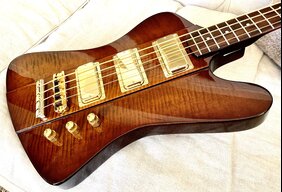
4004ci5-0044.jpg


Rimg1307.jpg


Rimg1283.jpg


4003s5-20.jpg

:eek: Wow - I didn't even know Rics came in Walnut (at least I guess that's what that is). And as for the Fireglow - the fretboard on that neck is a work of art. Is that Bubinga???


Hat's off to you and your Ric arsenal.
 
When I'm learning tunes at home I practice along with a CD. I like the tone of my bass to just stand out over the tone of the bass on the recording, so I turn the sub off. This way I can hear both basses, and I try to get as close as I can to the bass line on the recording.
So... When I changed the body on my P(arts)-bass from a (MIM) 2008 CAR to a 2010 LPB one, I noticed that I had to adjust the tone controls to get the same sound that I like, and I eventually had to turn down the treble and bass knobs on my SB-12 (to augment the mids) about 1/8 of a turn.
Both bodies are alder, both come from the same place. The body was absolutely the only thing I changed. I even had to re-install the strap buttons! The same pup is installed at the same height, the action and intonation is set up the same. I used the same strings and bridge, too.
So IME, wood matters, especially if your amp doesn't have tone controls. :D
p-bass4X6halfsize.jpg
Bluebodycroppedenhancedhalfsize.jpg


Same bass, different body (and tone)
 
Bluesbob - another excellent example of Wood Matters.
Of course there are those out there that will tell you - "you only heard a difference because you wanted to hear a difference" or "the body wood has no real impact on tone" or a host of other lame non-experiencial generalizations. The bottom line, in my experience and the prevailing industry position is that Wood Matters, sometimes a little - sometimes a lot depending on a lot of different factors.
I had a similar experience to yours when putting a new neck and body on a bass build that I did some time ago. And I suspect you were like me, in that you weren't expecting to hear a difference, and you would have preferred to not hear a difference since that would have been easier to deal with.
So much for the "you only hear a difference because you wanted to" camp and the "wood makes no significant impact on tone" camp.
Nice basses by the way! Thanks for the pics.
 
Bluesbob - another excellent example of Wood Matters.
Of course there are those out there that will tell you - "you only heard a difference because you wanted to hear a difference" or "the body wood has no real impact on tone" or a host of other lame non-experiencial generalizations. The bottom line, in my experience and the prevailing industry position is that Wood Matters, sometimes a little - sometimes a lot depending on a lot of different factors.
I had a similar experience to yours when putting a new neck and body on a bass build that I did some time ago. And I suspect you were like me, in that you weren't expecting to hear a difference, and you would have preferred to not hear a difference since that would have been easier to deal with.
So much for the "you only hear a difference because you wanted to" camp and the "wood makes no significant impact on tone" camp.
Nice basses by the way! Thanks for the pics.

+1.... I have yet to read any significant experience related rebuttle from those who are non believers
 
The easiest way to hear the wood tones is with acoustics. Wood matters.

wings2.front.jpg

wings2.rear.jpg

mmmmm..... look at all that acoustic goodness! Let me guess, you like the sound of Tacoma guitars, right? That's quite an impressive collection man! Just guessing but it looks like some might have rosewood backs and others have mahogany backs. I love the warm sound of a rosewood guitar on a mellow laid back song.

;)Wait a minute, let me correct that. Wood makes no difference, all your guitars sound exactly the same, and because they do you really don't need all those. You can give me the rosewood ones since the "wood makes no difference" trolls have scientifically proven beyond a shadow of a doubt that the only difference you hear is in your mind not the instrument. In fact, somewhere on this thread you can even find a guitar made of the same lumber as the wood deck your guitars are sitting on - and it sounds exactly like any other guitar. So really, come on man, get with reality - put some guitar strings on the deck handrail and throw a couple of your Tacomas may way. (sarc. off)

Thanks for the post, excellent collection and some really beautiful wood there. Ok, the deck looks nice too.:)
 
In addition to the back/body woods rosewood or mahogany, notice on the front pic there are front woods of spruce or cedar. Each wood and wood combination has a signature tone, which remains consistent and identifiable across model and size variations. Of course, I am preaching to the choir. :D

The weird thing: even in acoustic guitar circles, there are a few wood-deniers who insist that the signature tone of a guitar or model is based in design and build quality, and has nothing to do with the tonewood selection. It makes me wonder if some people are deaf to certain tone colors, similar to color blindness or tone deafness, but not so extreme. :hmm: :confused:
 
In addition to the back/body woods rosewood or mahogany, notice on the front pic there are front woods of spruce or cedar. Each wood and wood combination has a signature tone, which remains consistent and identifiable across model and size variations. Of course, I am preaching to the choir. :D

The weird thing: even in acoustic guitar circles, there are a few wood-deniers who insist that the signature tone of a guitar or model is based in design and build quality, and has nothing to do with the tonewood selection. It makes me wonder if some people are deaf to certain tone colors, similar to color blindness or tone deafness, but not so extreme. :hmm: :confused:


Randy, that could very well be the case. What a bummer it would be to go through life not being able to distinguish the different tones you can draw from different woods. To me woods are much like spices, they give the meal it's flavor, in some cases very subtle and in other cases they can even be overpowering. There are people out there that can't tase rosemary or salt in the mix so maybe there are people out there that can't hear a difference in woods. Unfortunate indeed.:(

Ummmm.... I see you slipped in some Wic pics also. If wood didn't matter we wouldn't have Warwicks! Love the sleek lines on that fretless.

Keep strummin, and let us know if the guitar strings on your deck hand rail sound anything like that mahogany/spruce bass you've got there, which I'm sure sounds just like your Warwick.:D
 
To carry on the cooking analogy, I don't look at wood as the spices. For me, the wood is the joint of meat. Electronics, strings etc etc. THERES your spice.

You start with a good quality joint of meat and then adjust the flavour with your spices.

In cooking, you can cover up a poor joint of meat by covering it with way too much spice, but it isn't EVER going to taste as well as a high quality joint, seasoned to perfection. High quality wood gives you the best platform from which to add your own flavours.

In my analogy, the luthier is the chef. All three come together to make or break the final product.

Do I think wood matters?

bass.jpg


The sound of wood ;)

I do think a weakness anywhere in the chain - wood, electronics, strings, luthierie - will cause significant compromise in the tone. I'm not terribly convinced on the significance of hardware, in my experience, I haven't been able to detect this.
 
To carry on the cooking analogy, I don't look at wood as the spices. For me, the wood is the joint of meat. Electronics, strings etc etc. THERES your spice.

You start with a good quality joint of meat and then adjust the flavour with your spices.

In cooking, you can cover up a poor joint of meat by covering it with way too much spice, but it isn't EVER going to taste as well as a high quality joint, seasoned to perfection. High quality wood gives you the best platform from which to add your own flavours.

In my analogy, the luthier is the chef. All three come together to make or break the final product.

Do I think wood matters?

bass.jpg


The sound of wood ;)

I do think a weakness anywhere in the chain - wood, electronics, strings, luthierie - will cause significant compromise in the tone. I'm not terribly convinced on the significance of hardware, in my experience, I haven't been able to detect this.

Far be it from me to disagree with a fellow Wood Matters bass player. I like your anology. By the way, this is quickly becoming a Warwick club. I wonder what the results would be if we held a pole and asked how many Warwick owners feel wood matters. I bet the numbers would be very high.
Nice Wic pic by the way!
 
Far be it from me to disagree with a fellow Wood Matters bass player. I like your anology. By the way, this is quickly becoming a Warwick club. I wonder what the results would be if we held a pole and asked how many Warwick owners feel wood matters. I bet the numbers would be very high.
Nice Wic pic by the way!

I think its because Warwicks are specifically built to really accentuate the sound of those beautiful woods. I don't doubt that some other luthiers out there build with the focus most heavily placed on the impact of the electronics. I think the impact of the wood will have less aural significance in these basses, but I don't think it'll be insignificant even in the most extreme example of this.

Different luthiers will approach the creation of their sounds in different ways I'm sure, but I find the idea of ignoring any of the factors to be laughable.