I'm an idiot and my audio tests are useless, and anyone who gets anything out of my tests is a moron. I get it.
Finally, you've seen the light.


TalkBass has been independent since 1998. Add your voice.
Create a free account to reply to discussions, view embedded media, and browse with fewer display ads.
Join free Log in
Want zero display ads or expanded classifieds tools? Compare plans.
I'm an idiot and my audio tests are useless, and anyone who gets anything out of my tests is a moron. I get it.
Great example. Nothing sounds like a 'wick.Wood definately matters

Great example. Nothing sounds like a 'wick.
I believe you are correct, sir.Didn't Warwick use "The Sound Of Wood" as their slogan?
Didn't Warwick use "The Sound Of Wood" as their slogan?

Didn't Warwick use "The Sound Of Wood" as their slogan?

Well I'm convinced. If it's in an advertising campaign it must be true.
Got him to buy two Warwicks. They sound like wood, afterall...
I don't think they'll want to talk to you, either.I'm sorry. I'll stop.
It's a nice day. I'm going out into my woods and listen to some nice ash and poplar.

kenfxj said:Well I'm convinced. If it's in an advertising campaign it must be true.
Got him to buy two Warwicks. They sound like wood, afterall...

Right, because the ash and bubinga corvettes sound SO similar
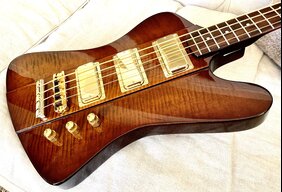
I've never experienced it in a guitar, but in a snare drum I owned it offered a really nicely rounded attack and girthy sound. Very cool.Hey fellow Wood Matters club members, I'm thinking about doing a bit of a change up on the tone of one of my basses.
Do any of you have any experience with Bubinga as a neck wood?
I've always liked the look and feel of it but have never seen or played a neck made out of it. My Warwick with a Wenge/Wenge neck and Bubinga body sounds very unique and growly. But this neck will go on an ultralight swampash body.
Also, is it exceptionally heavier than a maple neck would be thus creating potential for neck dive?
Any thoughts or experience with this would be helpful.
A very strong stiff wood used primarily for bass necks and in laminations. Used by Rickenbacker for fretboards and Warwick for bodies. As a bass neck, it provides bright midrange and a thick well defined bottom. Bodies made form Bubinga will be very heavy but will sustain for days.
Great example. Nothing sounds like a 'wick.
Sounds like you're in a great place. Enjoy anything you can!I've got a dangerous combination of spare time, full wallet and lots of gas. God help me....

Do any of you have any experience with Bubinga as a neck wood?
I've always liked the look and feel of it but have never seen or played a neck made out of it. My Warwick with a Wenge/Wenge neck and Bubinga body sounds very unique and growly. But this neck will go on an ultralight swampash body.
Also, is it exceptionally heavier than a maple neck would be thus creating potential for neck dive?
Any thoughts or experience with this would be helpful.
Hey fellow Wood Matters club members, I'm thinking about doing a bit of a change up on the tone of one of my basses.
Do any of you have any experience with Bubinga as a neck wood?
I've always liked the look and feel of it but have never seen or played a neck made out of it. My Warwick with a Wenge/Wenge neck and Bubinga body sounds very unique and growly. But this neck will go on an ultralight swampash body.
Also, is it exceptionally heavier than a maple neck would be thus creating potential for neck dive?
Any thoughts or experience with this would be helpful.