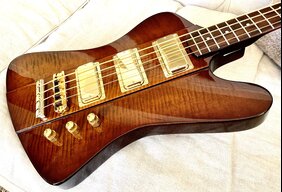
I'm a firm believer in the Wood Making a Difference in how the bass sounds, looks, feels and plays. Although I'm not a luthier by any stretch I've built a number of basses for myself and friends. In my quest for the perfect bass I did several years of R&D at a substantial investment in money and time.
The first thing I did was find a good playing "mule" that I could carve up and modify as many times as needed to find my favorite pickup and preamp combination. The "mule" was a brand new musicman SUB5 bass. I locked in on pickup styles that I liked best - jazz, pbass and stingray then bought several different brands of each (Bartolini, SD, Delano) and tried various combinations of them installed in the SUB5 Mule with Bartolini, Aguilar, Audere and East preamps. It took about 6 months of nightly testing to work through all the different combos that I was interested in. When I found the combo I liked best (Bartolini Pbass reversed at neck, Bartolini Stingray at bridge position and John East Vol/Pan, Tone, Tone preamp) I locked in those variables and then focused on high mass vs low mass bridges. Quickly settled on the low mass hipshot as the best one for my needs. Then I tested several different brands of each key type of strings - Round Wound, Flat Wound and Tape Wound to see what worked best on this bass. DR Black Beauties came out on top for what I was looking for. By this time about 9 months had transpired and I decided to stick with the Mule in this configuration for another 3 months to see if my tastes would change and to get a really good feel for what if anything else would need to be revised to perfect the build. Three months went by and all was still good so I decided to take my learnings to a final build.
This is when I found out first hand just how much difference wood can make in every aspect of a bass. Lacking some of the finer woodworking tools and experience I decided to go the Warmoth route and spec a body and neck. Some of my top end basses have mahogany bodies and my favorate fb material is rosewood. So I selected a solid one piece mahogany jazz bass 5 body and a solid rosewood neck. When the body came in I routed it for the pickup and preamp combo I settled on with the Mule. Got it all put together using the pickups, preamp, strings and bridge from the Mule and was shocked at how it sounded. Tons more punch, more sustain, much much deeper lows but not as much clarity on the top end. Keep in mind that I set up both basses so string height and distance between pickups and strings and all electronics were virtually identical. The only significant difference between the two basses was the wood. The mule had a basswood body, maple neck and rosewood fb - the second bass had a mahogany body, rosewood neck and rosewood fb. (note: I suspect there were also some differences in truss rods and stiffening rods of each neck so there could have been some impact from that as well).
Anyway, I liked the sound and feel of the new bass better but wanted to get the top end back. I had the neck refretted with brass frets and a brass nut vs the nickel and tusq ones originally installed and - bam- that was it. The bass absolutely destroyed every thing else I own, and I have some top end stuff.
Just to see how much difference other woods make I purchased a swampash body and a maple/maple neck and reinstalled all the electronics, hardware and strings from my mahogany/rosewood bass to this third one. Again, same experience - a completely different sound and feel. This body and neck seemed to be much more lively but the tone was also much more midrange focused with entirely too much zing on the top end. It completely lost it's deep dub low end and picked up some mid range growl and top end snap. Not what I was looking for so everything went back into the mahogany/rosewood bass and there it stays to this day.
Was this a scientific test - nope! Purely aneqdotal. Did it reinforce to me the prevailing opinion in the bass building community that wood does impact tone - yep, without a doubt.