• TalkBass has been independent since 1998. Add your voice.
    Create a free account to reply to discussions, view embedded media, and browse with fewer display ads.
    Join freeLog in
    Want zero display ads or expanded classifieds tools? Compare plans.

Double Bass Yamaha SLB300 New model

In my experience, intonation varies from instrument to instrument.

Yes, agreed.
I used to be quite good at switching between acoustic basses and adapting quickly. My classical teacher had a bass I would use for classical lessons; my music school had a couple basses and I would use those for jazz lessons, and I would practice and gig on my own bass.
I don’t know how I will go now, and how rusty I will be at switching.
 
  • Like
Reactions: Wasnex
Depends on the individual. Switching from bass to bass was never an issue for myself. As Don scientifically pointed out, we’re looking at a couple millimeters of difference if there is an extreme 1” difference in string length at half position and less than a millimeter further up. I’m not that good that I can do a long string jump and be dead nuts 0mm off constantly. I need to adjust here and there anyhow. After that, muscle memory takes over before the next micro adjustment. I think most of us learned the same thing in school.

One of the things that I learned from Lorraine Campet’s videos playing various basses at a store is (aside from the fact that’s she’s extremely talented) is a reminder of the basic principle of adjustment-muscle memory-adjustment. Adjustments are just a part of life no matter how good you are. Don’t make a basic principle more complex than it really is.

As I said before, it was an issue for me with EUB’s with no bouts. And bouts for myself need to be realistic both relative to the height and depth. It’s an important reference point but it can vary and will vary between basses. After that point it’s no different than switching between real basses where bouts vary anyhow.
 
Last edited:
  • Like
Reactions: Wasnex
Apologies to you experienced upright players, as i'm an electric bassist working to become proficient on an SLB300. Hopefully this post will resonate with others like me. . .

I love the SLB300 (with a few exceptions. . . like the batteries) but the one serious omission is a lack of any way to support the lower left of the instrument, as one would with a traditional DB using your left knee (i find the Yamaha accessory woefully inadequate). Some may say it's just poor technique on my part, but IMO anything that causes me to use my left hand to keep the instrument stable (or prevent it from twisting on the endpin) hampers playing.

so. . . .I'm now patenting an attachment that i call the "Freedom Mount". it inserts into a standard cymbal tripod, is both height and angle adjustable, and supports the bass solidly while being played or on break. You just walk up to the EUB and play (or walk away) and the EUB remains solidly in place at your selected playing angle. It has a small footprint (unlike the large storage-only stands currently available), and easy to pack for transport. It's designed to work with most EUBs that have an endpin, but i'm starting with the one i own, an SLB300.

anyone else out there see this need? especially if you're a singer or you double on other instruments, it's freeing (hence the name) to not have to worry about supporting a large instrument. I'm looking to produce a few prototypes--any beta testers out there?

thanks for any feedback.
 
Apologies to you experienced upright players, as i'm an electric bassist working to become proficient on an SLB300. Hopefully this post will resonate with others like me. . .

I love the SLB300 (with a few exceptions. . . like the batteries) but the one serious omission is a lack of any way to support the lower left of the instrument, as one would with a traditional DB using your left knee (i find the Yamaha accessory woefully inadequate). Some may say it's just poor technique on my part, but IMO anything that causes me to use my left hand to keep the instrument stable (or prevent it from twisting on the endpin) hampers playing.

so. . . .I'm now patenting an attachment that i call the "Freedom Mount". it inserts into a standard cymbal tripod, is both height and angle adjustable, and supports the bass solidly while being played or on break. You just walk up to the EUB and play (or walk away) and the EUB remains solidly in place at your selected playing angle. It has a small footprint (unlike the large storage-only stands currently available), and easy to pack for transport. It's designed to work with most EUBs that have an endpin, but i'm starting with the one i own, an SLB300.

anyone else out there see this need? especially if you're a singer or you double on other instruments, it's freeing (hence the name) to not have to worry about supporting a large instrument. I'm looking to produce a few prototypes--any beta testers out there?

thanks for any feedback.
I would like to test it with my 300.
 
Apologies to you experienced upright players, as i'm an electric bassist working to become proficient on an SLB300. Hopefully this post will resonate with others like me. . .

I love the SLB300 (with a few exceptions. . . like the batteries) but the one serious omission is a lack of any way to support the lower left of the instrument, as one would with a traditional DB using your left knee (i find the Yamaha accessory woefully inadequate). Some may say it's just poor technique on my part, but IMO anything that causes me to use my left hand to keep the instrument stable (or prevent it from twisting on the endpin) hampers playing.

so. . . .I'm now patenting an attachment that i call the "Freedom Mount". it inserts into a standard cymbal tripod, is both height and angle adjustable, and supports the bass solidly while being played or on break. You just walk up to the EUB and play (or walk away) and the EUB remains solidly in place at your selected playing angle. It has a small footprint (unlike the large storage-only stands currently available), and easy to pack for transport. It's designed to work with most EUBs that have an endpin, but i'm starting with the one i own, an SLB300.

anyone else out there see this need? especially if you're a singer or you double on other instruments, it's freeing (hence the name) to not have to worry about supporting a large instrument. I'm looking to produce a few prototypes--any beta testers out there?

thanks for any feedback.

I used to play an NS Design EUB. It had a tripod stand.
upload_2023-5-10_14-4-1.jpeg

It's a bit tricky to get the angle of the neck just right. Also many upright players do a little dance with the instrument while playing up and down the neck. The dance causes the bass to move around and the playing angle to change....the optimal angle for the neck varies depending on how high you play...so the dance facilitates the desired adjustment. Obviously this is not possible with a tripod. However, I do think a tripod would be appreciated by some SLB300 users.
 
  • Like
Reactions: mikeGJ and Hasty
Apologies to you experienced upright players, as i'm an electric bassist working to become proficient on an SLB300. Hopefully this post will resonate with others like me. . .

I love the SLB300 (with a few exceptions. . . like the batteries) but the one serious omission is a lack of any way to support the lower left of the instrument, as one would with a traditional DB using your left knee (i find the Yamaha accessory woefully inadequate). Some may say it's just poor technique on my part, but IMO anything that causes me to use my left hand to keep the instrument stable (or prevent it from twisting on the endpin) hampers playing.

so. . . .I'm now patenting an attachment that i call the "Freedom Mount". it inserts into a standard cymbal tripod, is both height and angle adjustable, and supports the bass solidly while being played or on break. You just walk up to the EUB and play (or walk away) and the EUB remains solidly in place at your selected playing angle. It has a small footprint (unlike the large storage-only stands currently available), and easy to pack for transport. It's designed to work with most EUBs that have an endpin, but i'm starting with the one i own, an SLB300.

anyone else out there see this need? especially if you're a singer or you double on other instruments, it's freeing (hence the name) to not have to worry about supporting a large instrument. I'm looking to produce a few prototypes--any beta testers out there?

thanks for any feedback.
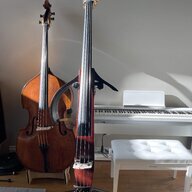

There are a few EUBs that have something like this. NS designs comes to mind and a couple of others that I can’t recall at the moment. However they might be proprietary to their particular models.

Be interesting to see what you come up with.
 
  • Like
Reactions: Wasnex
anyone else out there see this need?
As noted, the NS EUB works this way.

The problem is that DB players reposition the bass when playing on the upper ranges. You can't do that when the 300 is basically locked into place.

You can remove the fake shoulders on the 300, that might remove some of the need to reposition the instrument. But keep in mind that most DB players will see this as a bug rather than a feature.

You might be better off designing a larger/better knee pad for the 300.
 
I used to play an NS Design EUB. It had a tripod stand.
View attachment 5058430
It's a bit tricky to get the angle of the neck just right. Also many upright players do a little dance with the instrument while playing up and down the neck. The dance causes the bass to move around and the playing angle to change....the optimal angle for the neck varies depending on how high you play...so the dance facilitates the desired adjustment. Obviously this is not possible with a tripod. However, I do think a tripod would be appreciated by some SLB300 users.
 
thanks for the comments on the SlB300 mount. a few points:
-- i used to own an NS Designs EUB, so i understand how that stand works--nice stand, but proprietary, and the bass does not have the DB feel of the Yamaha, IMHO. i wanted to design something a bit more universal and could find nothing commercially available.
- re: movement of the bass, one of the big surprises in months of testing was the amount of both downward and side-to-side force a 15 pound instrument can place upon the mount. and because the point of contact is the endpin at the bottom, some movement at the "player end" is inevitable ( and desireable, as some comments have indicated). The trick is to come up with a mount design and material thats stiff enough to allow player adjustments while still giving you the confidence that the instrument is solidly supported when youre not holding it.
- re: adjustment, the built in adjuster will adjust in 5 degree increments. so far, that combined with the height adjustment from the tripod, appears to accommodate most possible playing positions, including sitting. (and btw, i'm using a heavy duty cymbal tripod--smaller footprint than the NS stand and extremely solid.)

net, i agree with your points, and when a prototype is available i will test for your concerns ( and hopefully have better players from Talkbass test as well).
 
  • Like
Reactions: Wasnex
I play an SLB 300, and find it more difficult to play standing compared to my traditional DB. I've wondered if a stand that employed a "ball and socket" head, like a camera tripod head, would be helpful. The advantage would be that the resistance to movement could be adjustable - you can tighten a camera ball head to be completely locked, or have it slightly looser to enable panning the camera. No idea at all how this could be implemented. Just my thought.
 
I've used Laborie's on my bass for decades since college which for me made my bass way more stable, balanced and has no tendency to pivot. We could create a whole thread about why a rod coming out of the endpin makes no sense to do outside of conforming to what was later incorporated into a cello's design, and a cello is played sitting down. I digress.

Anyhow when I got my SLB, I made an angled endpin rod. It again solved the problem for me.

IMG_9347.jpg
 
I play an SLB 300, and find it more difficult to play standing compared to my traditional DB. I've wondered if a stand that employed a "ball and socket" head, like a camera tripod head, would be helpful. The advantage would be that the resistance to movement could be adjustable - you can tighten a camera ball head to be completely locked, or have it slightly looser to enable panning the camera. No idea at all how this could be implemented. Just my thought.
interesting thought, though based on my testing the suprising amount of force applied by such a long instrument--it essentially acts as a lever--broke the holding power of any angle adjustment device that did not have teeth. so if your use case is to also have it supported while not holding it, a very strong ball and socket device would be needed. perhaps one exists, i just found it a challenge to find any adjuster small (and affordable) enough.
 
I've used Laborie's on my bass for decades since college which for me made my bass way more stable, balanced and has no tendency to pivot. We could create a whole thread about why a rod coming out of the endpin makes no sense to do outside of conforming to what was later incorporated into a cello's design, and a cello is played sitting down. I digress.

Anyhow when I got my SLB, I made an angled endpin rod. It again solved the problem for me.

View attachment 5060346
is this the Yamaha stand, and do you play the bass while on this stand?
 
A small footprint combined with a high center of gravity would concern me if I left the instrument unattended.
I've got the K&M version for my SLB200 and I've been pleased with its performance. It's not as rock solid as your stand, but it seems like these SLB's don't lend themselves to the "resting" type stands. Anytime I angle mine on a rest of any sort it tries to roll along its X-Axis.
 
Dear all,
I love my Yamaha SLB 300. For travel purposes I recently had a custom flight case made for it by a master builder/ guitar tech here in Los Angeles. If anyone else is interested in one, please send me a message and I will give you all the info.

-Chris
 

Attachments

  • IMG_1740.png
    IMG_1740.png
    14.1 MB · Views: 87
  • IMG_1739.jpeg
    IMG_1739.jpeg
    449.9 KB · Views: 85
  • IMG_1738.png
    IMG_1738.png
    12.2 MB · Views: 87
  • IMG_1737.png
    IMG_1737.png
    11.2 MB · Views: 90
What strings are y’all using on your Silent Basses? Has anyone experimented with Evahs?

I recently tried a really dead set (think like 4 years old with a hundred on-offs) of Evah Weich on my Yamaha SLB300. Huge upgrade in sound and feel on this bass from the Perpetuals I started out with (didn’t have the stock helicore light strings on long enough to get an impression, other than they felt very similar to the perps.) The perps started out VERY bright and were honky in the transition area at first. They seemed to have a lot of clankiness and unpleasant finger noise. This got better as they broke in and the bass sounded good, but there was some inherit thinness/hollowness/clank to the sound, particularly in thumb position. I tried the stark D+G too and that didn’t help.

I think the darker, thicker nature of the Evahs really brings out something good on the bass and provides a good fundamental along with some pleasant sustain and good pitch definition. They don’t feel too tight on my bass, either. About the same as the perps with the Stark D+G tension-wise. I’ve been impressed enough to order a new set, and I’m excited to break them in from the beginning on this bass.

Does changing strings impact the digital emulated sound, or just the piezo?