
Enjoy the benefits of a premium membership!
Upgrade Account
-
TalkBass has been independent since 1998. Add your voice.
Create a free account to reply to discussions, view embedded media, and browse with fewer display ads.
Join free Log in
Want zero display ads or expanded classifieds tools? Compare plans.
You are using an out of date browser. It may not display this or other websites correctly.
You should upgrade or use an alternative browser.
You should upgrade or use an alternative browser.
Zoom Owners' Club!
- Thread starter champbassist
- Start date
More options
Who Replied?
Hopefully I'm not the only one that picked up a GCE-3 on the special last month but it has slid in quite nicely into my recording setup for recording bass, piccolo basses, electric and acoustic guitars. If I can figure out how to use it for reamping already recorded direct tracks I'll be thrilled.
@andruca, when you gave the b1xon a g1xon effects transfusion, what happened to the graphic EQ? Do you now have two different graphic EQs to choose from, or did the transfusion replace the bass version’s frequency centers with different guitar frequency centers?
@andruca, when you gave the b1xon a g1xon effects transfusion, what happened to the graphic EQ? Do you now have two different graphic EQs to choose from, or did the transfusion replace the bass version’s frequency centers with different guitar frequency centers?
I used andruca's firmware to do this "transfusion" and I have two effects on my B1Xon - a Graphic EQ and a Bass Graphic EQ.

I currently own 3 Zoom multi effect, plus a handheld recorder, which respectively are a G1Xon, a MS-70CDR and a G1 Four, the handheld recorder being the H4n.
And I use all 3 effects in my current bass pedal effects setup, the MS-70CDR exclusively used for it's Boss CE-1 chorus emulation, the "Vintage CE" model (which in my opinion actually is a truly great emulation, only surpassed by the real original analog unit as far as chorus effects goes), the G1Xon partially used as my always on subtle plate reverb, and partially as part of my EQ based custom faux cab sim (consisting of some very specific EQ'ing, using 4 of the bass parametric equalizer model on the G1Xon (obviously using hacked firmware to make that possible) and 5 of the more detailed and specific, but with less boost/cut available (+/-12dB vs. +/-20dB), parametric equalizer model on the G1 Four), and the G1 Four which works exclusively as an extension of my EQ based faux cab sim.
But I plan to buy an additional MS-70CDR, exclusively with the purpose of functioning as part of my EQ based faux cab sim together with the G1 Four, to free up the G1Xon for use exclusively for different reverb effects, with different reverb patches of various density and intensity that I can switch between, including an extremely dense reverb functioning as a reverb pad effect used with volume swells with the build in expression pedal of the G1Xon (already created those reverb patches and am very satisfied with the result, but currently can't use them as long as part of my EQ based faux cab sim takes up 4 of the max 5 effect slots available).
You might ask why I am not just getting something like the Mooer Radar IR cab simulator, that also features a fully customizable parametric EQ, to replace the 2 Zoom multi effects that functions as my EQ based custom faux cab sim, but the thing is I have grown very accustomed to how my faux "homemade" custom cab sim sounds, which a lot of work went into creating before I finally managed to get it to sound exactly like I wanted it to, though some intense session of trial and error, dialing while carefully listening and then re-adjusting accordingly, and I am afraid that I wouldn't be able to recreate the exact same tone with the Radar, or at least get a tone I would be as satisfied with, since this is rather specifically shaped to match my personal preferences exactly spot on (as with the Mooer Radar I would have to rely on the fixed EQ curve of whatever cab IR I load and then only would have 4 (as far as I recall) parametric EQ bands to specifically customize it to my preferences (+ poweramp/mic combinations as long as I only use the stock cab IRs and not 3rd party ones (as far as I understood it)).
The point with the faux cab sim being able to get as close as possible to having the exact same tone, and shaped exactly like I want it to sound, regardless of weather I practice at home through a mixer and my studio headphones, record my bass directly through my setup, at band rehearsals through a poweramp and my approximately full frequency cab, or live through the PA.
And I use all 3 effects in my current bass pedal effects setup, the MS-70CDR exclusively used for it's Boss CE-1 chorus emulation, the "Vintage CE" model (which in my opinion actually is a truly great emulation, only surpassed by the real original analog unit as far as chorus effects goes), the G1Xon partially used as my always on subtle plate reverb, and partially as part of my EQ based custom faux cab sim (consisting of some very specific EQ'ing, using 4 of the bass parametric equalizer model on the G1Xon (obviously using hacked firmware to make that possible) and 5 of the more detailed and specific, but with less boost/cut available (+/-12dB vs. +/-20dB), parametric equalizer model on the G1 Four), and the G1 Four which works exclusively as an extension of my EQ based faux cab sim.
But I plan to buy an additional MS-70CDR, exclusively with the purpose of functioning as part of my EQ based faux cab sim together with the G1 Four, to free up the G1Xon for use exclusively for different reverb effects, with different reverb patches of various density and intensity that I can switch between, including an extremely dense reverb functioning as a reverb pad effect used with volume swells with the build in expression pedal of the G1Xon (already created those reverb patches and am very satisfied with the result, but currently can't use them as long as part of my EQ based faux cab sim takes up 4 of the max 5 effect slots available).
You might ask why I am not just getting something like the Mooer Radar IR cab simulator, that also features a fully customizable parametric EQ, to replace the 2 Zoom multi effects that functions as my EQ based custom faux cab sim, but the thing is I have grown very accustomed to how my faux "homemade" custom cab sim sounds, which a lot of work went into creating before I finally managed to get it to sound exactly like I wanted it to, though some intense session of trial and error, dialing while carefully listening and then re-adjusting accordingly, and I am afraid that I wouldn't be able to recreate the exact same tone with the Radar, or at least get a tone I would be as satisfied with, since this is rather specifically shaped to match my personal preferences exactly spot on (as with the Mooer Radar I would have to rely on the fixed EQ curve of whatever cab IR I load and then only would have 4 (as far as I recall) parametric EQ bands to specifically customize it to my preferences (+ poweramp/mic combinations as long as I only use the stock cab IRs and not 3rd party ones (as far as I understood it)).
The point with the faux cab sim being able to get as close as possible to having the exact same tone, and shaped exactly like I want it to sound, regardless of weather I practice at home through a mixer and my studio headphones, record my bass directly through my setup, at band rehearsals through a poweramp and my approximately full frequency cab, or live through the PA.
Last edited:
@andruca, when you gave the b1xon a g1xon effects transfusion, what happened to the graphic EQ? Do you now have two different graphic EQs to choose from, or did the transfusion replace the bass version’s frequency centers with different guitar frequency centers?
As @champlainbass said, I have both (bands aren't the same AFAIR). Still I prefer the 2-band ParaEQ/BassPEQ versions, have hardly ever used the graphics. Check this page I have with all relevant info about firmware fiddling and some firmwares to download (based on the latest from Zoom). In my case I have a G1Xon that I've loaded B1on/Xon effects into. But there's "hybrid" firmwares for models B1on/Xon, G1on/Xon, MS-50G and MS-60B. http://andresdemarco.info/ZOOMFIRMWARE
Thanks, guys.
I am thinking about the MS50G or MS60B, but I’m that weird guy who wants to use the Zoom as my entire front end, feeding a power amp, as I currently do with a Zoom B2. Based on Zoom’s published specs, the B1xon/G1xon would not have sufficient output to drive my power amp directly at +2 dBm. The B2 and MS series can both put out +5 dBm, and that is just enough to hit my power amp’s DDT nearing the Zoom’s full ouput.
Anyway, since I also play guitar and lap steel, I was asking about the EQ because I would like to retain the bass-friendly EQ centers on the graphic. I would probably also want to use the Plexi Marshall amp model, and it looks like they left the Marshall Super Bass out of the bass amp list on the MS60B.
So I guess whichever Multi Stomp version I choose, I would want to grab some FX from the other version to augment it.
I am thinking about the MS50G or MS60B, but I’m that weird guy who wants to use the Zoom as my entire front end, feeding a power amp, as I currently do with a Zoom B2. Based on Zoom’s published specs, the B1xon/G1xon would not have sufficient output to drive my power amp directly at +2 dBm. The B2 and MS series can both put out +5 dBm, and that is just enough to hit my power amp’s DDT nearing the Zoom’s full ouput.
Anyway, since I also play guitar and lap steel, I was asking about the EQ because I would like to retain the bass-friendly EQ centers on the graphic. I would probably also want to use the Plexi Marshall amp model, and it looks like they left the Marshall Super Bass out of the bass amp list on the MS60B.
So I guess whichever Multi Stomp version I choose, I would want to grab some FX from the other version to augment it.
I had the same concern and used a TC Spark mini to provide enough clean boost to drive a power amp from my G1x and it rocked.Thanks, guys.
I am thinking about the MS50G or MS60B, but I’m that weird guy who wants to use the Zoom as my entire front end, feeding a power amp, as I currently do with a Zoom B2. Based on Zoom’s published specs, the B1xon/G1xon would not have sufficient output to drive my power amp directly at +2 dBm. The B2 and MS series can both put out +5 dBm, and that is just enough to hit my power amp’s DDT nearing the Zoom’s full ouput.
Anyway, since I also play guitar and lap steel, I was asking about the EQ because I would like to retain the bass-friendly EQ centers on the graphic. I would probably also want to use the Plexi Marshall amp model, and it looks like they left the Marshall Super Bass out of the bass amp list on the MS60B.
So I guess whichever Multi Stomp version I choose, I would want to grab some FX from the other version to augment it.
I had the same concern and used a TC Spark mini to provide enough clean boost to drive a power amp from my G1x and it rocked.
Cool...how much of the tone shaping was done in the Zoom? Did you have other pedals upstream helping it out?
I have managed to get a amp-like warm clean tone for guitar and lap steel (with or without Zoom’s “spring reverb” and tremolo), and a Marshally crunch sound, and three or four different distortion sounds that work better for single-string parts. A couple of them sound pretty garage. Kind of Black Keys. I am pleased that a 15-year-old entry-level modeler is capable of that.
For bass I only use one sound, but it’s all from the Zoom and uses a little compression, the Marshall Super Bass sound at low gain, noise reduction and a little graphic EQ. I dig being able to shape the whole tone for several hours on a handful of AA batteries and only have to plug in the power amp.
I haven’t experimented much with having the Zoom share duties with additional pedals, but am curious about it...
@mexicanyella A pitchshifter fed to a pair of dirt pedals and then the G1X to the Spark mini to a powered cab that needed a line in. Worked great. It was my octave up side in a power trio.
Thanks, guys.
I am thinking about the MS50G or MS60B, but I’m that weird guy who wants to use the Zoom as my entire front end, feeding a power amp, as I currently do with a Zoom B2. Based on Zoom’s published specs, the B1xon/G1xon would not have sufficient output to drive my power amp directly at +2 dBm. The B2 and MS series can both put out +5 dBm, and that is just enough to hit my power amp’s DDT nearing the Zoom’s full ouput.
Anyway, since I also play guitar and lap steel, I was asking about the EQ because I would like to retain the bass-friendly EQ centers on the graphic. I would probably also want to use the Plexi Marshall amp model, and it looks like they left the Marshall Super Bass out of the bass amp list on the MS60B.
So I guess whichever Multi Stomp version I choose, I would want to grab some FX from the other version to augment it.
AFAIK the Super Bass is a guitar amp. IDK why the MS-50G firmware comes half empty (takes about 2/3rds of memory space compared to the MS-60B's latest firmware, which takes almost all memory). I have both "augmented" versions in the link in my previous post. The "augmented" MS-50G version, even tho' I left everything stock and imported 49 more fx from the MS-60B (everything bass worthy really), still has space for some 30 more fx, just didn't want to complete it up to capacity with filler crap (not into having 10 flavors of chorus/flanger/delay/reverb).
AFAIK the Super Bass is a guitar amp.
If my experience with playing bass through a (guitar) Pod 2.0 is any indication, a Marshall Plexi emulation does the same general thing I like...even though the Pod only provided an emulation of a passive three-band tone stack.
If my experience with playing bass through a (guitar) Pod 2.0 is any indication, a Marshall Plexi emulation does the same general thing I like...even though the Pod only provided an emulation of a passive three-band tone stack.
The actual Marshall Bass aka Major was a guitar front end with the "passive" Jim Marshall variation on the Baxandall tone stack and a beefed up power section, it DID NOT have an active equipment with variable mid like the Zoom. It had a much larger power transformer, or in some cases two transformers, and different tube layout. It was designed that way to drive the 4x15" cabinets like the ones Lemmy famously used. Sadly Zoom only offers the 15" with the Polytone or the B15, luckily I happen to like both of those.
I wonder how much I’d like playing through an actual Plexi or Super Bass. Having the expanded EQ options on the Zoom suits me pretty well; I seem happiest being able to target the 300-400 Hz area for a slight dip (the Zoom B2 graphic gets close with a 450 Hz center) and also being able to roll off some highs starting around 4 kHz. The B2 allows some approximation of this with the graphic, parametric or shelving, and the ability to select different EQ types in the Lo and Hi EQ modules is kinda cool; something I’m still experimenting with.
I wish I knew if the three cab emulations in the B2 were modeled after any specific cab configuration, or if they are just different EQ curves not intended to emulate anything in particular—the manual doesn’t specify that.
Since I usually use the B2 to drive a power amp and 4 x 8” cab, I run the speaker sim “off” with bass, but in the few times I’ve recorded direct with it I liked the third of the three sims the best, or “off.”
When I set up the handful of guitar and lap steel patches in the B2, most of the time I like it best through cab sim #3 for distorted sounds, even if I’m hearing it through a speaker. It “de-harshes” the distortion in a pleasing way that I can’t quite nail with just the graphic, parametric or shelving EQs. The clean sound I set up uses no speaker sim...on that, the sim seemed like an artificial layer of wet blanket.
I wish I knew if the three cab emulations in the B2 were modeled after any specific cab configuration, or if they are just different EQ curves not intended to emulate anything in particular—the manual doesn’t specify that.
Since I usually use the B2 to drive a power amp and 4 x 8” cab, I run the speaker sim “off” with bass, but in the few times I’ve recorded direct with it I liked the third of the three sims the best, or “off.”
When I set up the handful of guitar and lap steel patches in the B2, most of the time I like it best through cab sim #3 for distorted sounds, even if I’m hearing it through a speaker. It “de-harshes” the distortion in a pleasing way that I can’t quite nail with just the graphic, parametric or shelving EQs. The clean sound I set up uses no speaker sim...on that, the sim seemed like an artificial layer of wet blanket.
Last edited:
I've been lamenting firmware couldn't be customized in my Zoom B3. I use it a lot as an interface for home recording, and I really wanted to have some guitar amps in there. That was until yesterday, when I got a G3 for cheap. Already had firmware 2.0 (6 FX slots), still I upgraded to v.2.10. I knew most effects (from my G1Xon, they sound exactly the same).
So this is my current Zoom family. Have a second R24 not shown in the photo (playing control surface duties in my studio).
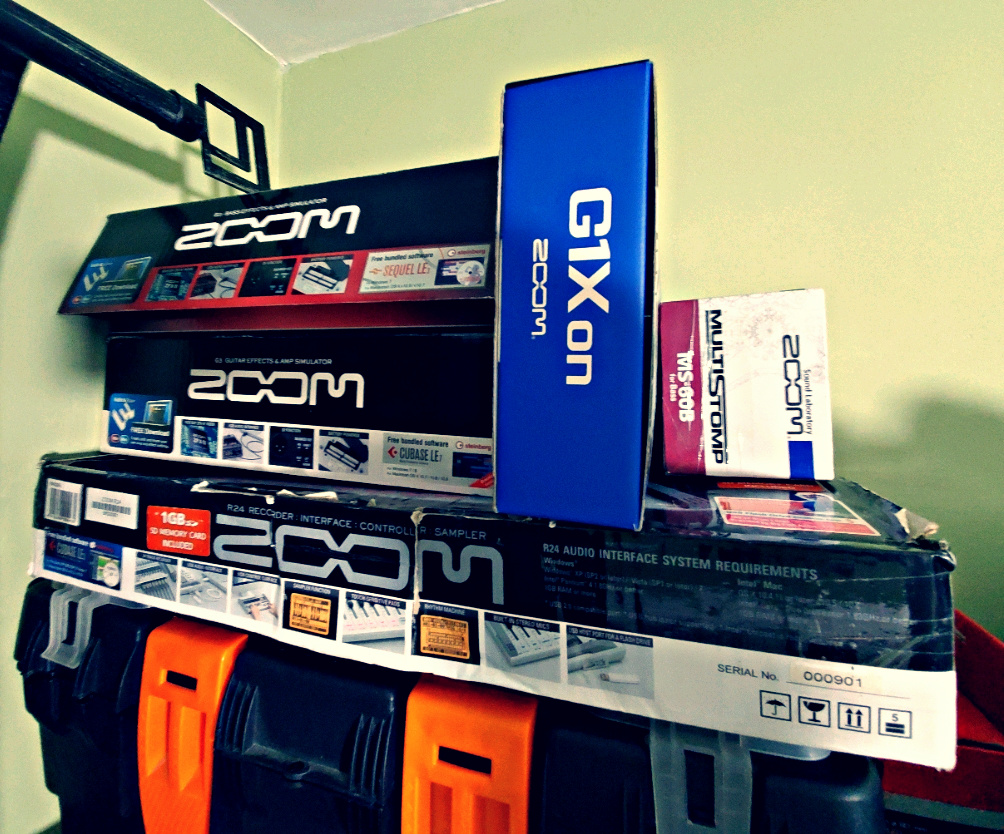
So this is my current Zoom family. Have a second R24 not shown in the photo (playing control surface duties in my studio).
As a happy owner of B3n (now with added G3n effects) I'd like to have a number as well.
I also have a 505, though it did not see any use for at least 3 years.
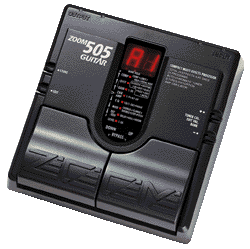
I also have a 505, though it did not see any use for at least 3 years.
As a happy owner of B3n (now with added G3n effects) I'd like to have a number as well.
I also have a 505, though it did not see any use for at least 3 years.
#193: Eli_Kyiv

@bassbrad, I'll give it a try this weekend. Thanks!@pbass74 I usually do the octaver first then the mono pitch up octave, the trick is using the tones and blends for the desired result. The Poly pitch shift is a bit more glitchy and singy sounding.


