• TalkBass has been independent since 1998. Add your voice.
    Create a free account to reply to discussions, view embedded media, and browse with fewer display ads.
    Join freeLog in
    Want zero display ads or expanded classifieds tools? Compare plans.

63 Fender Jazz. Need Advice

When I say destroyed I mean from a 1974 Fender Pbass perspective.

You have a collection of 37 year old parts from that may or may not all come from the Fender factory. If this was a Nashville flood victim, completely sanding and gouging the thing destroyed most of the value recognized by the market.

This is not to say it could be put back together..however, as someone said earlier, whatever you put into it, if you sell it, probably only a % of that investment will be recovered. However, left as is and put back together, if the neck is straight and the frets are true, would be a cool player with a story.

 
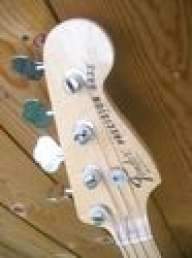
The only thing that may not clean up, is the tip of the headstock. More sanding or bleach may help. If it is too bad, you could always do a painted matching headstock, it would not be improper for this year range. Soak the bridges in mild muratic acid solution and you may be able to disassemble them. Have the plates nickel plated. I would not hesitate to put a new Fender decal on it, It is a REAL Fender.
Rocky
 
I've just spent a few short minutes looking up the molasses idea, and have only heard good things regarding. Is there any specific reasons not to use molasses?

As I said, the headstock seems recoverable. I'm hoping to turn this whole thing around.

Things aren't looking too bad, as far as making this a player.
 
I've just spent a few short minutes looking up the molasses idea, and have only heard good things regarding. Is there any specific reasons not to use molasses?

common sense ..

umm okay, I'm a wiseass but JohnK will chime in with some more friendly advice I'm sure ..

Molasses is highly concentrated sugar/water mix. Unless you're planning on giving it to your cat as a salt lick I would avoid that
 
if the screws are frozen up, molasses will not penetrate the threads because it is too thick. it may remove surface rust and grime, but that's about it.

i would soak it in some liquid wrench (has a super thin viscosity) overnite, then dry it and use heat to break them free. you could take a soldering iron and hold it on the saddle to heat it up (they're steel saddles) and then carefully try turning the screws.
 
I've just spent a few short minutes looking up the molasses idea, and have only heard good things regarding. Is there any specific reasons not to use molasses?

As I said, the headstock seems recoverable. I'm hoping to turn this whole thing around.

Things aren't looking too bad, as far as making this a player.

i guarantee that the pots will not like the molasses treatment.

i wouldn't use anything but caig deoxit on them.
 
if the screws are frozen up, molasses will not penetrate the threads because it is too thick. it may remove surface rust and grime, but that's about it.

i would soak it in some liquid wrench (has a super thin viscosity) overnite, then dry it and use heat to break them free. you could take a soldering iron and hold it on the saddle to heat it up (they're steel saddles) and then carefully try turning the screws.

I was referring to the heavy gunk and surface rust on the bridges, mostly. A 50/50 mix of molasses (feed grade) and water is quite thin and will penetrate those threads. I've used this method on hundreds of metallic parts. It works like magic. I didn't believe it either....until I tried it. It beats mechanical methods, which could damage the surfaces, imo. Honestly, I'd do the molasses trick, THEN use a penetrating oil on the screws, if necessary. But I bet the molasses mix alone will do the trick just fine.
 
I was referring to the heavy gunk and surface rust on the bridges, mostly. A 50/50 mix of molasses (feed grade) and water is quite thin and will penetrate those threads. I've used this method on hundreds of metallic parts. It works like magic. I didn't believe it either....until I tried it. It beats mechanical methods, which could damage the surfaces, imo. Honestly, I'd do the molasses trick, THEN use a penetrating oil on the screws, if necessary. But I bet the molasses mix alone will do the trick just fine.

Wow, i sure learned something....
 
You guys must be looking at different pictures form the ones I'm seeing. If the neck is straight and the pups work, this bass just needs a little TLC, some elbow grease, and a paint job and she's good to go. I'd give $300 in a skinny minute. OP, I'd listen to any advice JohnK 10 offered, if I were you.
 
personally, i think that it has all the makings for a great bass.

if it were mine, i'd completely strip what's left of the poly finish on the neck and then use oxalic acid on it to remove the mold, dirt, or whatever those stains/discolorations are. then i'd reshoot it with either poly (if you want it stock) or nitro (which is what i would do since i like the way it looks and feels more), put a new fender decal on it and reshoot the body a stock fender color. poly to be authentic or nitro (for a more vintage vibe). i'd probably just replace the bridge with a USA fender '75 reissue, but keep the original with it for posterity's sake. thenm i'd make a pickguard for it that duplicated a '74 (screw pattern and thumbrest locations) and then play the heck out of it.
 
Any updates? Are you keeping the bass?

So, the guy just GAVE it to you? Man, that's pretty sweet.

Personally, I'd do a nitro refin and ANY color of your choice. Natural finished 70's basses are a dime a dozen, and not the most attractive way to spice up an old beater. I'd do something unique out of the Fender color list.

Plus, you have the original PU's. There's something to be said about that as well. People who are saying this is only worth $200, are nuts IMO. You could put that thing on Ebay and it would fetch way more than that. At least a few hundred more.
 
personally, i think that it has all the makings for a great bass.

if it were mine, i'd completely strip what's left of the poly finish on the neck and then use oxalic acid on it to remove the mold, dirt, or whatever those stains/discolorations are. then i'd reshoot it with either poly (if you want it stock) or nitro (which is what i would do since i like the way it looks and feels more), put a new fender decal on it and reshoot the body a stock fender color. poly to be authentic or nitro (for a more vintage vibe). i'd probably just replace the bridge with a USA fender '75 reissue, but keep the original with it for posterity's sake. thenm i'd make a pickguard for it that duplicated a '74 (screw pattern and thumbrest locations) and then play the heck out of it.

Where does someone get oxalic acid? I've got some projects I'd like to remove mold on.