It's hard to say what was wrong without hearing it. I've been somewhere that has a drummer playing a small room like he's got to fill a stadium. The guitarist puts himself loud enough to be heard above the kit. The mic can't get anywhere near loud enough for the words to be heard, owing to the feedback. The drummer doesn't like being asked to play quieter. My band had a stand-in at a practice get angry and shout at us. We told him not to come back.
The above may or may not be the problem.
As a sound engineer, it is mind boggling how often some variation of this is the case. If you have a full PA, and ESPECIALLY if you have a sound engineer to run it (ie not a band member), by all means LET THEM do the heavy lifting. Get a BALANCED and MODERATE stage sound (nobody should be playing as hard as they can or as softly as they can), because you want to maintain the ability to have DYNAMICS. And it only takes a few db too many in a given instrument to make everyone else have to fight it. It's one thing if the drummer gets excited and hits a crash too hard every so often. But it's another if THAT"S THEIR ONLY SETTING AND IT'S HAPPENING ALL NIGHT LONG. It just obliterates any possibility for a pleasing and egalitarian stage and therefore house mix.
Subs, in my experience, are great for kick drum and certain particular styles of music. No so much for bass, though.
This makes no sense. A full octave and change of the bass guitar range is typically below what any commercial powered mains can reproduce (unless you have something giant and semi fancy like some SRX835s). What subs do is allow you to put bass into the PA without high passing the living hell out of it. For small/medium shows, you probably have JUST enough power in the mains for the vocals to be clear and audible. You start putting a bunch of bass in there and that capability gets eaten up quick without subs to take some of that load. But as an engineer, you want the bass to be quiet enough on stage that you can put some in the PA, because otherwise it's just the wild west and why even have an engineer if all they can do is try to push the vocals to the bleeding edge in hopes of competing with an out of control band? But even with a non out of control band, I STILL want everything in the mains because then I can make necessary adjustments from moment to moment and song to song.
I'd really prefer the band not use the sub
I guess if you hate the drummer and don't want anyone in the audience to hear the kick this is fine. In a small bar with a well balanced band, and a drummer with a nice kit that knows how to tune it, etc... you can get away without miking the kick. In any other situation, it's almost always advantageous to put some kick in the PA, and for that you really need at least one sub. If a band wants me to put kick in the mains in the absence of a sub, there's really only so much I can do, even into a pair of 15s (that only realistically go down to about 55 or 60 Hz and are trying to carry vocals, acoustic, keys, etc...).
More likely, the PA was just not tuned appropriately and/or mixed properly.
I would ALWAYS recommend a full band use 1 or more subs for an outdoor gig except in rare circumstances. Properly crossed over and tuned, and then with a reasonable "stage" balance/volume and PA mix, it should sound fantastic. The equipment is not the problem, how it's utilized is.
We heard Jacob Collier at Lincoln Center in NYC and when he played the lower end of his Nord it was nice and full but it brought no attention to the subwoofer. That's the correct use.
For keys, in many cases, sure. Other times aesthetically it makes sense to be more pronounced.
Hahahahahahaha! That guy is hired
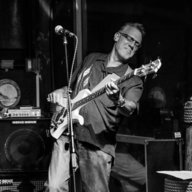
Skunk Baxter's stunt double (minus the facial hair).
Many years ago when we were setting up for a small gig with just a vocal PA the drummer suggested that I set my volume to match the kick drum level. Anymore than that is too loud. He was right.
This is such a "duh" thing, regardless of PA support or not, but 95% of bands fail at this. The drummer should be able to play a backbeat while the bassist plays root/octave 1/4 or 1/8th notes and the guitarist plays chords and everything should sound FANTASTIC before the PA or monitors are even turned on. Then you put the vocals, acoustic, keys, etc... in the PA to sit comfortably with that. Then you bring everything up proportionally to fill the room (leaving a little headroom). And THEN you backfill ONLY what is ABSOLUTELY NECESSARY in the monitors. As I like to say, "Monitors are not miracles", and it's always better to take away what you have too much of rather than try to add what you have too little of. But I should be able to put the vocals at a comfortable level in a wedge WAY before feedback is remotely an issue, and the band should play to that level basically.
when they added subwoofers and more speakers and suddenly everything sounded like mud onstage. When I told the sounds guys, their response was "Yeah, but everything sounds great out front."
When I do sound for bands in this digital mixer/ipad age, I try to get up and walk around on stage during sound check, so I know what the musicians are hearing. I will stand next to each person and try to adjust their monitor to something that makes sense, anticipating what they need and what they don't. That way I know that everything is kind of at a baseline and I know how much room I have to be able to add or subtract things. I don't want to have any idea what the monitors are doing if I'm out front. If I can hear your wedge from out front, you have failed musician school, or your band has failed band school. Or both. If I cut the mains, it should be hard for me to tell the wedges are doing anything compared to the band, unless I mute them all at once. That might be an exaggeration but basically that's the idea.
The other thing that bands don't understand, is as they make more and more unrealistic demands of their monitors, I have to hack the EQ to pieces to keep feedback at bay, and that's probably just going to make them want MORE VOLUME because of how much is being cut. So if you can get by with a more modest level and just tell the guitarist to turn down from 12 to merely 11, just the whole on stage experience will improve drastically.
Slight tweaking of the gain of each channel can be done as the band is playing, but if the gain pot of each channel has to be moved more than 1 notch either way, getting the band to sound balance in the FOH becomes more difficult.
"Unity" is sort of meaningless with a mixer/PA situation (by definition with mics you're usually adding a LOT of gain actually, my typical mic gain setting for vocals is between 25 and 35). It makes sense with like a guitar/bass and pedals (anything where you can compare with or without a given gain stage in other words). So for instance you set your OD level so that when you kick it on the perceived volume is roughly the same as with it bypassed. But gain staging in general is absolutely key. You want to have a good strong signal without clipping. If you have that and the band is balanced on stage, and the PA is sufficient for the room, you should have no issues.
When the Beach Boys took to the stage it sounded like the lead audio tech simply pushed all the faders to max. The sound was painfully loud and the system was pushed into noticeable distortion. The highs were brittle, crunchy, and IMHO painful. To my ears it sounded absolutely awful.
Engineering malpractice,
This. So many bass players want a "nice full sound on stage" Truth is that's the last thing you want. Ur stage tone wants to be mean lean and kinda meh. Kill the bass knob on ur amp and push those mids/lower mids. Bass frequencies coales at about 50 feet into a nice tight ball...Keep it lean.
There's a balance to be had. You want enough rig on stage that you don't have to EQ it into oblivion to get the volume you need for the situation. The bass knob on your amp or your active bass should be used judiciously, and with respect to what is going on with the rest of the EQ. I typically will play with bass knob flat or boosted just slightly (also depends on which cabs and amp I'm using), usually low mids slightly cut, maybe around 200 or something like that, being sure not to take away body, but just backing off any boominess, probably another cut in the upper mids (2-4k), and highs (5-10k or higher) anywhere between a slight cut and a slight boost. Fletcher and Munson (those bastards) mean that the EQ of the bass in the PA may have to be somewhat different to get the same perceived sound in the mains at show volume.
***
Anyway, OP, it seems you probably just need more rig for gigs like that and you seem to have arrived at that conclusion. Also, depending on what makes/models your PA is could be playing a role as well, plus what whoever is in charge is doing with said gear. For instance the QSC KSubs (which I believe are a bandpass design) have an absolutely ridiculous resonant peak that absolutely needs to be aggressively EQ'd out with a graphic and a keen ear (or spectral analyzer/DriveRack wizard/etc...). The JBL PRX800 stuff (which is what I have) actually has built in DSP addressable via wifi through ipad with like 6 bands of parametric EQ per box which is pretty cool (although I still haven't delved into that after more than a year, because I just use my DriveRack or the graphic/parametric in my digital A&H mixer).
A tuned and crossed over PA and a well balanced band (ie with a stout enough bass rig) should sound really good and be capable of a nice mix. Even on crappy gear you can get a decent mix if you do all the right steps and respect the equipment and its limitations. And depending on where you are in MD, I may be semi local (I'm outside DC). Sometimes a professional 2nd opinion can do wonders.