• TalkBass has been independent since 1998. Add your voice.
    Create a free account to reply to discussions, view embedded media, and browse with fewer display ads.
    Join freeLog in
    Want zero display ads or expanded classifieds tools? Compare plans.

Any tips for Self Taught Bassists?

Hey.

Ive been playing for around 8 months now and i feel asthough ive really learnt fast. Im in a band and im complimented often on my playing and the speed ive learnt. However ive been told by some bassists that "I lack talent, technique and it just feels as though i know the song"

So i feel as though i should put this out their and ask does anyone have any tips for self taught bassist? Anything will do. Websites, finger exercises, Anything.

Another question i have is, Is my technique right and is their anything i should bear in mind to make it better?

My technique is...
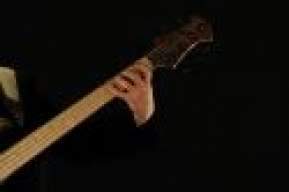
Left hand: Pad of thumb rests on Apex of neck, My Palm doesn't grip. For my 2nd 3rd and 4th finger i try to use fingertips and aim to place them on or just behind the fret Fingers curled and use the tip. (Playing piano for 9 years taught me always keep them fingers curled) however i will occasionally use the pad of my finger and sometimes even knuckle if im flicking between strings, making a bar or bending a string)

Right hand: I cant use a pick to save my life so i fingerpick. I use the walking technique to pluck the string and use my thumb or above string to land my fingers on. Always resting my thumb on the pickup or strings.

More in depth stuff: Think like a drummer, Feel the music and emotion the peice creates, and dont drown your noise in effects.

Thats it really. Any advice anyone can give would be a great help. Thanks.
 
Eh, I'd have to actually see you play to offer any advice on your technique.

Knowing the songs and having good time and tone are the most important qualities to have as a bassist. Those bassists that are telling you you lack talent are most likely guys that like making meaningless comments to inflate their own ego. And they accidentally complimented you in the process of putting you down.

If you're looking for specific exercises to improve your technique, you're probably about to get four pages worth of it from other posters. Assuming your technique, tone, and time are solid, then the only really necessary things to add would be ear training, sight reading, and chart reading. Fancy technique stuff can be fun and useful in very select settings, and can make everything else you do that much easier, but it's not absolutely necessary to fulfill your role as a bassist. Judging from the second to last line of your post, you're already more mature on the instrument than 99.9% of people that think they know how to play bass.
 
I've been an almost entirely self taught bass player and have been playing and gigging including many years of pro work for over 20 years. The biggest advice I can give is find a good teacher that connects with you and isn't just trying to show you how to play certain songs. Technique isn't the only thing. No matter how much technique someone can learn, they can not truly learn feeling.
 
Think: first part of chain that ends in sound coming out of your speaker is your mind. Listen to the music A LOT and try to hear bass lines. Think, why does it sound so good? What makes it groovy, mellow, silky, whatever you think of it? Sing along the same line. Sing the line you would have played instead.

I've had a 6 years pause of playing bass, and my friends pro musicians claim that my playing developed in the meantime. During the pause, I listened a lot to the music, and I think that most developing potential any bass player has is purely intellectual.

Performing: don't overstretch yourself. Better to simplify bass line and play it spot-on, than to try something impossible and make mistakes. One of basic keys of good bass playing is to be accurate. Beginners often make mistake of taking bigger bite than they can chew, don't do that. Make it simple (as much as it is necessary to sound accurate), and make every note count. You'll sound like a pro :)
 
I'm a self taught bassist as well. I've read a lot of beginner books and watched many instructional video's. I spent a lot of time getting the muting right, both finger style and picking.
From the moment I started to play along with existing music, I started recording my playing. Afterwards I mixed it, using Audicity. I then listen to it very critically, when I'm driving to and from work. This is how I detect the little flaws in my playing. It really helped me becoming a better bassist.
 
When I was learning and when I had students, an exercise I would do is turn off all the lights, turn some music on and play along with the songs. Any songs you want to learn, mine were Hendrix and Zepplin...etc. What this does is train the ears and the hands to work together with out looking. Helped me and my students out with ear training and being comfortable to improvise.
 
not that I know, but there's a possibilty that the comment 'you only know the song' refers to lack of grounding in theory.
everyone I know came up playing by learning song after song. That's pretty much why anybody picks up an instrument, but that's pretty much like moving to a new city and learning a few roads and routes to get from here to there and never learning how the street grid interconnects, the map of the city.
Once there's a grounding in theory there's the possibilty of taking different routes to the same place.
If you learn as quickly as you say you're the kind of student teachers look for, because generally a good teacher is as eager to share what they know as a good student is to learn. Find a teacher with some theory and see how that goes.
 
Hey.

Ive been playing for around 8 months now and i feel asthough ive really learnt fast. Im in a band and im

complimented often on my playing and the speed ive learnt. However ive been told by some bassists that "I lack

talent, technique and it just feels as though i know the song"

For the first year and a half as I learned to play music, I was repeatedly told to please stop as I clearly didn't have any talent.

After about 2 years, a friend called me "Eddie Van Halen on bass" which back then was somewhat complimentary (I don't think much of Eddie's rather derivative style myself, but the guy saying it did, so I accepted that).

DO NOT LISTEN to people who have only derogatory feedback for you. Those kinds of comments certainly don't tell you anything useful.

After over 25 years of playing, I certainly don't need others' opinions to validate what I am doing. I don't ask people if I am good -- it's not a relevant measure of what I'm doing. I ask them if they like what I'm doing.

That's all I care about. If a listener does not like my music, well I'm not forcing anyone to listen to me.

Most importantly do you like what you are doing. A true artist's only valid critic is himself. Period. If you like it, you will put your enthusiasm and effort into it.

If you don't, you will destroy your self-confidence with someone else's often unimportant, unreachable goals for your playing.

I was self-taught through most of my early years, and I did just fine. If you already have musical experience on the piano, a lot of what theory teaches you may already be self-evident, and if not it is so easy to find material on the web.

If you know how to read, you've got the tools to understand theory right there. If you don't, spend a little time with it. On a day-to-day basis I do not use my reading/writing skills even though both of my bandmates are musically literate. It is easier to just play them what I want to hear, and we work it out in practice. I'm the songwriter in my band, and I feel we thrive on collaboration so I play my part for 'em, and they make up their own, and we hem and haw and argue until we find a medium that works.

However, I also practice reading and exercise it to improve my technique and broaden my vocabulary. I recently learned the Prelude to Bach's cello suite in G, and it was a very positive and delightful experience, and I plan on incorporating that into our show as an opener for the second or third set.

If you don't have ear training, you should also develop it. As I think 2 or 3 people have said, just listening to and learning other recordings is very useful. That is how I developed most of my technique and style, and I used Beatles, Rush, and Yes recordings to learn new things. Due to that immersion, and my persistence at learning those songs and lines, I often get tagged with the nickname "Geddy Jr.," which I can't take as anything but a compliment.

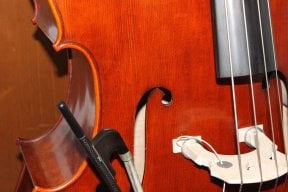
I did take DB lessons in college, as I minored in music. By that time I had been playing for about 5 years, and my string instructor also happened to be the professor who conducted the orchestra. His first comment was that I had very good LH technique already. I am a leftie who learned rightie, so I guess the hand-strength and dexterity advantage helped me get up to speed quickly. I only played DB for about two years, and I moved out of town at the end of my college career, and I was unable to take my rental bass with me and finish paying it off. One day when the finances line up I plan on getting another because it was a great learning experience for me, and I actually composed one of my favorite songs on a double-bass. Very inspring instrument . . . it's something else to be moving so much air with nothing but strings and wood under your hands.

I think the most important thing I could impart, standing on the other side of 25+ years of mostly self-taught playing is to listen, to be open to trying new things, and to listen. Also, I think I mentioned, do some listening. Yep. That's about right.
 
After 3 years of self study I took a couple of lessons - not too long ago actually. It was a real eye opener and a fantastic boost to my continued self study.

I am a very casual player (though I love it and practice every day whenever possible) so will probably only take a handful of lessons per year. But as others have said, there really is no substitute for at least a little bit of real-time one-on-one feedback.
 
Get a teacher, or at least try a month of weekly lessons.

I have nothing at all against self-taught, but IME lessons with a good teacher (+ practice) can advance your progress exponentially and augment (or correct, if necessary) whatever you're teaching yourself.

Good luck!
 
I am self taught on bass (with 15-16 years experience), but with a music background before then.

8 months is the earliest stages of getting started!

Just keep playing. Run the same drills as you would any other instrument. Eventually time will catch up and people will think that you have "talent" and all that. If you search around these forums you can probably find more info and ideas on this stuff than you'll ever have time to do.
 
For the first year and a half as I learned to play music, I was repeatedly told to please stop as I clearly didn't have any talent.

After about 2 years, a friend called me "Eddie Van Halen on bass" which back then was somewhat complimentary (I don't think much of Eddie's rather derivative style myself, but the guy saying it did, so I accepted that).

DO NOT LISTEN to people who have only derogatory feedback for you. Those kinds of comments certainly don't tell you anything useful.

After over 25 years of playing, I certainly don't need others' opinions to validate what I am doing. I don't ask people if I am good -- it's not a relevant measure of what I'm doing. I ask them if they like what I'm doing.

That's all I care about. If a listener does not like my music, well I'm not forcing anyone to listen to me.

Most importantly do you like what you are doing. A true artist's only valid critic is himself. Period. If you like it, you will put your enthusiasm and effort into it.

If you don't, you will destroy your self-confidence with someone else's often unimportant, unreachable goals for your playing.

I was self-taught through most of my early years, and I did just fine. If you already have musical experience on the piano, a lot of what theory teaches you may already be self-evident, and if not it is so easy to find material on the web.

If you know how to read, you've got the tools to understand theory right there. If you don't, spend a little time with it. On a day-to-day basis I do not use my reading/writing skills even though both of my bandmates are musically literate. It is easier to just play them what I want to hear, and we work it out in practice. I'm the songwriter in my band, and I feel we thrive on collaboration so I play my part for 'em, and they make up their own, and we hem and haw and argue until we find a medium that works.

However, I also practice reading and exercise it to improve my technique and broaden my vocabulary. I recently learned the Prelude to Bach's cello suite in G, and it was a very positive and delightful experience, and I plan on incorporating that into our show as an opener for the second or third set.

If you don't have ear training, you should also develop it. As I think 2 or 3 people have said, just listening to and learning other recordings is very useful. That is how I developed most of my technique and style, and I used Beatles, Rush, and Yes recordings to learn new things. Due to that immersion, and my persistence at learning those songs and lines, I often get tagged with the nickname "Geddy Jr.," which I can't take as anything but a compliment.

I did take DB lessons in college, as I minored in music. By that time I had been playing for about 5 years, and my string instructor also happened to be the professor who conducted the orchestra. His first comment was that I had very good LH technique already. I am a leftie who learned rightie, so I guess the hand-strength and dexterity advantage helped me get up to speed quickly. I only played DB for about two years, and I moved out of town at the end of my college career, and I was unable to take my rental bass with me and finish paying it off. One day when the finances line up I plan on getting another because it was a great learning experience for me, and I actually composed one of my favorite songs on a double-bass. Very inspring instrument . . . it's something else to be moving so much air with nothing but strings and wood under your hands.

I think the most important thing I could impart, standing on the other side of 25+ years of mostly self-taught playing is to listen, to be open to trying new things, and to listen. Also, I think I mentioned, do some listening. Yep. That's about right.

Excellent advice.

For more TB info on the topic, check out the >500 link in my sig. below for some great bass learning info.

Btw, if you're able to play the songs your band is playing with few errors and no pain, then, I'd say you're successful in your endeavor. If you want to learn more, learn more, if not, just enjoy playing in your band and don't worry about it.

For people (especially people you don't know or even if you do) who tell you you're a failure because you haven't learned this or that, just ignore them and come up with something like: "How did you like the band?" as a response. Or just smile and say "Thank you for your opinion." or "Thank you for exercising your First Amendment right".

Good luck.