• TalkBass has been independent since 1998. Add your voice.
    Create a free account to reply to discussions, view embedded media, and browse with fewer display ads.
    Join freeLog in
    Want zero display ads or expanded classifieds tools? Compare plans.

Bergantino's Vertical 410!!!!!

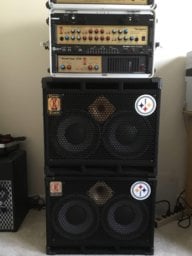
Im instantly thinking, what would 2 , stacked vertically sound like? If i had the $s, and someone to help the old guy (me) lug in out, i would grab them , in a heartbeat. For last year iv been using 2x Bergantino NXV 210s, vertically. . No horn, ported, neo drivers. I absolutely them. A pair of ceramic , sealed, 4x 10 versions, would be my 'dream stack'.!
 
A few more NV410T demo notes, after months of daily play thru it. Spec numbers aren’t my thing—just sharing what I actually hear, for both home (in my case, at significantly higher than “bedroom”) and gig volumes.

———————————————————————
Probably should also mention:

I have a strong preference for sealed~ceramic cab’s—always have, even though I’ve had my share of ceramic (and neo) ported cab’s.

Previously owned sealed~ceramic’s:
•NV115 (x2)
•NV412T
•HG410X (sealed~neo)

Currently owned sealed~ceramic’s:
•NV610T (x2)
•Ampeg Heritage 810E (‘24 build)

Amps used with NV410T:
•Eich T900
•Berg Ultra
•Heritage SVT-CL
———————————————————————

•I find the NV410T pretty well balanced, top to bottom. Clear and present mids; cab has plenty of bottom-end. I typically eq/filter the bottom-end close to what I do for my NV610T, as there’s a lot of cab similarity.

•NV410T bottom end is very different than the NV115(s)…not as rounded, and more efficient volume output.

•If you enjoy the NV610T, I’m pretty confident you’d be happy with the NV410T. They’re not exact (2 less woofers, different woofer positioning, enclosure size, etc) but no question to my ear…they’re not just in the same zip code—more like a one-story vs two-story floor plan option in the same cul-de-sac—for tone, behavior, and feel.

•I spent many hours comparing this cab to my NV610T—a large stack of notes! But more recently, I abandoned all the comparative effort; focus on simply appreciating the two cabs for what they each bring to the tone/feel table.

•HG410X—still my clear favorite neo cab. Also sealed, but…not in the same NV 610/410 “cul-de-sac”…

•SVT-CL feet “straddle” the NV410T top; feet don’t contact the top of cab. Fairly stable, but I’d need to use a pad between the head and cab, due to the screw heads projecting underneath the tube head. I’d rather use my Ultra or T900 for this cab—particularly the Ultra, because I can opt to make it very vintage tube sounding.

Obviously, sealed~ceramic isn’t everyone’s cup of tea…I get it, and that’s very okay.:-) For someone like me who views the NV610T the holy grail cab, the NV410T is a nice option. It alleviates some of the NV610T mobility challenges; has similar 610 tonal character; plenty of efficient volume output; excellent hearability; won’t scare your bandmates (or appear out of place) in smaller gig applications.
 
Last edited:
Sealed, 79 lbs, sensitivity only 101 dB. Rolls off at 48 Hz.

I’ll pass.
Sealed and ceramic is exactly what my ears desire.

79 pounds is significantly less than my current big cab: the NV610 (100 pounds).

Spec micromanagement has already been addressed. My own take: I play BEADG 5 string but have always loved the tight bottom end of sealed cabs. The rolloff can be a great thing in general: especially at bar gigs with wonky acoustics, but also in larger venues where the sound tech doesn't want low frequency clash with FOH.


I’m sure it will sound great since all of his cabinets do. I wonder if it’s interesting enough to be better than a pair of 210s stacked, which have the portability advantage.
I've often rocked a 2x10 stack, and disagree with "portability advantage". 2x10 stack usually requires two trips, unless you have a cart. The NV410T has the cart built in! One trip.

The phrase I'd agree with is "modularity advantage". I play some lower volume gigs where a single 2x10 is plenty.
 
sensitivity only 101 dB.

I’ll pass.

If it’s not at least 117dB at 1 meter, I’m not interested.

backfuture1034-3897750156.jpeg
 
I ordered an NV410T as soon as the link went live. :bassist:

I'm really psyched to get the NV610 magic (close enough to it) in a lighter box, and with a narrower footprint that will be far more gig friendly! It's also a few inches taller than the NV610, which may help a bit in cramped conditions.

Since the pandemic I've only used the NV610 a few times, mainly outdoors with no FOH support. Even then I'm not sure I pushed it to the max. Sure, it's fun to make my pants flap (I wear quality hearing protection), but these days I'd rather not play gigs where I have to push a 6x10.

Even a few years before the pandemic my most common rig was a modular stack: 2x210, 2x112, and lately 210+112. This is because of fairly regular gigs where the band is crammed in a corner and every inch of real estate matters (the NV610 is a wide load). A 79 pound 4x10 is intimidating, but with a reasonably flat load-in the NV610 was easy to roll in and out of venues, so the narrower/lighter NV410 will be even easier.
 
I was just paging through The Mixing Engineer's Handbook 5th Edition, by Bobby Owsinski. It has a wealth of information on and different approaches to mixing compiled from a who's who list of grammy award winning mix engineers from a wide variety of musical genres. (These experts totally know their subject.)
It has tables and descriptions of key frequencies for mix elements, trouble frequency areas, the relationship between bass and drums, fitting it all in the mix, EQ techniques for each element, and so much more. Here are just a few excerpts I found interesting:
- "Before you continue to EQ at other frequencies, filter out any unnecessary bass frequencies so the kick and bass are not boomy or muddy (below 30 Hz on kick and 50 Hz on the bass), although this can vary according to style and taste." With the styles of music I play (rock, blues, country, funk) the FOH engineers I've spoken with roll off the bass guitar under 50Hz so it sits on top of and works well with the kick. I've found setting the HPF on my bass amp around 45-50Hz keeps the low end solid but not woofy.
- "Since the kick tends to be more transitory than the bass guitar, for pop music, it's best to have the kick provide the percussive nature of the bottom while the bass fills out the sustain and the musical component."
- "For bass the ratio between low bass (80 to 120 Hz) and mid bass (120 to 200 Hz) is important." Correct balance of this ratio helps to keep the bass full but distinct.
- "Muddy bass can mean a lot of things, but it usually involves a lack of presence of the higher harmonics. Most bass tracks have a sweet spot between 600 to 1200 Hz where the upper order harmonics sing, so this is the place to boost for more presence in the mix."
- "With hip-hop and electronic music the bass tends to contain a lot of information in the 30 to 60 Hz range that you can literally feel, so many hip-hop or EDM records will raise the low frequency target area slightly higher to 70 to 100 Hz and elongate the duration." This creates that huge bass feel.
- "With rock bass to create that in your face energy, boost anywhere between 50 to 100 Hz for the bottom end, dip between 400 to 800 Hz in the low mids to allow the guitars and vocals to have more room to speak musically, and boost between 1.5 and 2.5 kHz for midrange." Different musical styles take different approaches but foundational principles are still valid.

I use a Barefaced Super Twin T which has a monstrous low end for a 212 and can handle peaks of 1200 watts rms and a Bergantino HP Ultra which has enough clean headroom to run the Super Twin at full rated power (stupid loud). I don't run anywhere near this but the headroom allows for a deep, controlled low end. Without having the HPF around 45-50 Hz I find the low end can be overbearing. With this in mind I'd think if you're not playing hip-hop or EDM, the Berg NV410T would make an excellent stage rig with a solid but not exaggerated low end that would sit well in a number of different mixes. IMO, a bass cab should be optimized for the way bass guitar sounds and doesn't need the same spec as a large FOH stack.
 
That's why many upper end amps incorporate hpf (and lpf). People who own these amps, but don't evere use it..should realise even on hpf's lowest setting, it's rolling off 25hz to 30hz..depending on design.

For me a sealed cab is a lazy man's HPF* because it mitigates undesirable onstage rumble. The correct thing to do would be to add an actual HPF to prevent my amp from wasting headroom on the low-lows that were being rolled off by the sealed cab.

*Fact is that each of my two pedalboards has an HPF. But I don't always gig with a board, so I really should invest in a third for standalone use.


P.S. Didn't the venerable SVT 8x10 start rolling off around 48Hz?
 
P.S. Didn't the venerable SVT 8x10 start rolling off around 48Hz?

Per Ampeg, 58hz is -3dB and 40hz is- 10dB. However, AFAIK the roll off starts much higher than that.

I believe the following traces are a fair approximation of an Ampeg 810E (yellow) and a fEArful 1515/66 (white). The drivers for the 810E model are Eminence B810, which are said to be fairly similar to the standard OEM 10s, but not exactly the same.

Here you are with a cab simulation of 215 3015LF verses a 810 B810 modelling.
System input power equals 800 Watt for each system
upload_2018-10-29_1-32-21.png


You can look at the response of the SVT210AV for comparison. Per the following document, -3dB is 58hz and -10dB is 40hz just like the 810E:
1754096492800.png


This documents shows the response as measure by BGM. IMHO it looks pretty similar to the yellow trace of the B810s above:

1754096562453.png


So the roll off appears to start about 140-150hz or so.
 
Most players that run four 10's "usually" work with only one cabinet.

This design seems to me to be the best and smartest solution for a stand alone, single 410 cabinet.

Mr. Bergantino, are there any plans to carry this taller 410 cabinet design approach to your other models?

Possibly a ported, Neo driver loaded, available in 4 or 8 ohms, 410 NXT?
 
Last edited:
I am absolutely certain this is sonically a killer cab.

Not for me though; and there are two aspects that don’t compute for me.

First, TB’ers seem to be dramatically obsessed by comb filtering. There are extremely simple ways to eliminate this effect using two 2x10’s or, even better, two 2x12’s; by positioning in side by side shallow V. I experimented with both vertical vs side by side shallow V when I was gigging a pair of the Berg AE212’s. The shallow V placement sounded VASTLY superior to my ears vs stacked. I concluded that the vertical thing was an optics pref; but, each to their own. BTW. I also placed those to cabs side by side in line; and yes, one can detect the filtering walking around the room, but, I was unimpressed by the magnitude of the issue. Again, each to their own. I don’t hear it AT ALL with the NV610T.

Second, I already have the 100 pound NV610T; which inhabits space in my garage. Not going up and down the basement stairs with that one. It is a PHENOM cab. I don’t use it much; but, it’s a keeper just the same. 20 pounds less is 20 pounds less. I roll the NV610T; and I would have to roll an NV410T. Don’t see much difference there. Tipping in and out of the back of the car, or up onto a stage? Ummm, don’t see that as a big deal. I suppose that IF I had to navigate stairs, then the 20 pounds might matter.

If I did not have the NV610T, this cab could be interesting.

Stacking two NV410T’s sounds physically dangerous. Wouldn’t be my choice. For those choosing that deployment, exercise care and have a bud to assist.
 
This design seems to me to be the best and smartest solution for a stand alone, single 410 cabinet.

The one design factor I wonder about is the form factor; specifically the width. My impression is the all-tube advocates are the ones most likely to want a sealed cab. The width of this cab will result in a T-top with pretty much any higher powered all-tube amp I can think of. Probably the narrowest giggable tube amp in my collection is an Orange AD200B MkIII, which is about 21.5" wide compared to 18.5" for the NV410. You also get a T-top if you use an older rack-mount head. No problems with one of the modern compact Class-D heads or lower powered tube heads like the Ampeg PF50T or Ashdown LB30.
 
Last edited:
The very strong tradition of putting the amp on top of the cab is unfortunate, especially a tube amp.
No it’s not unfortunate. There’s no problem with any reasonably well designed, reasonably well built amp.
 
No it’s not unfortunate. There’s no problem with any reasonably well designed, reasonably well built amp.
While I was thinking of vibration, there's also the "T-top" problem Wasnex was talking about, and the weight.
My SVT-CL might never make it to the top of my fridge again. But it seems very comfortable on the floor.

If I owned this NV410T I, myself, would not need to put an SVT or my HIWATT clone on top.
 
My impression is the all-tube advocates are the ones most likely to want a sealed cab.
There are also those (like me) who want vintage SVT magic without all the bulk and weight, so we use tube sim pedals along with a micro amp. A sealed cab enhances that vintage vibe.

The NV410 is weighty, but half as much as the SVT fridge cab. A sealed cab with neo woofers would be even lighter, but my ears still prefer ceramic.