
Enjoy the benefits of a premium membership!
Upgrade Account
-
TalkBass has been independent since 1998. Add your voice.
Create a free account to reply to discussions, view embedded media, and browse with fewer display ads.
Join free Log in
Want zero display ads or expanded classifieds tools? Compare plans.
You are using an out of date browser. It may not display this or other websites correctly.
You should upgrade or use an alternative browser.
You should upgrade or use an alternative browser.
Best Users of Distortion/Overdrive
- Thread starter visa
- Start date
More options
Who Replied?
his 5:05 solo has a HELL of alot of overdrive...
5:15..
Yeah, thats his treble rig, the one you are most probable to hear through Youtube and regular TV Speakers.
He tri-amped at the last, one for Bass, one for middle and one for treble.. on the CD from "Live at Royal Albert hall", with my new earphones, All i hear is the mid's amp
 it even overpower Pete at times. sometimes you hear the synthetic distortion from his treble rig. I Love it! sounds like its 2 bass players up there, i bet it was even cooler to hear "real" live.
Larry Graham, Duff McKagan
When have Duff Mckagan used distortion??

In the later years he used alot of overdrive. I have his Instructional DVD, and there he is clearly using overdrive. I think the Live at Leeds sound sounds quite a bit overdrived to.
I don't know about the instructional vid, but Live at Leeds was recorded in 1970. What amps do you think we had back then? What you are hearing is John turning his amp up loud enough to hear himself!
This is the usual reason for gritty tone from albums from the 60's and 70's. They didn't make really big bass amps back then.
The other reason is when you have someone using tube amps, like Marshalls and Hi-Watts. Listen to jack Bruce in the studio, and then live.
From 1967 to 1971 Entwistle used the following amps:
•Two Marshall 1959 JTM100 Super Lead amplifiers into Marshall 1960A (angled front) and 1960B (straight front) or 1982A (angled front) and 1982B (straight front) speaker cabinets.
•One (with another Marshall amp) or two Marshall 1967 Major Lead (The “Pig”
 200-watt amps into Marshall cabinets (as above).
•U.S. Thomas Organ (Vox) V1141 Super Beatle solid-state amps and cabs (U.S./Canada tours only).
•Two Sunn 100S amplifiers with two or four Sunn 200S 2x15 cabinets (U.S./Canada tours only)
•Two modified Sound City L100 amps with four Sound City 4x12s (UK/Europe tours only).
In 1975 he used the following:
Amplifiers
Two Crown DC 300 power amplifiers or two Sunn Coliseum Power Amp power amplifiers.
Two Alembic preamps
Speakers
Two Sunn 412L 4x12 speaker cabs
Two Sunn 3x12 speaker cabs
Two Sunn 1x18 speaker cabs
Two Sunn W 1x18 reflex bins
His 1989 rig:
Treble/high-end signal
Instrument signal via Sennheiser wireless receiver, into
Alembic preamp/splitter, into
Gallien-Krueger 2000 preamp, into
T.C. Electronics 2290 programmable delay
(with an optional 64-second oversampling conversion)
Acts as controller for other processors to recall programs
Stereo noise gate
Yamaha SPX 1000 digital effects processor
Korg KEC42 (hum cancellation)
T.C. Electronic 1128 programmable 32-band graphic equalizer
Two Trace Elliot 300-watt power amps
One amp powers one A.S.S. 4x12″ cabinet with Fane speakers
One amp powers one A.S.S. 16x5″ speaker cabinet with Fane speakers
Bass/low-end signal
Instrument signal via Sennheiser wireless receive (from above), into
T.C. Electronic 1128 programmable 32-band EQ or Trace Elliot EQ (presumably Trace Elliot MP11 graphic equalizer)
Trace Elliot preamp, into
Trace Elliot (RA500) 500-watt power amp
Power amp drives four A.S.S. 1x15″ cabinets with Fane speakers
In 1989 in Guitar Player he said:
“I use the distortion from the Yamaha SPX1000 combined with the natural distortion of the overdriven Gallien-Krueger preamp, which gives me long sustain even at lower volumes. I have various choruses, exciters, echoes, and delays on at all times. They’re programmable and all go through the treble side only. I’ve already programmed 10 of the Who songs for the tour, and will probably use the sampler to play back the bass lines during my big solo feature in ‘Shakin’ All Over,’ where I play with the drums and then cue them out to do a free-form thing.”
OK, so I guess he did use overdrive....
The guy from muse, i love the simple yet great distorted bassline in starlight and hysteria i think is a great distorted bassline
DavidRavenMoon: Overdrive my friend, a OVER DRIVEN amp, thats overdrive.. "grit" is another way to say it.
IMO, ofcourse
IMO, ofcourse


I dont think it was deliberate, just "kids" playing through tubes CRANKED back in the day, but I myself really dig Mel Schacter's tone on Grand Funk's Red Album. Just a touch of fuzz, I still use that type of sound today. Done with tubes and a maple-necked jazz, and I can switch to a Markie Adams sound with a simple pregain/master vol adj and pup rebalance.
Hugh Hopper
+1000000
I was waiting....now when is someone gonna name the true master, the fuzz master.....Hugh Hopper!

No love for Doug Pinnick?! Doug's "King's X" and "Dogman" era tones in particular are phenominal!

Squire and Geddy go without saying...whoops
I'd say Greg Lake, who doesn't give himself any credit at all as a bass player. But "The Barbarian" is MONSTEROUS!
Blacky from Voivod. Fuzz fuzz fuzz. Like a thrash metal Chris Squire.
I'd say Greg Lake, who doesn't give himself any credit at all as a bass player. But "The Barbarian" is MONSTEROUS!
Blacky from Voivod. Fuzz fuzz fuzz. Like a thrash metal Chris Squire.
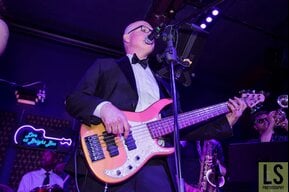
How about Robert Sledge from Ben Folds Five.
+1; you don't need no guitar when you Sledge on the bass! Great stuff on the Whatever and Ever Amen album!
Oh, my goodness, yes. "Willow" just kills me every time.No love for Doug Pinnick?! Doug's "King's X" and "Dogman" era tones in particular are phenominal!


