• TalkBass has been independent since 1998. Add your voice.
    Create a free account to reply to discussions, view embedded media, and browse with fewer display ads.
    Join freeLog in
    Want zero display ads or expanded classifieds tools? Compare plans.

Big Cabs Club

Status
Not open for further replies.
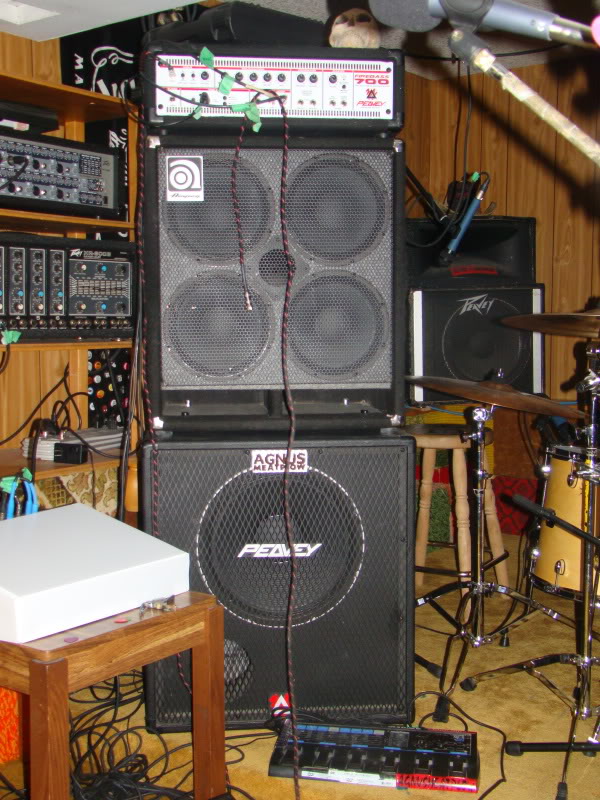
I don't quite get it? My main rig wouldn't cut it, it would be too small?

DSC04405.jpg


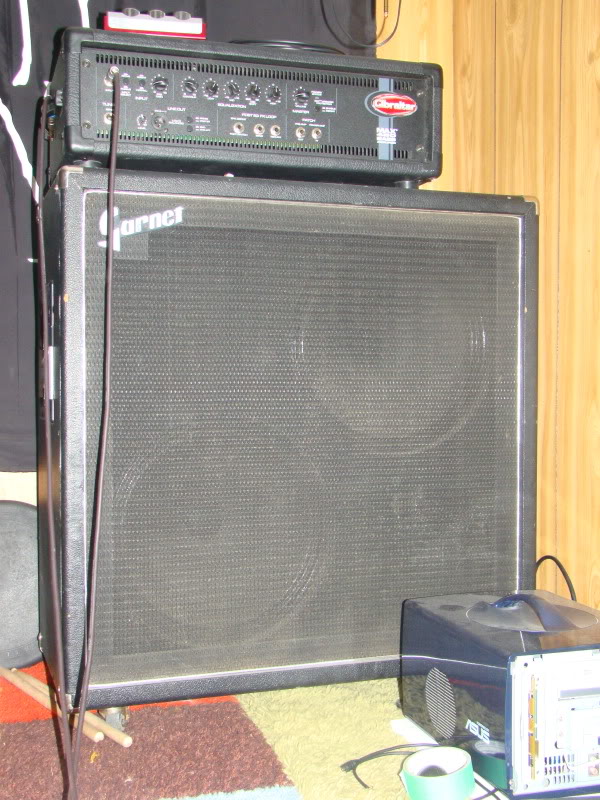
But my practice rig would qualify?

DSC04403.jpg


Simply put I'd rather carry that Garnet 2x15 over that ampeg 4x10 anyday.


Before I go tearing the Garnet open, would anyone know what watts it would be, I know its 8 ohm and thats about all.

And if this doesn't make me a member, I am negotiating a deal on a Peavey 1820 as we speak. So one way or another may I have banned member #2?

Huh? You qualify w/ the 2x15.
 
...
DSC04403.jpg


...

Before I go tearing the Garnet open, would anyone know what watts it would be, I know its 8 ohm and thats about all.

...

The dust caps on the 15s look small, meaning that the voicecoils aren't that large either. Also, guessing that it was made in the '70s, so I'd venture that the power rating is rather low...100 - 150 watts maybe. I may be way off, but that's my semi-scientific guess.
 
BTW the sound from the Eden 215XLT is awesome. Great deep bass, good mids, handles my distortion and wah pedals. I think the tweeter helps although, i dont play fast and high upon the neck like a guitar player. It definitely provides the sound that i like. I dont think it sounds slow or floppy or any of the other terms that people use to describe 15's.
 
It's all in your head and the marketing schemes which MADE YOU SPEND YOUR HARD EARN (sic) MONEY
The "marketing schemes" convinced me that I could get away with a solid state amp, that I needed a rack system with a compressor, preamp and power amp (a crossover too!) so that I could get a "that sound".
Many amps, preamps, cabinets and various rack peripherals later I tried someones tube head at a show. It just sounded good.
I ditched all the rack gear and got a nice traynor YBA1a. A well known cult classic head. Somehow delivers 90 watts from two EL34s. I would like to meet the 90 watt SS bass head that can get soundmen to come begging you to turn it down.


It takes so much watts to put out so many decibels, regardless of tubes or solid state transistors, FACT BUDDY, LOOK IT UP! :p
Actually that is a common misconception. That is like saying a speaker is just a big expensive resistor. When you plug a speaker into an amp it is part of a circuit. The amplifier uses electrical current to wiggle a voice coil back and forth on a magnet.
While the watt rating may be the same for two amps, a solid state one and a tube one, the tube amp will sound louder.
This is simple see if you can follow.
Tubes dont sound bad when they clip. The tube amp can be and usually is driven up to the point of clipping.
Power transisitors sound bad when they clip.
To avoid this solid state amps are usually run well bellow clipping. If you have a 300 watt amp and are running 10 db below clipping you are using 30 watts. If you are running 3db below clipping you are only using 150 watts.
So you see the tube amp can use all of its watts (and then some) while the solid state amp will always throw away some watts you could be using so you can retain headroom.
This is why you see lots of kilowatt+ solidstate amps, and rarely any tube heads over 300 watts. FACT BUDDY, LOOK IT UP!

Yes old technology tubes are a transistors (sic) " tube transistors" . Here is the first transistor made View attachment 158184 different from modern day bi-polar or mosfet etc.

That isnt a tube, its merely a (replica) prototype of the first semiconductor device under glass.

Tubes existed for about 50 years prior to transistors and operate on an entirely different principle. One is a semiconductor, the other a thermionic device.
FACT BUDDY, LOOK IT UP!
 
The "marketing schemes" convinced me that I could get away with a solid state amp, that I needed a rack system with a compressor, preamp and power amp (a crossover too!) so that I could get a "that sound".
Many amps, preamps, cabinets and various rack peripherals later I tried someones tube head at a show. It just sounded good.
I ditched all the rack gear and got a nice traynor YBA1a. A well known cult classic head. Somehow delivers 90 watts from two EL34s. I would like to meet the 90 watt SS bass head that can get soundmen to come begging you to turn it down.


Actually that is a common misconception. That is like saying a speaker is just a big expensive resistor. When you plug a speaker into an amp it is part of a circuit. The amplifier uses electrical current to wiggle a voice coil back and forth on a magnet.
While the watt rating may be the same for two amps, a solid state one and a tube one, the tube amp will sound louder.
This is simple see if you can follow.
Tubes dont sound bad when they clip. The tube amp can be and usually is driven up to the point of clipping.
Power transisitors sound bad when they clip.
To avoid this solid state amps are usually run well bellow clipping. If you have a 300 watt amp and are running 10 db below clipping you are using 30 watts. If you are running 3db below clipping you are only using 150 watts.
So you see the tube amp can use all of its watts (and then some) while the solid state amp will always throw away some watts you could be using so you can retain headroom.
This is why you see lots of kilowatt+ solidstate amps, and rarely any tube heads over 300 watts. FACT BUDDY, LOOK IT UP!


That isnt a tube, its merely a (replica) prototype of the first semiconductor device under glass.

Tubes existed for about 50 years prior to transistors and operate on an entirely different principle. One is a semiconductor, the other a thermionic device.
FACT BUDDY, LOOK IT UP!

Too many points (talking points that is) to address. Fact; there is only one Scientific formula for Wattage output to Db levels. There isn't one for tube amps and a different one for solid state. Arguing scientific data is ignorant!

If both amps are putting out 300 watts measured with a test meter, both will put out the same DB level. I already stated how tube amp are more forgiving at extreme input levels (clipping) yet a test I read on an Ampeg SVT classic tested out at 338 watts when pushed. Hardly enough to gain one DB level above a Solid state 300 watt amp running under clip.

Perception, hype, marketing, and public opinion don't change any part of the DB to wattage formulas.

I remember back in the 80's when Peavey came out with a 160 watt solid state guitar amp (Renown). This was a 2x12 combo amp and I remember it being louder than a Marshall half stack, But that can't be, because the Marshall was a 100 tube amp!

Rock on!:D
 
one statement of yours I would like to point out is
This is why you see lots of kilowatt+ solid state amps, and rarely any tube heads over 300 watts."
One reason is cost and size and weight and portability. This doesn't mean at all that they will outdo solid state amps with or without kilowatt ratings just because Bass amp manufactures don't make one. With solid state amps, there is more of a choice and why not get lot's of power. I used to play in a metal band with 2 guitars and a loud aggressive drummer with my Peavey Mark4 (300 watts) and 2 -18x 10 cabs and I kept up just fine.

There are tube amps in amateur radio ( class A/B just like guitar amps, just different applications) that are rated in Kilowatts, but they are the size of refrigerators and you need a forklift to move it. The Mesa Boogie 400, Hi-watt 400, and one made by Aguilar are the largest wattage bass tube amp I'm aware of and they are big and heavy enough.

Also 90 watt tube bass amp and too loud onstage? that's a good one!!!

Also, did I miss a pic on this thread of your equipment because I would like to see your big cabs with your setup!
 
Amateur radio frowns on the use of C class. these are known as splatter boxes used by outlaw freebanding CB'RS. Linear amps are most common and are A/B class.

Really? So AM/FM and ham radio have done it wrong all these decades? Class A/B was adapted to RF was it? That must be one heck of a finial section to support class A/B in RF, and double the output tubes. Interesting. A/B also being in linear operation also interesting.
 
fourstringburn: thanks a lot man
It seriously has surpassed my every expectation. I used to run 2 ampeg cabs a 410 and a 115, and this is much louder, cleaner, and the sound is more crisp! I am absolutely blown away with this cab!

Your welcome! It's nice to see Acoustic getting back into the bass amp market because I thought they had all but disappeared. This seems to be an updated version from the famous Acoustic 360 of yesteryear. My first amp was an acoustic 126 combo amp and served me well during my younger years.

Enjoy your new amp!!!
 
Really? So AM/FM and ham radio have done it wrong all these decades? Class A/B was adapted to RF was it? That must be one heck of a finial section to support class A/B in RF, and double the output tubes. Interesting. A/B also being in linear operation also interesting.

Were getting too far off topic into another subject. Yes class C is more efficient, but as a ham radio operator, I can go on and on about why these are considered trashy splatter boxes but your probably the illegal radio operator I was referring to. Look at the quality ham amplifiers by Ameritron, Henry amps, Acom, Heathkit,etc. you will notice they are linear amps not class c amplifiers, there is a big difference. Davemades, fatboys, x force, etc. aren't linear, they are class c splatterboxes.

Go on the "world wide radio forum" and you will have plenty of support for your competition- big maul -superbowl -mud-duck stomping class c amplifier!:D:D:D
 
Status
Not open for further replies.

Latest posts