
- Apr 3, 2003
- 35,516
- 19,952
- Disclosures
- Editor-in-Chief, Bass Gear Magazine
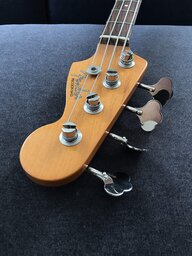
Sorry, reposted with better image quality.
No worries! Especially when it's a bass as good-looking as that one! Nice!


TalkBass has been independent since 1998. Add your voice.
Create a free account to reply to discussions, view embedded media, and browse with fewer display ads.
Join free Log in
Want zero display ads or expanded classifieds tools? Compare plans.
Sorry, reposted with better image quality.

+1 I can honestly say that I've yet to touch the treble boost control on either my LG or LM in the years I've owned them. Both those basses sound reasonably 'period legit' to my ear (close enough in a mix anyway) in passive mode, and as you've heard in my clips, the only difference in active mode is the classic buffering effect you get with any active circuit (a bit more deep low end and a bit more sparkle way up high).
Seems like Jimmy revoiced the LM's quite a bit from the New York shop days based on Tom and Peter's comments. I guess that isn't good nor bad, but I like that very pronounced upper mid grind that, to me, defines the 70's sound. There still seems to be some confusion by some thinking that LG's somehow don't have treble extension. If anything, they can sound more 'sparkly' up top, since they don't have that strong upper mid grind that masks the top end sizzle a bit. However, dialing in an active treble control ain't gonna do it for most. Like you say, artificial and 'electronic' sounding. Again, the 70's thing to my ear is all about upper mid and lower treble grind, not pure upper treble sizzle.
As I've commented a zillion times before, the top end of my LG, if anything, has more pure upper treble sparkle than my LM... it's that brightness and grind in the LM's upper mid/lower treble that just kills in a more aggressive pop/funk setting.
That being said, I've played so many 70's J's, and they all sound quite different. I've played ones that sounded close to Marcus Miller's active tone in stock 'off the shelf' passive configuration, and I've played others that were quite dark, and had more mid punch and less grind.
Wood and its interaction with electronics is a funny thing and is quite hard to predict given spec only info.
That being said, Jimmy obviously changed his approach and spec and voicing on the LM's since mine was made in New York. I guess only the individual player can decide if that was a move in the positive direction.
In addition to the Marcus bass I had at the house last week, a friend also came by with a '78 last night. They both sound a little bit different then the LM, while also sounding different from one another. The '78 being all passive, but sounding "active".
Without those basses around to A/B it is harder to hear the difference in the upper mids/lower highs. My LM just sings and without those basses to directly compare to I doubt I would have made the comments I did about the tonal difference.
It's also worth noting Jimmy's pickups and preamps have not changed from his NYC days. I traded emails with Jimmy and he says any tonal difference would be associated with the wood only. My body is the same as any NYC the neck however is a little thicker in the lower positions and of course is a one piece (fingerboard and neck are the same piece of wood not two pieces glued together), I believe but am not quite sure that the headstock may be a touch larger. The body could be considered moderate weight, it's not super heavy as was both Fenders I referenced and not light like Ken's bass or the Sadowsky UV70 I had.
I don't want anyone to take my comments the wrong way, I totally love the sound and feel of this bass and was only attempting to call it as I hear it vs. the other basses I was able to get my hands on at the time.
I consider myself very fortunate to have what might be the ultimate 60s and 70s fenders in their modern 5 string form...



+1 Every bass sounds quite different, even with the same electronics and spec'd similarly/identically. I had two Celinder Udates spec'd virtually identically (one was about a pound lighter than the other). One was the literal definition of 'Marcus Miller on Steroids' active J bass tone... massive low end, MASSIVE sizzle up top. The other one was low mid punchy, grindy in the upper mids, and a bit polite in the upper treble region. Go figure
+1 I have a 72 J (alder/maple, 70's spacing - the RA5 specs) that sounds VERY different from my 79 J. And my LM5 sounds very different from both of them, even thuogh it's actually closer to the 72 than the 79.
Ken, you mentioned the Celinder J-Update. How would you compare the sound of that bass to your LM5? I have both an LM5 and a J-Update 5 right now, and they sound like night and day (EXTREMELY DIFFERENT) even though they both seek to mimic a late 70's ash/maple bass with 70's spacing.
Both of them sound fantastic, but in unique ways, so they actually complement each other quite well. The natural sound of my Celinder is much less pleasing at first, but it sits in the mix like no other bass I own (or have owned). The LM5 sounds better on its own, but I need to work a little harder to find the perfect balance (probably due to that fact that I have only had it for a few weeks...).
BTW, the same goes for Precisions. I have owned/own 5 different P basses form the mid to late 70's, and all of them sounded different... Even the ones that were close in both manufacturing years and serial numbers. I think the 70's was quite an inconsistent century for Fender in terms of build procedures and quality. Some of the best basses I have ever played are 70's models - as is some of the worst...
Lichtaffen;
Labella 760FL are much more motown that chromes.


f/s only
2008 LG5 alder / rosewood
I hate to let this bass get away but unfortunately the 19mm spacing in too much for me.
----------------------------------------------------------------------------------------------------
Hello Lullbass ,
Nice LG 5 , is the 19 mm spacing due to the Hipshot bridge?
By the way, if you use the full word form for "I'm" and "Lovin", then "I'm Lovin' It" is a palindrome for "Ailing Vomit".

I hate to let this bass get away but unfortunately the 19mm spacing in too much for me.
Nice LG 5 , is the 19 mm spacing due to the Hipshot bridge?
All Jimmy's basses are 19mm spacing...Do you have a custom bridge on your LM?
All Jimmy's basses are 19mm spacing...Do you have a custom bridge on your LM?
Hey Jonno ,
I dont have a custom bridge on my LM , but today i checked the Hipshot website and it seems they have different spacings ( but i guess Jimmy only uses the 19 mm spacing).
"Hipshot Style B Bass bridges are available in a wide variety of string spacing; in your choice of aluminum or brass. Type B saddles feature solid brass barrel saddles and quick release string loading. All Hipshot bridges are CNC machined from solid aluminum or brass billet. Precision side-to-side saddle fit provides maximum support for superb tone and rattle free performance
Hey Jonno ,
I dont have a custom bridge on my LM , but today i checked the Hipshot website and it seems they have different spacings ( but i guess Jimmy only uses the 19 mm spacing).
"Hipshot Style B Bass bridges are available in a wide variety of string spacing; in your choice of aluminum or brass. Type B saddles feature solid brass barrel saddles and quick release string loading. All Hipshot bridges are CNC machined from solid aluminum or brass billet. Precision side-to-side saddle fit provides maximum support for superb tone and rattle free performance
Most 5 strings have 19mm spacing, since that results in a 'between string' feel that is similar to the classic 4 string spacing. So, most boutique J's (virtually all) have the 'standard' 19mm spacing.
I guess if you are used to narrow spacing (like the Music Man 5 strings), or are a new 5 string user, the neck can feel pretty wide and big. However, with a little bit of time, most can adjust with no problem.
However, if it doesn't work for you, it doesn't work. Also, remember that nut width can really make a difference in the feel of the 'size' of the neck independent of the bridge spacing. I love the more standard 1 7/8's nut spacing on J's like the Alleva and Sadowsky (I think that's the measurement). However, the 1 3/4" nut spacing of, for example, the FBass J Bass model makes that neck feel much smaller, even though the bridge spacing is still 19mm.
Most 5 strings have 19mm spacing, since that results in a 'between string' feel that is similar to the classic 4 string spacing. So, most boutique J's (virtually all) have the 'standard' 19mm spacing.
I guess if you are used to narrow spacing (like the Music Man 5 strings), or are a new 5 string user, the neck can feel pretty wide and big. However, with a little bit of time, most can adjust with no problem.
However, if it doesn't work for you, it doesn't work. Also, remember that nut width can really make a difference in the feel of the 'size' of the neck independent of the bridge spacing.
Thanks Kjung ,
For the record : I am fine with my LM and 19 mm spacing .
Unfourtunately LullBass is not, its a pity its a great LG 5 he has got there.
Also, remember that nut width can really make a difference in the feel of the 'size' of the neck independent of the bridge spacing.
Very very true...If your used to a more narrow spacing you may want Jimmy to do a 1 3/4 nut width for you instead of his standard 1 7/8...
Thanks Kjung ,
For the record : I am fine with my LM and 19 mm spacing .
Unfourtunately LullBass is not, its a pity its a great LG 5 he has got there.
Yeah, that's a beautiful bass!



