• TalkBass has been independent since 1998. Add your voice.
    Create a free account to reply to discussions, view embedded media, and browse with fewer display ads.
    Join freeLog in
    Want zero display ads or expanded classifieds tools? Compare plans.

Club Alleva-Coppolo (Part 15)

Status
Not open for further replies.
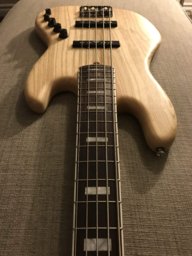
That spec really does the upper treble sizzle quite well, versus IMO and IME the more Marcus upper mid grind. Nice tone profile... wide, smooth, lots of upper treble extension if it is similar to the other RA's I've owned and played. As you say, more of an early 70's thing versus the more familiar tone of the later 70's influenced LM's. Not really the spec I would have thought Joel would go for, but a nice one nonetheless.

Definitely not my "typical" spec. I've got an army of Ash/Maple basses to prove it! I also have been spending a lot of time with my Brazilian/Alder Sadowsky PJ5 over the last couple of years. So, I guess I'm more tonally flexible than I thought!

I do think it's going to be a really cool bass though and worth checking out. I think it might actually end up working pretty well for me.

JC
 
Definitely not my "typical" spec. I've got an army of Ash/Maple basses to prove it! I also have been spending a lot of time with my Brazilian/Alder Sadowsky PJ5 over the last couple of years. So, I guess I'm more tonally flexible than I thought!

I do think it's going to be a really cool bass though and worth checking out. I think it might actually end up working pretty well for me.

JC

That one is a beauty!
 
I'm finally in! I should have this baby in a week or so. I've been wanting both an AC and an Orange bass for a while -- and as luck would have it, this is both of those things. :hyper:

DSC00834.gif


I was THIS close to snagging that bass! you lucky dog :)
 
Hey guys. For you 'Fender history' fans, I was reading through the Time's 'Best Books of 2010' and came across:

Fender: The Golden Age: 1946-1970 by Kelly, Foster, & Kelly.

Just arrrived, and it is a fantastic history of the company and also the various instruments made during that period. Beautiful pictures of dozens and dozens of classic instruments, amps, marketing materials and early shop activity. Well worth it!
Thanks for the heads up! Just reserved it for pickup at my local Barnes & Noble. Looking forward to checking it out tonight!
 
Thanks for the heads up! Just reserved it for pickup at my local Barnes & Noble. Looking forward to checking it out tonight!

Interesting that the only nit the reviewer had with this book is that most consider the 'Golden Age' of Fender to be the pre CBS age (46 to 65 or 66 or whatever). However, they make a pretty compelling case that the early 'post CBS' instruments are still considered 'classics' by many. I'm not really that up on the minutiae of that 'transition era', but interesting to see the evolution of all this stuff. LOTS of info on various P and J builds, along with the Mustang.
 
Interesting that the only nit the reviewer had with this book is that most consider the 'Golden Age' of Fender to be the pre CBS age (46 to 65 or 66 or whatever). However, they make a pretty compelling case that the early 'post CBS' instruments are still considered 'classics' by many. I'm not really that up on the minutiae of that 'transition era', but interesting to see the evolution of all this stuff. LOTS of info on various P and J builds, along with the Mustang.
Very cool. Some great reading for the weekend!
 
Interesting that the only nit the reviewer had with this book is that most consider the 'Golden Age' of Fender to be the pre CBS age (46 to 65 or 66 or whatever). However, they make a pretty compelling case that the early 'post CBS' instruments are still considered 'classics' by many. I'm not really that up on the minutiae of that 'transition era', but interesting to see the evolution of all this stuff. LOTS of info on various P and J builds, along with the Mustang.
I've read lots of stuff on this over time and the general opinion I've gathered is the 65 and 66 instruments are still considered pretty much the same from a valuation standpoint, since especially many of the 65's were made from the stuff that was done before Leo sold the company (in early '65.)

IMHO, CBS didn't really start messing with things from a cost cutting standpoint until the 70's, so even though the perception of value is still probably lower compared to pre-65's, I'd still feel like a late 60's J would be every bit the instrument an early 60's J would be.

Anyway, FWIW.
 
I'd still feel like a late 60's J would be every bit the instrument an early 60's J would be.

Anyway, FWIW.

I dont think so...I'm sure CBS added allot of employees in order to increase productivity and this in itself always has an overall effect on quality control...Even if the parts were the same through the mid sixties the hands building them were definitely different.
 
I've read lots of stuff on this over time and the general opinion I've gathered is the 65 and 66 instruments are still considered pretty much the same from a valuation standpoint, since especially many of the 65's were made from the stuff that was done before Leo sold the company (in early '65.)

IMHO, CBS didn't really start messing with things from a cost cutting standpoint until the 70's, so even though the perception of value is still probably lower compared to pre-65's, I'd still feel like a late 60's J would be every bit the instrument an early 60's J would be.

Anyway, FWIW.

I totally agree....about a year ago, some NYC buddies and I had a little vintage Fender party and I was one of the only guys with a post CBS Fender. But let me tell you, other than this guys '54 P, my '69 P felt and sounded better than everybody else's pre-CBSs. One guy with a '66 P even offered to trade me!!

Fender definitely started playing around with things in the later 60's (headstock logo change, poly lacquer, heavier cheaper woods, etc.) but I don't think the basses began to suffer until the 70s for sure. But obviously the difference between Leo owning the shop and CBS crankin 'em out is your difference in monetary "value".
 
I'm finally in! I should have this baby in a week or so. I've been wanting both an AC and an Orange bass for a while -- and as luck would have it, this is both of those things. :hyper:

DSC00834.gif

Enjoy it Joel, I miss her dearly. I took her home after NAMM 2010... I fell into MTD gas and traded her, no regrets but I miss her.

I guess my incoming LM5 and LG5 will have to do. :D
 
I dont think so...I'm sure CBS added allot of employees in order to increase productivity and this in itself always has an overall effect on quality control...Even if the parts were the same through the mid sixties the hands building them were definitely different.
I agree with your comment, but not your timeline.

Any time a company acquires another, and the result is a new business area for the company, they pretty much always take at least a year or two before they get involved in ways that could affect product. I've been through this exact thing personally three times now (tho not in music products) and it has gone that way every single time.

Same thing with Tobias and Gibson. There was a good chunk of time after the acquisition where it was pretty much the same stuff, hence the serial number check.
 
well maybe if he did, he'd have more players exclusively using AC stuff!

I see your point Mitch, but honestly I don't know if that's enough of a guarantee.

For example, I assume Hugh has a deal with Sadowsky, but it doesn't seem to stop him from playing other instruments.
I don't claim to know the details of their deal or any deal, I am only assuming there's a deal.

I guess you'd have to get paperwork and lawyers involved to ensure something like that. Cause as we all know, players change tastes. Some more than others.
 
I guess you'd have to get paperwork and lawyers involved to ensure something like that. Cause as we all know, players change tastes. Some more than others.
+1

Endorsement deals are simply co-promotional agreements just like any other. They can be as flexible or restrictive as the vendor and professional see fit. They may or may not be backed by written documentation with lawyers, but they certainly can be. Just depends on the relationship between the vendor and the professional.
 
I see your point Mitch, but honestly I don't know if that's enough of a guarantee.

For example, I assume Hugh has a deal with Sadowsky, but it doesn't seem to stop him from playing other instruments.
I don't claim to know the details of their deal or any deal, I am only assuming there's a deal.

I guess you'd have to get paperwork and lawyers involved to ensure something like that. Cause as we all know, players change tastes. Some more than others.

No, you're totally right....and being as small of an operation as Jimmy's is right now, throwing out endorsements wouldn't be very good for making $. It's a big enough of an endorsement just to see his basses being used by some of these big guys and knowing they DON'T have an endorsement!
 
Status
Not open for further replies.