• TalkBass has been independent since 1998. Add your voice.
    Create a free account to reply to discussions, view embedded media, and browse with fewer display ads.
    Join freeLog in
    Want zero display ads or expanded classifieds tools? Compare plans.

Club Fbass (thread 12)

Status
Not open for further replies.
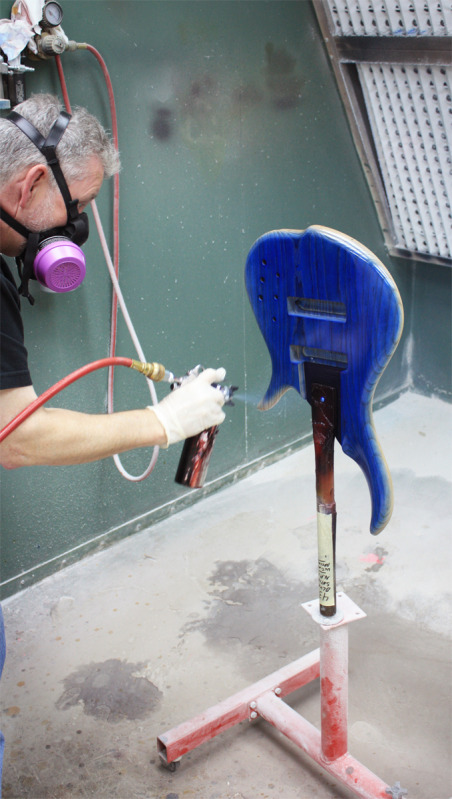
Marcel provided me with an updated photo of my BN6 today. They've begun to apply the color. Marcel advised me the gentleman in the photo is their finisher, Wes. (One of the men responsible for much of our F Bass GAS.)

My bass is approximately 2-3 weeks from completion. Progress seems to be flying by...

null_zpsbaf86797.jpg
 
Well I finally own one of George's masterpieces and I now understand first hand what all the fuss is about with these basses.

This is a 1987 BNF5, neck-through, passive, 34" scale that I just received today after having George refurb it in his shop for the last four months.

It's total fretless awesomeness.................WOW

May I have a number please?

file_zps4c227aa8.gif


file_zpsc99fdf9a.gif
 
Took delivery of my new AC5 a week ago (sold my BNF5 in the process). Damn near swallowed my tongue when I first saw it. Then did so again when I started to play.

Anyway, my original intention was to put TI Jazz Flats on it, as some of you here have done. I'm not so convinced I still want to do that, but have a question in case I go ahead. Adjusting saddle height on these babies is not the simplest of chores. For those who strung up non-exposed core strings (TIJFs / DDTs), were you able to get away with not adjusting the saddle height?
 
For those who strung up non-exposed core strings (TIJFs / DDTs), were you able to get away with not adjusting the saddle height?

I didn't, particularly the large strings were way too high. I trick I used in the past (back when I was not comfortable doing this on my own) was to just count the revolutions (turns) you gave to each screw when adjusting the bridge. Just keep a piece of paper, and keep count of what you do. If ever you get to the point of no return with the new strings, just move back to the original position, bring the old strings back, and you are back in business.
 
In a nutshell, yes.

I put TI jazz flats on my AC6, and the only slight issue is that the action on the B string is a bit higher than I would ideally like, but it's not enough to bother me. Having said that, it isn't my main bass...


For those who strung up non-exposed core strings (TIJFs / DDTs), were you able to get away with not adjusting the saddle height?
 
DR Black Beauties? Wow, I never thought about them. I bet they do sound wonderful.

I knew about Thor since his inception almost. Edmond and I communicated when he ordered it, and he sent me photos when he first got the bass, as well as a couple of [Invalid or Expired Link Removed].

Likewise George kept me apprised of Thor and sent me a few photos as well. I think many of us were quite curious about a fretted AC6, including Alain Caron, as you can see in that photo. I believe it was taken before it was sent out to Edmond in Israel.

At the time I had saturated my wife's capacity for saying "Yes," to new basses, so I was sad I couldn't get a fretted AC6. In her defense, I do have enough and am probably too greedy when it comes to basses.

Imagine my surprise when Thor appeared on the Fbass site for sale. I begged and pleased with Mrs. Tom7, but the only Yes I could get was if I sold basses I wasn't playing.

That was fine by me, but I was scared someone would buy it before I could get basses sold.

Enter Donovan. He was interested in the bass too. 6 strings aren't his thing, but he was curious and wanted to own it at least for a little bit. I told him I was selling a Fodera so I could get Thor, so he bought Thor knowing I would be buying it from him as soon as I raised the money. It was a win/win for all involved. In this video demoing Thor, Donovan mentions me by name.

Anyway, I had a 4-string Fodera Yin Yang that I loved but never played. I loved it because I love Victor Wooten, but I never played it because I never play 4-strings anymore.

I listed the Yin Yang on TB and instantly had a ton of interest, a sure sign my price was too low. I ended up selling it to Jason, the founding partner of Fodera who told me he wanted it for his own collection, but I guess he changed his mind because just weeks later he sold it on for a profit.

No matter, I now could get Thor, a 6-string bass that I would actually play.

Time passed, and I decided to go all in with a right hand fingerstyle I had been dabbling with. Among other things, it requires my left hand to learn to do the string muting, just like I have to do when I am slapping. However, because I'm an old dog trying to learn a new trick, I have to commit to it, otherwise I don't keep my left hand habits and my play gets super sloppy.

Soon after I realized that for me, 28 frets are 4 too many. After a year or so of denial, I came to terms with the fact that Thor was a tough fit for me now, just as the Yin Yang was before.

Musing aloud about Thor here, I was surprised to get private messages from 4 people expressing interest.

That reality check made me doubt I wanted to part with Thor, but after some soul searching, and realizing what a BETTER home he would have, I agreed to sell him.

I don't know if anyone cared about all that, but at least it fills in some of the gaps of history for Thor.

By the way, those ramps are AMAZING! Great decision, and even greater work, Fbass! Wow.

WILDWEST...Did you string those DR's through body or top load?

thanks
 
WILDWEST...Did you string those DR's through body or top load?

thanks

Through. I believe there is a supersonic reason (I may have read at some time on one of these forums) where the strings through the bass help the instrument's overall resonating capabilities, and since this was the way the strings were set by fBass I followed their suggestions.

You have to be sure that the E and B strings are completely passed though as because of their size they may get stuck (the surface of the strings is very close to the inner walls of the holes through the bridge)... other than that, worked perfect.
 
I didn't, particularly the large strings were way too high. I trick I used in the past (back when I was not comfortable doing this on my own) was to just count the revolutions (turns) you gave to each screw when adjusting the bridge. Just keep a piece of paper, and keep count of what you do. If ever you get to the point of no return with the new strings, just move back to the original position, bring the old strings back, and you are back in business.

Thanks Wild, but I think you may be referring to conventional bridges. The AC5 requires a more complicated process and the use of shims. It's not very difficult, but it does take some time.

Just in case anybody out there wants to know the 'how to' on this, and hasn't already got the F Bass instructions, I'll post them here for posterity:
_________________________________________________
AC saddle height instructions:
Open control cavity cover
Remove battery
Place bass on bench or other surface, where the cavity can remain exposed on the bottom
Loosen strings and remove
Unscrew bridge screws
Lift up bridge and remove wire retainer or copper foil. You may at this point need to push the piezo wires up from the cavity

RAISING THE ACTION
:
If you want to raise individual saddle, you need to add a “horseshoe” shim under it.
Push up the wire in question and slip the shim in

LOWERING THE ACTION:
Push saddle through the bridge, up from the bottom
Remove piezo elements
Now you may modify the wood saddle, either shave some off the bottom, if they all need to be lowered the same amount, (draw the saddle over a sheet of flat sandpaper) or if you want to do individual adjustments, you must remove material on the surface that the piezo element seats upon. Use a small file and make sure you get the corners. The upright posts are somewhat fragile. Handle with care.

RE-ASSEMBLY:
Slide the elements back on the saddle, in colour orientation, C-black, G-blue, D-green, A-yellow, E-orange, B-red.
Push the saddle back up into the bridge
Replace the wire retainer, to keep the wires bunched up inside the bridge, so that they do not get pinched between the botttom of the bridge and the top of the instrument and eventually short out.
Guide wires back into the control cavity
Seat the bridge, making sure it is in the correct position.
If there is any play in the bridge positioning, make sure the G string saddle measures 34.5 inches from the nut (or whatever scale length the instrument is)
Hold the bridge in place and screw back on, with gentle/firm pressure, so as not to split the bridge
Place the wires as before in the cavity
Re-string
 
  • Like
Reactions: ZuluFoxtrot
Thanks Wild, but I think you may be referring to conventional bridges. The AC5 requires a more complicated process and the use of shims. It's not very difficult, but it does take some time.

Just in case anybody out there wants to know the 'how to' on this, and hasn't already got the F Bass instructions, I'll post them here for posterity:
_________________________________________________
AC saddle height instructions:
Open control cavity cover
Remove battery
Place bass on bench or other surface, where the cavity can remain exposed on the bottom
Loosen strings and remove
Unscrew bridge screws
Lift up bridge and remove wire retainer or copper foil. You may at this point need to push the piezo wires up from the cavity

RAISING THE ACTION
:
If you want to raise individual saddle, you need to add a “horseshoe” shim under it.
Push up the wire in question and slip the shim in

LOWERING THE ACTION:
Push saddle through the bridge, up from the bottom
Remove piezo elements
Now you may modify the wood saddle, either shave some off the bottom, if they all need to be lowered the same amount, (draw the saddle over a sheet of flat sandpaper) or if you want to do individual adjustments, you must remove material on the surface that the piezo element seats upon. Use a small file and make sure you get the corners. The upright posts are somewhat fragile. Handle with care.

RE-ASSEMBLY:
Slide the elements back on the saddle, in colour orientation, C-black, G-blue, D-green, A-yellow, E-orange, B-red.
Push the saddle back up into the bridge
Replace the wire retainer, to keep the wires bunched up inside the bridge, so that they do not get pinched between the botttom of the bridge and the top of the instrument and eventually short out.
Guide wires back into the control cavity
Seat the bridge, making sure it is in the correct position.
If there is any play in the bridge positioning, make sure the G string saddle measures 34.5 inches from the nut (or whatever scale length the instrument is)
Hold the bridge in place and screw back on, with gentle/firm pressure, so as not to split the bridge
Place the wires as before in the cavity
Re-string

Does anyone have instructions for lowering the action of a Ebony bridge BNF5?
 
What is a "horseshoe" shim? Is it something I need to buy or can it be made?

I just got a used AC-5 and I think I might want to raise the action a bit. I'm not 100% sure yet though.

There's a very fine violin-maker in town here who can make anything out of wood I need if I give him some specs.


Thanks,

Martin

Thanks Wild, but I think you may be referring to conventional bridges. The AC5 requires a more complicated process and the use of shims. It's not very difficult, but it does take some time.

Just in case anybody out there wants to know the 'how to' on this, and hasn't already got the F Bass instructions, I'll post them here for posterity:
_________________________________________________
AC saddle height instructions:
Open control cavity cover
Remove battery
Place bass on bench or other surface, where the cavity can remain exposed on the bottom
Loosen strings and remove
Unscrew bridge screws
Lift up bridge and remove wire retainer or copper foil. You may at this point need to push the piezo wires up from the cavity

RAISING THE ACTION
:
If you want to raise individual saddle, you need to add a “horseshoe” shim under it.
Push up the wire in question and slip the shim in

LOWERING THE ACTION:
Push saddle through the bridge, up from the bottom
Remove piezo elements
Now you may modify the wood saddle, either shave some off the bottom, if they all need to be lowered the same amount, (draw the saddle over a sheet of flat sandpaper) or if you want to do individual adjustments, you must remove material on the surface that the piezo element seats upon. Use a small file and make sure you get the corners. The upright posts are somewhat fragile. Handle with care.

RE-ASSEMBLY:
Slide the elements back on the saddle, in colour orientation, C-black, G-blue, D-green, A-yellow, E-orange, B-red.
Push the saddle back up into the bridge
Replace the wire retainer, to keep the wires bunched up inside the bridge, so that they do not get pinched between the botttom of the bridge and the top of the instrument and eventually short out.
Guide wires back into the control cavity
Seat the bridge, making sure it is in the correct position.
If there is any play in the bridge positioning, make sure the G string saddle measures 34.5 inches from the nut (or whatever scale length the instrument is)
Hold the bridge in place and screw back on, with gentle/firm pressure, so as not to split the bridge
Place the wires as before in the cavity
Re-string
 
I love coming to this Club to see all the eye candy, and hope to some day have my own Fbass...

I gotta say, for such amazing basses, the thread names are rather dull and boring, not in keeping with the basses. Club Fbass (thread 10) (thread 11) (thread 12). :hmm:

Throw in some hyperbole, or something witty, humorous ... anything to make the title pop as much as the Fbass finishes. Get creative.
Here's some suggestions for the next iteration:

"Club Fbass Unlucky 13, Thank Your Lucky Stars You Have an Fbass" or
"Club Fbass, The Baker's Dozen (Thread 13)" or
"Club Fbass, a Standard Torus Cut 3 ways";
"Club Fbass, Thread 13, A Full Chromatic Octave";
"Club Fbass XIII, Card of Death";
"Club Fbass XIII, Triskaidekaphobia? What Triskaidekaphobia?
"Is it the sixth prime number? The smallest Emirp? The third ordered Bell number? One of the Three Wilson Primes? Perhaps a cheesy prepubescent musical? NO! It's Club Fbass Prime Time, Part 13!

$0.02 devalued by extreme inflation from a non-owner, non-member – so take it for what it isn't worth. :D
 
Status
Not open for further replies.