• TalkBass has been independent since 1998. Add your voice.
    Create a free account to reply to discussions, view embedded media, and browse with fewer display ads.
    Join freeLog in
    Want zero display ads or expanded classifieds tools? Compare plans.

Damnation Audio Fan/Appreciation Thread

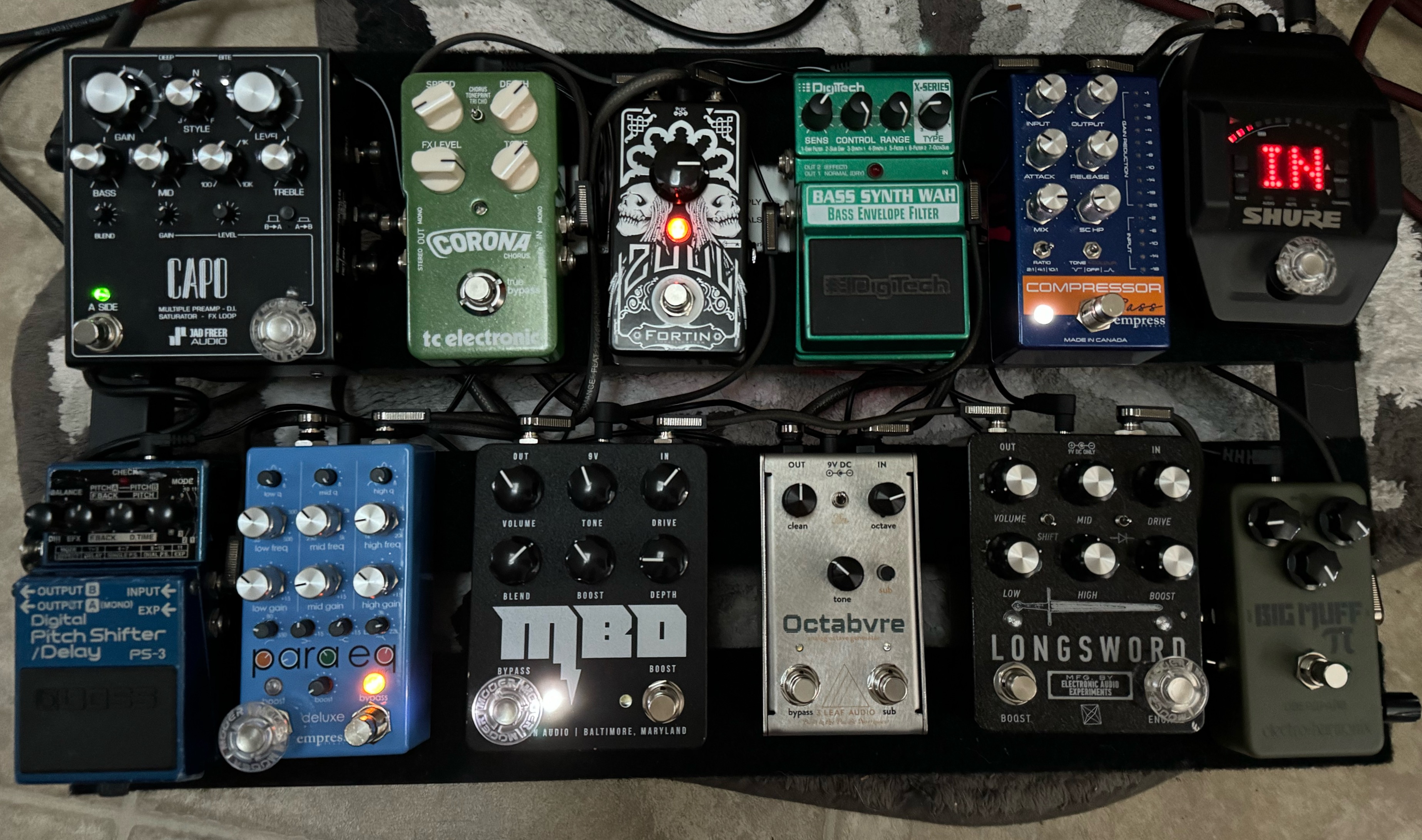
MBD is still carrying my board along with the CAPO - I have been using my MM Bongo while my Dingwall is being set up ahead of some upcoming shows, and it kills even on a bass that sounds very different than what I've been using with this band

Just like day 1, I've got the main drive set up as a tone similar to Timmy C's main drive tone, and then the boost gets it into DG alpha Omega territory (but better imo - I've compared back to back quite a bit)
IMG_1579.jpeg
 

Attachments

  • IMG_1414.jpeg
    IMG_1414.jpeg
    628.5 KB · Views: 13
Anything specific I should cover at the dirt clinic?
  • The MBD is an original design in a market saturated with clones. This is pretty cool. I'd stress this and also talk about how it came to be: the various evolutions, the challenges in the design process, etc.
  • Funny stories about Dave; @whoismarykelly should tell funny stories about Jeff
  • Future plans
  • Things you've learned along the way and how your philosophy as a small business owner has changed
  • Encourage people to sign up for the newsletter. The dry humor is not to be missed.
 
Weird question, but anyone know what value input capacitor is in the MBD? I'm taking a pedal building class right now and now I'm curious what value is in the MBD.
Which one? The first input is 100n with a 1M bias resistor. The depth control mixes a 4n7 with a 100n with a 47k input impedance to the distortion blocks.
 
Weird question, but anyone know what value input capacitor is in the MBD? I'm taking a pedal building class right now and now I'm curious what value is in the MBD.

To add a bit to what Jeff said earlier, the input cap value in and of itself doesn't mean much. For most pedals the input cap creates a high pass filter with a bias resistor going to a voltage reference and the way that maths out you can have a pretty small input cap that effectively passes all signal well below the range of human hearing.

For example, the 22n input cap on a Rat creates a ~7Hz filter with the 1M bias resistor on the gain stage which is why making the input cap bigger (a common way people try to mod things 'for bass') makes no difference.

Sometimes a value is arbitrary because it will work in that position and simplifies the parts list for the pedal.
 
  • Like
Reactions: Zanshin_
To add a bit to what Jeff said earlier, the input cap value in and of itself doesn't mean much. For most pedals the input cap creates a high pass filter with a bias resistor going to a voltage reference and the way that maths out you can have a pretty small input cap that effectively passes all signal well below the range of human hearing.

For example, the 22n input cap on a Rat creates a ~7Hz filter with the 1M bias resistor on the gain stage which is why making the input cap bigger (a common way people try to mod things 'for bass') makes no difference.

Sometimes a value is arbitrary because it will work in that position and simplifies the parts list for the pedal.
Thanks! I was under the impression that the higher that value the more low end it allowed. I'm sure I'm oversimplifying it.
 
Thanks! I was under the impression that the higher that value the more low end it allowed. I'm sure I'm oversimplifying it.

There are some cases where that is true but it depends on the math. A bigger input cap will allow more bass in situations where the input cap is intentionally small to attenuate low frequencies.

A dallas rangemaster treble booster has a 5nf input cap which, in combination with the bias circuit, attenuates all frequencies below about 2500Hz. Making that input cap bigger will pass more bass.
 
  • Like
Reactions: BklynKen

Latest posts