
Lol I was so wrongI just did a quick plot of blend 100%, drive 0%, volume/tone 50% on the MDB (NOTE: I don't completely trust the amplitudes here, need to mess with this tool a bit more. NOTE 2: there might be an issue with the test signal, so I'll try this gain later too):
View attachment 5470177

Enjoy the benefits of a premium membership!
Upgrade Account
-
TalkBass has been independent since 1998. Add your voice.
Create a free account to reply to discussions, view embedded media, and browse with fewer display ads.
Join free Log in
Want zero display ads or expanded classifieds tools? Compare plans.
You are using an out of date browser. It may not display this or other websites correctly.
You should upgrade or use an alternative browser.
You should upgrade or use an alternative browser.
More options
Who Replied?
You had the right shape, just the numbers were a bit offLol I was so wrong


I just did a quick plot of blend 100%, drive 0%, volume/tone 50% on the MDB (NOTE: I don't completely trust the amplitudes here, need to mess with this tool a bit more. NOTE 2: there might be an issue with the test signal, so I'll try this gain later too):
View attachment 5470177
This is awesome. I know we're in the damnation thread, but could you do a frequency response plot of the character knob on the Darkglass Harmonic Booster? I've wanted to see that forever, and the HB and MBD2 are the foundations of my sound for the last year or so

I just did a quick plot of blend 100%, drive 0%, volume/tone 50% on the MDB (NOTE: I don't completely trust the amplitudes here, need to mess with this tool a bit more. NOTE 2: there might be an issue with the test signal, so I'll try this gain later too):
View attachment 5470177
Very cool.
It would be interesting to see how flat you could make the response using the contour and EQing the parallel dry signal (nothing in the loop) then playing through it with a bass to compare that to your bypassed tone.
Would it sound like two different signals, or a bigger version of your bypassed tone?
I don't have a HB anymore, but I believe it should be the same EQ curve as a B3K (except clean). I've previously used a B3K based EQ curve on my EQ2 and it sounded pretty close to the HB. I haven't unpacked my EQ2, but this is a screenshot I previously made (the generated graph doesn't quite match the numbers on the sliders, I think the mid cut is too deep for the UI to handle):This is awesome. I know we're in the damnation thread, but could you do a frequency response plot of the character knob on the Darkglass Harmonic Booster? I've wanted to see that forever, and the HB and MBD2 are the foundations of my sound for the last year or so
There are also some graphs made by others of the B3K:
Hope that helps!
Channeling the Oxblood V1 with some new Davies 1400 knobs for my MBD3.
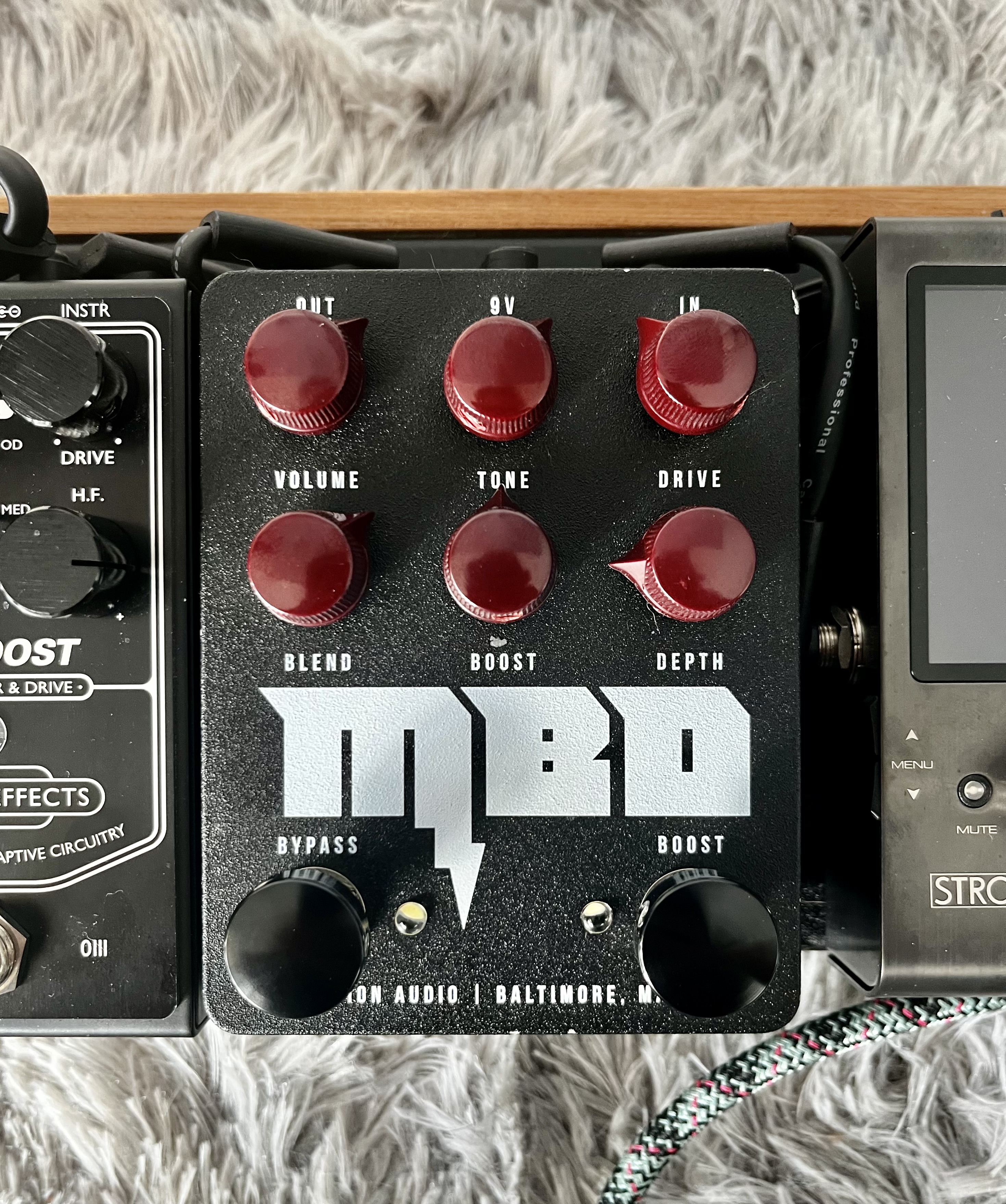

Channeling the Oxblood V1 with some new Davies 1400 knobs for my MBD3.
Here's hoping that these 1400 knobs age better than the ones on the original.
Here's Jeff's photo from when he decided on them:

And here's how mine look today, 6 years later:

But hey, knobs are cheap and readily available, and your MBD3 looks great with those knobs!

I beg to differ. I like them aged. They're like a fine wine.Here's hoping that these 1400 knobs age better than the ones on the original.
Here's Jeff's photo from when he decided on them:
View attachment 5472193
And here's how mine look today, 6 years later:
View attachment 5472194
But hey, knobs are cheap and readily available, and your MBD3 looks great with those knobs!
I beg to differ. I like them aged. They're like a fine wine.
I mean, I don't mind them. Despite knobs being cheap and readily available, I've not felt a want to replace the ones on mine.
However, IMHO, they definitely looked nicer new.
The only difference I see is one high res well lit picture vs. a low res poorly lit picture.Here's hoping that these 1400 knobs age better than the ones on the original.
Here's Jeff's photo from when he decided on them:
View attachment 5472193
And here's how mine look today, 6 years later:
View attachment 5472194
But hey, knobs are cheap and readily available, and your MBD3 looks great with those knobs!
The only difference I see is one high res well lit picture vs. a low res poorly lit picture.
I'd never dare claim to be anything more than an abysmal photographer

Here's what I'm hoping to be a more useful photograph:

Perhaps the difference is still only in the total quality of each picture, in which case we can safely assign what I'm seeing in person to the psychovisual realm.
Regardless, this is of no real importance, and wasn't mentioned as a point for or against the pedal itself.

One (minor) complaint about the MBD3.
I've owned a MBD-1 for 6 years now.
The bypass switch is on the right.
On the MBD3, it's on the left.
I often find myself going for the boost switch out of instinct.
I've owned a MBD-1 for 6 years now.
The bypass switch is on the right.
On the MBD3, it's on the left.
I often find myself going for the boost switch out of instinct.

That's an interesting point. My MBD is always on, so I guess I never thought about it.One (minor) complaint about the MBD3.
I've owned a MBD-1 for 6 years now.
The bypass switch is on the right.
On the MBD3, it's on the left.
I often find myself going for the boost switch out of instinct.
Only (also minor) complaint I have about the MBD3 is that the finish seems to chip fairly easily. I don't even know how mine got chipped, but then I've seen a couple more like that as well.

On the MBD3, it's on the left.
The reason for the footswitch alignment is most people are right handed and tap pedals with their right foot. When I lay out hardware on a design I don't want to be stepping over the switch that could turn the pedal off to turn on the 'extra feature' of the pedal.
I'm left-handed and play left-handed, but I'm well used to having to deal with a right-handed world. My instrument cable I got right-angle to right-angle because I realized the best way to route from tuner pedal (first) to bass is out around the back of my board and out to the bass. But hey, I'm likely to die early from right-handed power tools. So yay me.The reason for the footswitch alignment is most people are right handed and tap pedals with their right foot. When I lay out hardware on a design I don't want to be stepping over the switch that could turn the pedal off to turn on the 'extra feature' of the pedal.
Only (also minor) complaint I have about the MBD3 is that the finish seems to chip fairly easily. I don't even know how mine got chipped, but then I've seen a couple more like that as well.
Yeah, I’ve had that with mine too, a few little chips here and there from very minimal handling. There’s one just above the boost knob label that I have no idea how it happened! Adds some character I guess!

I just sold my MBD3, but had the exact same chipping issue. Still sounded awesome though
I can appreciate your reasoning, but this doesn't track with me at all.The reason for the footswitch alignment is most people are right handed and tap pedals with their right foot. When I lay out hardware on a design I don't want to be stepping over the switch that could turn the pedal off to turn on the 'extra feature' of the pedal.
I'm lefty, but it doesn't mean I favor my left foot.
I actually tend to favor my right.
And if I'm going for a foot switch, I'm stepping out directly towards it. Not over the pedal, and panning to the desired foot switch.
So many people these days favoring 125b enclosures with all top jacks, tightening up so many pedalboards.
If the signal flow is generally right to left (input/output), wouldn't it make sense for dual switches to remain the same?
Or, am I just being an arsehole?
Last edited:

As a fellow lefty, I pretty much agree on all accounts. I don't have many dual switch pedals (actually, I have none of them for bass), but of course the ones I do have (for guitar) serve the same function and have opposite arrangements... I don't gig or anything, so no big deal, but I've occasionally hit the wrong switch.I can appreciate your reasoning, but this doesn't track with me at all.
I'm lefty, but it doesn't mean I favor my left foot.
I actually tend to favor my right.
And if I'm going for a foot switch, I'm stepping out directly towards it. Not over the pedal, and panning to the desired foot switch.
So many people these days favoring 125b enclosures with all top jacks, tightening up so many pedalboards.
If the signal flow is generally right to left (input/output), wouldn't it make sense for dual switches to remain the same?
Or, am I just being an arsehole?
I can appreciate your reasoning, but this doesn't track with me at all.
I'm lefty, but it doesn't mean I favor my left foot.
I actually tend to favor my right.
And if I'm going for a foot switch, I'm stepping out directly towards it. Not over the pedal, and panning to the desired foot switch.
Different strokes I guess. I design stuff how I like it to work for me. I've experienced enough issues with bypass switches on the right being an issue with dirt pedals that I make all mine with bypass switches on the left.
So many people these days favoring 125b enclosures with all top jacks, tightening up so many pedalboards.
I wouldn't want to make a two footswitch pedal in a 125B. Very little margin for error during a hectic set which is how most of my music is. Some brands really make it work and its their thing. I'd prefer to almost exclusively work in 1590BB2s but we do have some 125B stuff in the works because I know folks like to save a bit of room.
If the signal flow is generally right to left (input/output), wouldn't it make sense for dual switches to remain the same?
The bypass switch and the boost switch aren't really related to signal flow. One turns the pedal on and off. The other changes parameters in the circuit. I guess we could have made the pedal many other ways but this is the way we made it.
Or, am I just being an arsehole?
Nah different people like different stuff. There are like 1000 pedal brands so hopefully everyone can find stuff that works for them!
Answers in the quote


