

Enjoy the benefits of a premium membership!
Upgrade Account
-
TalkBass has been independent since 1998. Add your voice.
Create a free account to reply to discussions, view embedded media, and browse with fewer display ads.
Join free Log in
Want zero display ads or expanded classifieds tools? Compare plans.
You are using an out of date browser. It may not display this or other websites correctly.
You should upgrade or use an alternative browser.
You should upgrade or use an alternative browser.
Dingwall Owners Club
- Thread starter FroggyOne2
- Start date
More options
Who Replied?The later ones have an extra strap button in the back to move the nut about 1.5" closer to your body if you choose to use it.THE separated pickups are 95% or more percent of the time gonna be super fatties. I really enjoy those pick ups. They are a bit “calmer” then FD3s and such.
Other then that the bridge pieces may be slightly different with a side post for the string ring to sit on.
I betcha neck and body construction is quite similar to modern ones.
Not sure if the dual density body wood was always a thing - I think that may be more recent.
The knobs have changed from slippery, hard and skinny with a nipple position marker to tacky, softer and fatter with a dimple position marker.
They switched over from Super Fatty pickups to FD3's for a while, then FDV's became standard.
The weights can vary widely, from high 8's (rare) to about 10 lbs depending on wood and other options. Mid 9's is typical. Age is probably not a determining factor as much as just the wood itself.
The paper that accompanies the toolkit used to tell you which wrench was for what function, but didn't tell you the wrench sizes. The wrench sizes were eventually added on the piece of paper, which is very helpful if you misplace a wrench.

No, those just switch each pickup from series wiring to parallel wiring for its two coils.Does the cluster of 3 switches indicate fd3s?

No, those just switch each pickup from series wiring to parallel wiring for its two coils.
And they can be applied to any Canadian 3x model I believe.
Did the type of strap button change at some point? the most recent ones look to be flush Dunlops.
B>
B>

- Sep 3, 2006
- 4,358
- 6,117
- Disclosures
- Authorized dealer for Dingwall, Genzler, Phil Jones Bass, Cort, Traynor, Yorkville Sound
No, those just switch each pickup from series wiring to parallel wiring for its two coils.
Yes, any Canadian bass with 3x can be ordered with S/P switches. To me, it is a no-brainer to add them as this opens up so many tonal possibilities. Although many of us find a tone we like and kinda stick with it, one never knows when we may want variation due to genre or recording.And they can be applied to any Canadian 3x model I believe.

Any of you folks out there with smaller hands/arm length have issues with 5 strings Dingwalls (SKLAR, ABZ5)??

IvanBassist
Commercial User
- Jun 8, 2008
- 3,744
- 11,129
- Disclosures
- Content Manager at Darkglass Electronics, Dingwall Guitars Artist
Playing on the lower frets definitely felt like a bit of a stretch to me when I had an ABZ.Any of you folks out there with smaller hands/arm length have issues with 5 strings Dingwalls (SKLAR, ABZ5)??
Now that I have a SJ, it's all good
 I'm 5'3-5'4 btw
Playing on the lower frets definitely felt like a bit of a stretch to me when I had an ABZ.
Now that I have a SJ, it's all good
I'm 5'9 but I don't have Sklars wingspan lol.

I am 5’10”. I have a Ab1 and an Abz5. I have no issue when on a strap. Sitting it’s a long reach but in a strap it feels like my 34”-35” scales to me.
IvanBassist
Commercial User
- Jun 8, 2008
- 3,744
- 11,129
- Disclosures
- Content Manager at Darkglass Electronics, Dingwall Guitars Artist
I think the "reach reducing" pin on the back helps a lot, though. Back when I had mine that feature didn't come installed from the factoryI'm 5'9 but I don't have Sklars wingspan lol.

I'm 5'10" and in general didn't have any problems with the 37" scale. However, now that I'm a senior citizen, my speed and stretch are slightly compromised, and I believe the Super Series got me a more years of playing especially on some of the 1-4 walking bass lines required by some Country songs, e.g., Lonesome Me by the Kentucky Head Hunters
Any of you folks out there with smaller hands/arm length have issues with 5 strings Dingwalls (SKLAR, ABZ5)??
In all honestly to move fast on the lower frets on the B and E of my 6 strings can be more work then on a 5 string and definitely more work then my SJ. It’s not impossible or undoable. Just more work.
But a little extra work for the MASSIVE tone is worth it IMO.
That said my 6er is easily to play then some 5s of other normal scale brands which puts a 5 string long scale Dingwall easily justifiable in comparison I think.

5'6", average sized hands, first Dingwall was an ABZ5 which I later traded for an ABZ6. The reach on a Dingwall is similar to that of a typical 34" bass, and I bet the reach-reducing pin on the back makes it even better for shorter players.Any of you folks out there with smaller hands/arm length have issues with 5 strings Dingwalls (SKLAR, ABZ5)??

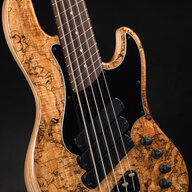
If you want to know what kind of pickups you have, it's really easy to unscrew one, lift it up and it will be labeled the back.Does the cluster of 3 switches indicate fd3s?

- Feb 3, 2005
- 7,331
- 10,197
- Disclosures
- Endorsing artist: Bergantino Audio Systems and GHS Strings
Hi guys!
It's hard to find details on the difference between the D'bird custom and the import version. Aside from being produced outside of Canada, does anyone have any hard facts for me?
I own the Canadian version. One difference would be some of the options. Besides the different colors between the 2 lines, the Canadian model has options such as a solid wenge neck and luminlay neck inlays.

Other than the neck options I’m pretty sure the Canadian version of the D bird has a different body contours on the back. But I may be miss remembering

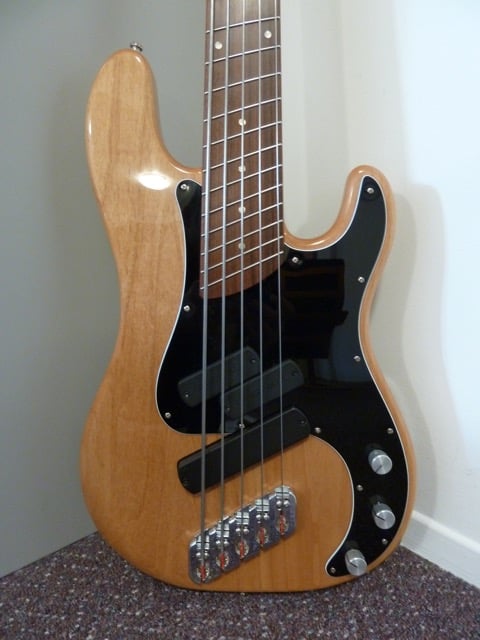
My SP5 is back and now sporting a bridge FDV, side mounted jack and a 4-position rotary switch. I will be restringing with rounds tonight.
Last edited:


