
• TalkBass has been independent since 1998. Add your voice.
    Create a free account to reply to discussions, view embedded media, and browse with fewer display ads.
    Join freeLog in
    Want zero display ads or expanded classifieds tools? Compare plans.

Dingwall Owners Club

It minimizes twist this way. Twist happens the more the string wraps around the the tuning peg... by prewrapping the tuning peg and inserting into bring at latest possible moment twist is reduced

To add to this the more wraps the less intonation and tuning accuracy a person will have. Think of it this way. When you introduce a spring or coil into any system you add flexibility. Decreasing the size of the coil reduces flexibility increasing accuracy.
Not so good on a 4x4 vehicle but quite logical on a bass guitar IMO. 1.5-2 wraps max is what I usually strive for.

8673AE33-2144-4CF7-BA70-4E39015CCB08.jpeg
 
To add to this the more wraps the less intonation and tuning accuracy a person will have. Think of it this way. When you introduce a spring or coil into any system you add flexibility. Decreasing the size of the coil reduces flexibility increasing accuracy.
Not so good on a 4x4 vehicle but quite logical on a bass guitar IMO. 1.5-2 wraps max is what I usually strive for.
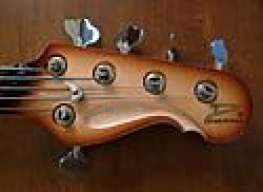
View attachment 3418003

But do more wraps introduce a spring into the system, or provide additional friction between the string and post to prevent slippage? Seems to me the wraps are north of the vibrating string length and therefore not in the system. However maybe I need more coffee today.
 
But do more wraps introduce a spring into the system, or provide additional friction between the string and post to prevent slippage? Seems to me the wraps are north of the vibrating string length and therefore not in the system. However maybe I need more coffee today.

Oh don’t you dare quote me as being correct here(which your not.... smrt on your part) !!! ;)

I hear exactly what your saying. I don’t think I can agree but I see the logic in that reasoning. I just dont think it quite applies that way.

If you have 3-4 coils and twist the tuner.
The tension is then applied and divided through the wraps. So as the tension increases and the string tightens/stretches the the entire length of the coil reducing fine tuning accuracy.
Also as the string gets used, with additional ability to play in the coil I would think tuning is more susceptible to change.

Perhaps one simple test would be to take a broken in string. String it with more wraps, give it a tug/stretch and see how in tune it still is. Cut some of the wraps, try it my way and do the same exercise. See which one stays closer to pitch?

I’m just pulling all of this outta my butt right now and I’m open to being wrong but that’s just how my brain applies it.
 
Last edited:
Oh don’t you dare quote me as being correct here(which your not.... smrt on your part) !!! ;)

I hear exactly what your saying. I don’t think I can agree but I see the logic in that reasoning. I just think it quite applies that way.

If you have 3-4 coils and twist the tuner.
The tension is then applied and divided through the wraps. So as the tension increases and the string tightens/stretches the the entire length of the coil reducing fine tuning accuracy.
Also as the string gets used, with additional ability to play in the coil I would think tuning is more susceptible to change.

Perhaps one simple test would be to take a broken in string. String it with more wraps, give it a tug/stretch and see how in tune it still is. Cut some of the wraps, time it my way and do the same exercise. See which one stays closer to pitch?

I’m just pulling all of this outta my butt right now and I’m open to being wrong but that’s just how my brain applies it.

This is making more sense as the caffeine sinks into my head today. The string should also be under tension as it wraps the post ... so it’s susceptible to stretching. I’ll buy that.
 
Am I the only person who strings from the tuner first and then slides the ballends into the bridge?


No, that's exactly how I do it as well for the same reason. I size the string (to cut to length) by putting it in the bridge and measuring out to the tuner. But once that is done, I insert and wrap at the tuner. As I get close to the required tension, that's when I put it into the bridge and make sure there is no twist in the string. The ball ends will go where they go. I used to try and align them perfectly, but that might induce some twist in the string.
 
No, that's exactly how I do it as well for the same reason. I size the string (to cut to length) by putting it in the bridge and measuring out to the tuner. But once that is done, I insert and wrap at the tuner. As I get close to the required tension, that's when I put it into the bridge and make sure there is no twist in the string. The ball ends will go where they go. I used to try and align them perfectly, but that might induce some twist in the string.

Same journey here
 
No, that's exactly how I do it as well for the same reason. I size the string (to cut to length) by putting it in the bridge and measuring out to the tuner. But once that is done, I insert and wrap at the tuner. As I get close to the required tension, that's when I put it into the bridge and make sure there is no twist in the string. The ball ends will go where they go. I used to try and align them perfectly, but that might induce some twist in the string.

I use the old string to measure the new string to locate the ninety-degree bend and to cut the part going into the tuner to the proper length. I wind the tuner with my left hand while maintaining tension with my right. I wind it a little further than needed, then unwind enough to allow seating the ball end in the bridge. Once again, I maintain tension with my right hand and wind with my left. Easy peasy. :)
 
  • Like
Reactions: BuffaloBob4343