
Enjoy the benefits of a premium membership!
Upgrade Account
-
TalkBass has been independent since 1998. Add your voice.
Create a free account to reply to discussions, view embedded media, and browse with fewer display ads.
Join free Log in
Want zero display ads or expanded classifieds tools? Compare plans.
You are using an out of date browser. It may not display this or other websites correctly.
You should upgrade or use an alternative browser.
You should upgrade or use an alternative browser.
Dingwall Owners Club
- Thread starter FroggyOne2
- Start date
More options
Who Replied?

Sorry to change chat direction here, but I have just found a 'Match Made in Heaven'.
Dingwall with new Payson reduced core strings thru' my new Reeves C225.
The PAYSON RC strings arrived just over a week before the Reeves arrived.
I have never been fond of the Dingwall D & G strings, they just don't have a tonal balance
across the strings, OK for slappers but not if you want a more musical, pleasant tone.
I am also not a fan of the 'Nolly' sound, I lean more towards the Squire / Entwistle sound.
I gigged the reduced cores the other night & have to say that they are the best strings I have ever
had & I have tried many throughout my long life.
They sat in the mix with what I can only describe as a tonal EnhancemenT to the overall bands' sound
texture, without being overly dominant, we play mainly blues / rock. Perhaps it could be due to the
piano'ish sound character adding & creating the illusion of having a keyboard in the line up.
It's always difficult to adequately describe ones perception of tonal texture to someone else.
I felt that they have these qualities, growly, snarly, strange harmonic richness, piano like
without harshness, not overly bright or aggressive & the D & G sounded balanced with the other strings.
At first, in my little music room, I felt they were over the top but my wife, who is not a sound expert &
is indifferent most of the time, said she loved them for the "alive" presence compared to other strings
she has heard me play. She surprised me. I'm sure my description could be a lot better if I
could think of the words to use.
In short, I love them.
Then shortly after that, the REEVES arrived.
View attachment 3584762
Full Sonic Spectrum while retaining the low mid thump. More energy in your sound and under your fingers. Very smooth on the fingers and easier on the frets.
I'm sure Payson will correct me if I'm mistaken, but I don't see any "reduced core" strings on his website. I know they were listed in the past, and I've tried them.
It’s still there, but as a description instead of nomenclature.
Ok I see it now. The website design has improved some, but has a ways to go. I've tried the reduced core but found the tension to be a little too much. (I assume "reduced core" means the core wire is hex.) So I switched to the "regular" medium lights instead. Might try the black coated strings when they become available.
What would you like to see different on the site? The front landing page has all the strings visible with a minimal scroll of the thumb. 2-3 ways to get to products and a way more intuitive pop out cart so you can see exactly what and the quantity you're purchasing.
If you like coated strings they are awesome. The one main annoyance with them is the lack of taper on the “B” but that’s fairly minor.
the feel is very similar to DR black beauties. I’d say same for tone.
Very clean and sterile as with other coated strings. Sound great for solo work or classical type stuff. I like them a lot but find that I’ve never been able to work with coated strings in Any band setting. I think for some of the jazzier/Latin type stuff we do they were a solid option but as soon as I had to do a bit of slapping I found them to be the wrong string tonally
All the strings will be tapered on the Payson Fanned Black Dagger V3’s except for the G. They are as close to the PFNS-RC sets as possible retaining the full spectrum tone. Should be able to switch ‘em out without any or very minimal set up.
I just took a set of these off of my NG-3/5 and my opinion, pretty much, mirrors yours. I was slightly more annoyed at the lack of taper on the B string and the fact that I had to go through a couple of B strings before I got one that worked. The first one started tapering before it got to the nut, so I had to wait for them to ship me another one. They took care of me and I got a B that worked, but I also found them to be a bit on the sterile side. Plus, they didn't really last that much longer than a non-coated set. I may try one more set, see if I can get one, continuous set, and see if that makes a difference. I'm actually looking forward to trying the upcoming Xtra-long Dunlop Super Brights. I used them, previously, on other basses and I really like them.
Thank you for your patience. The PFBD-V3’s will be tapered. I think coated strings have a built in broken-in sound out of the package by and large. But we are trying to minimize that with the V3’s.
The black one is in C w heavier strings than the white one in D#. That being said in passive mode in the parallell neck/bridge setting, the first thing that jumps out is the “More” in the white one. The wenge neck really adds punch and girth to the sound. The black one is definitely more subtle (although switching the pickups to series can really change the tone).
The white one sporting the Payson Fanned SS’s?




Can one of you with a Ducati White bass take a close-up picture of the finish while it's under a light?
Bringing this to the next page for any of you guys that can help out Silky here. He just finished building an amazing little studio and now he needs a beautiful white D-Roc to put in it.

It won't be a D-Roc. I'm going with a 4-string Super J 3X. Thanks for the studio compliment tooBringing this to the next page for any of you guys that can help out Silky here. He just finished building an amazing little studio and now he needs a beautiful white D-Roc to put in it.

Ahhhh, my mistake. This is giving me GAS flareups for an AB or Combi 4 string.It won't be a D-Roc. I'm going with a 4-string Super J 3X. Thanks for the studio compliment too

- Feb 3, 2005
- 7,331
- 10,197
- Disclosures
- Endorsing artist: Bergantino Audio Systems and GHS Strings

It won't be a D-Roc. I'm going with a 4-string Super J 3X. Thanks for the studio compliment too
Any chance we might be able to get a look at the new studio? I’m looking for ideas for a refresh of my own little studio...
All the details (in far too much detail) are here: My New Studio Build (perhaps overly detailed)Any chance we might be able to get a look at the new studio? I’m looking for ideas for a refresh of my own little studio...
Gotcha. There’s a certain 4 string AB that keeps grabbing my attention recently.FDV’s in the black one too.
Well, I now own 2 ABZ's. To say they are my favorite basses would be an understatement. The black one with the maple neck is all passive with the 3 series/parallel switches for each pickup. The white one has the solid wedge neck and is active with the Darkglass preamp. I think these are the perfect basses for me.
View attachment 3585831
What a fun pair.
Black beauties were me favorite strings when I had m SJ5. One thing I noticed is that they seemed to last forever.the feel is very similar to DR black beauties. I’d say same for tone.
Really looking forward to these. I have used them exclusively on my 34" scale bass over that years.I'm actually looking forward to trying the upcoming Xtra-long Dunlop Super Brights.

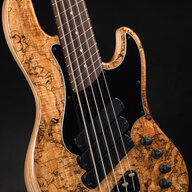
That fingerboard, and inlays!View attachment 3586183
I love this thing. It seems to change color depending on my mood.
Lots of love for the four string Dingwalls here.Finally home from work and getting ready to put #3 through its paces!View attachment 3586515
You know, I used to think that fanned frets on a four string were fairly pointless. Maybe it isn't strictly necessary, but Dingwall makes some really nice basses. I may do a NBD thread later, but for now, here's a quick comparison between my Super P and my D-Roc.Lots of love for the four string Dingwalls here.
The Super P is definitely a P bass. My favorite pickup combination is P only, and it sounds like a P. The pickup is at the more "mellow" end of the spectrum. The bass hangs comfortably on a strap, and the medium scale is perfect for me. Fit and finish are flawless, which is a trait both my Canadian basses have in common.
The D-Roc is completely different. Tone-wise, it is more aggressive, but I wouldn't say it sounds like a Thunderbird at all. It doesn't have the super-thick low end and muted top end that all my other 'birds have. The pickup selector and pickup placement is well designed; rotating the knob clockwise takes you from a thinner, cleaner sound to a thicker, fatter tone. If the switch had a couple more positions, the tone progression would get into 'bird territory. For me, it saves me all the thinning out and cleaning up of EQ that I do when I use a Thunderbird. This bass has a BIG low end, especially for a passive bass. It is humbucker-esque, with maybe a better top end.
The D-Roc is a player. The setup was spot-on right out of the box. The nut feels wider than the Super P, but I think that is because this neck is a little thinner than the fairly chunky P neck. I definitely notice the difference in scale length, especially when I play the low F.
The bass hangs on a strap perfectly, but that solution presents another problem. The neck joint interferes with upper fret access a little - it joins the body at the 14th fret as opposed to the 16th or 17th fret on the Super P. With a strap attached, this is more noticeable. Also noticeable is 20 frets as opposed to 22 on the Super P. None of this upper fret access matters much to me, but I suspect Sheldon will tweak that neck joint at some point in the future; I can't imagine he is completely happy with it yet.
Fit and finish is excellent, but falls a little short of my Canadian basses. For example, the finish in the recessed jack cavity isn't perfect. I was also a little surprised to see that the rear control cavity cover isn't recessed. The bass is super light - I can't weigh it super-accurately, but I put the D-roc at about 7.6lbs and the Super P at 8.8lbs. My bass is matte black and has a black vinyl pickguard. It is beautiful, but I wonder how durable the finish is. I also miss the Canadian Dingwall knobs.
Both basses are exceptional. I give the edge, due to personal preference, to the Super P, but the D-Roc is killer. The D-Roc is as aggressive sounding as it looks - I can't wait to use it with the rock band, some overdrive, and some really heavy-handed pick playing. I can already see that it will love that kind of abuse.
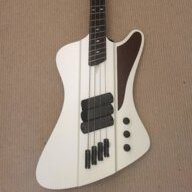
You know, I used to think that fanned frets on a four string were fairly pointless. Maybe it isn't strictly necessary, but Dingwall makes some really nice basses. I may do a NBD thread later, but for now, here's a quick comparison between my Super P and my D-Roc.
4 string dingwall is great for BEAD, down tuning or even Eb and using a hipshot xtender to drop to Db!
I thought it might be a little extreme for a 4 but its not 37" on the 4th so its a little less ...no different to the 4th string on a 5 hahah!

EXCELLENT (and honest) review. Thanks for that!!You know, I used to think that fanned frets on a four string were fairly pointless. Maybe it isn't strictly necessary, but Dingwall makes some really nice basses. I may do a NBD thread later, but for now, here's a quick comparison between my Super P and my D-Roc.
The Super P is definitely a P bass. My favorite pickup combination is P only, and it sounds like a P. The pickup is at the more "mellow" end of the spectrum. The bass hangs comfortably on a strap, and the medium scale is perfect for me. Fit and finish are flawless, which is a trait both my Canadian basses have in common.
The D-Roc is completely different. Tone-wise, it is more aggressive, but I wouldn't say it sounds like a Thunderbird at all. It doesn't have the super-thick low end and muted top end that all my other 'birds have. The pickup selector and pickup placement is well designed; rotating the knob clockwise takes you from a thinner, cleaner sound to a thicker, fatter tone. If the switch had a couple more positions, the tone progression would get into 'bird territory. For me, it saves me all the thinning out and cleaning up of EQ that I do when I use a Thunderbird. This bass has a BIG low end, especially for a passive bass. It is humbucker-esque, with maybe a better top end.
The D-Roc is a player. The setup was spot-on right out of the box. The nut feels wider than the Super P, but I think that is because this neck is a little thinner than the fairly chunky P neck. I definitely notice the difference in scale length, especially when I play the low F.
The bass hangs on a strap perfectly, but that solution presents another problem. The neck joint interferes with upper fret access a little - it joins the body at the 14th fret as opposed to the 16th or 17th fret on the Super P. With a strap attached, this is more noticeable. Also noticeable is 20 frets as opposed to 22 on the Super P. None of this upper fret access matters much to me, but I suspect Sheldon will tweak that neck joint at some point in the future; I can't imagine he is completely happy with it yet.
Fit and finish is excellent, but falls a little short of my Canadian basses. For example, the finish in the recessed jack cavity isn't perfect. I was also a little surprised to see that the rear control cavity cover isn't recessed. The bass is super light - I can't weigh it super-accurately, but I put the D-roc at about 7.6lbs and the Super P at 8.8lbs. My bass is matte black and has a black vinyl pickguard. It is beautiful, but I wonder how durable the finish is. I also miss the Canadian Dingwall knobs.
Both basses are exceptional. I give the edge, due to personal preference, to the Super P, but the D-Roc is killer. The D-Roc is as aggressive sounding as it looks - I can't wait to use it with the rock band, some overdrive, and some really heavy-handed pick playing. I can already see that it will love that kind of abuse.
I own a Super PJ, and a custom ABZ (its technically more like an AB1)...annnnnd locally a dealer got a D-Roc in - same feelings as you had. I prefer both of mine - tonally - BUT looks, went to the D-Roc. I think they LOOK sharp!

Oddly, i find where the nut ends at the G#, my index finger seems to rub against where the headstock wood drops off (towards the tuners)..maybe i should say its where the index finger first knuckle bends from the hand...(on ALL the Dingwalls)...almost like the wood should still go past the nut at the same height and straight down - not angling with the nut...having it drop away hooks and rubs me from time to time. Maybe i fret oddly there - i will have to pay attention.
I think this "first run" of D's will be fine tuned quickly - i can only imagine the difficulty in having products made overseas and trying to stay on top of Quality from across the globe. Having said that - i still think they're far superior to many other known quality brands (which are made on this continent).

You can see some highlights below. I've never noticed any 'sparkle' in Ducati White. I think it absorbs most light and is a completely flat finish. I can try to shine a bright light on it when i get home. No disco here, just class...Can one of you with a Ducati White bass take a close-up picture of the finish while it's under a light? I'm working with Billy and Paul at Dingwall on a color choice (pearl white to match the finish I had done on a custom Thunderbird a couple years ago) and I'm curious as to how close Dingwall's Ducati White already is to what I'm looking for. Basically it's just a solid white with a little bit of sparkle to it. Not as much as a true sparkle or a flake, but just a little hint of excitement when the lights hit it without getting into disco territory.
Examples:
View attachment 3586185 View attachment 3586186


