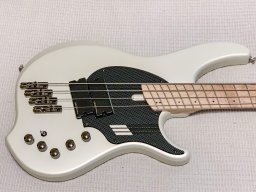
FBass is pretty similar. Here's my BNF5:
View attachment 3666670
Admittedly, the dots along the bottom of the fingerboard are damn near useless, at least I can't see them in playing position. If they were Luminlays, that would be a different story. IF, and this is a big if, I were to get a Dingwall fretless, I'd probably do the Luminlay lines and dots, like @BurningSkies bass. I can't really play this bass in the dark, LOL!
Your thoughts do echo mine. While I had the 'dots' on the neck of the Combustion enlarged a bit, they fall on the neck behind the strings from 'playing view' so you're not going to get much from them. Similarly, the far edge of the neck isn't terribly visible from standing/playing vantage point.
I chose large dots on the side of the neck to keep me oriented (larger, but basically the same as I did on my NG3 for low-light settings), then I asked for the luminlay fret-lines to be easily visible at the side of the fingerboard, which along with them being full lines makes things about as 'visible' as you're going to get.
...part of the process though is to think about how you're playing and using the fretless. I know guys who go with the 'shut your eyes, only use your ears/hands/muscle memory' school of fretless playing. That denotes and connotes a certain style of bass-music. That's a stylistic thing, you'll be doing a whole lot of sliding into stuff, micro and macro adjusting and vibrato. There is nothing wrong with this and a huge portion of fretless is this and recognized as this.
I on the other hand am more interested in using the instrument a bit closer to a 'traditional' bass guitar that has the innate tone you get from fretless but not necessarily the stereotypical playing style that goes with it. That compounded with the fact that much of my playing will always remain fretted, it made much more sense to have full lines for the additional visual cues. That sort of allows me to 'drop in' more effectively on notes and move neck positions. Then I can use the other tone/style aspects of the fretless at will in limited but specific ways.
When I picked up fretless after a few decades away (I played an unlined 4 string Jazz bass for a while in the late 90's), I for the first time dug into what a bunch of the know pro-players were saying. The conventional wisdom was way closer to what I was thinking...get lines (use them or ignore them), don't treat it as a different instrument & woodshed like it's any other bass...the rest will fall in line. That made total sense to me. There are guys here and places like FB who are all "LULZ DON'T LOOK YOU'RE NOT DOING IT RIGHT PLAY IN A DARKROOM YO!!!11!" Because I guess there's supposed to be a single way to play an instrument.

...
As a side note, I don't think that the Dingwall shop will do full fretless lines anymore for fear of issues with the integrity of the neck/fingerboard? I'm about a year into having and playing mine and I haven't had any issues, though the neck has been thoroughly worked over and refinished, both front and back. The finish that Mo's Shop's finishing people did to it make it the nicest smoothest neck of ANY of my Dingwalls. Across the humid hot summer and drier winter there's absolutely no seam sprout on the neck profile (and ALL my other Dingwalls have had this) and it is as stable as any. I would suggest that if you're going to get a fretless made, whichever neck that has the most carbon-fiber/graphite for overall stability is your very best option.








 That bass would get me back to playing a long scale again. That might just be my favourite that I’ve seen lately.