• TalkBass has been independent since 1998. Add your voice.
    Create a free account to reply to discussions, view embedded media, and browse with fewer display ads.
    Join freeLog in
    Want zero display ads or expanded classifieds tools? Compare plans.

Dingwall Owners Club

Made in China and inspected, assembled, fret levelled in Canada

I wonder if the Korean D-rocs are inspected in Canada as well, not sure given their lower price point!

They are.

"Our ready-to-play models provide the ultimate combination of performance and value due to our hybrid manufacturing approach. We start with high-quality North American sourced hardwoods, then combine the efficiencies of Dingwall’s Far Eastern manufacturing with final production, quality control and setup done in Canada by our skilled team of artisans."

D-ROC Standard
 
They are.

"Our ready-to-play models provide the ultimate combination of performance and value due to our hybrid manufacturing approach. We start with high-quality North American sourced hardwoods, then combine the efficiencies of Dingwall’s Far Eastern manufacturing with final production, quality control and setup done in Canada by our skilled team of artisans."

D-ROC Standard


Ok thanks! Well someone told me he couldn't get a low action like on his Combustions, so I thought they maybe did not have the fret levelling the Combustions had.

Or perhaps, user error or bad luck :)

I confirm that I have never touched a D-roc before!
 
Looking at @Andyman001's seemingly pristine ABZ makes me wonder how many of us run our basses exactly the way they were shipped.

I got my NG-3 in 2018, and last month (Jan. 2022) I tightened the truss rod by 1/4 turn. So I guess it's not exactly the way it was shipped, but pretty close. ;) (And it's not like I've kept it in a temperature-controlled humidor. I've played it hundreds of hours, done outdoor and indoor gigs all over town during all four seasons... maybe I got lucky with goldilocks neck stability. Definitely a good look for Dingwall).

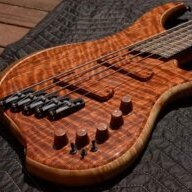
Edit: In praise of factory NG-3s! Many of the things people seem to replace are what I love most about it - the smoked chrome hardeware, the carbon fiber pickguard, the pointy monorail bridges... love all that stuff. (I'm tempted by the invisible six-way pickup switch mod, however).
 
Last edited:
Looking at @Andyman001's seemingly pristine ABZ makes me wonder how many of us run our basses exactly the way they were shipped.

Out of the 4 I bought new 2 of them are as they were shipped, the ABZ 3X and the Super P. The other two have been changed about a bit, Combustion has had a bunch of mods and my D-Roc custom now has a P-tone as I wasn't a fan of the FDV's.
My Super J was used when I bought it and had already been modded so I'm not counting that one.
 
My 2016 ABZ is all factory as well :)
FA635277-80D2-4540-9D3A-B4979A572D99.jpeg
 
I had my first recording session with one of my NG3'S yesterday, the one with the stacked 500k/250k vol/passive tone and stock FD-3N's. I ended up using the bass in passive for the whole session with just a hair rolled off on the passive tone. Sounded absolutely fantastic!

I also finally sourced some matching stack knobs (knurl patterns slightly different, color matches) and will be offering a drop-in stack vol/passive tone soon if anyone is interested. No drilling, 500k/500k with .047 cap. Only 4 wires for the connections. Super easy install.

20220206_104122.jpg
 
The TL: DR here is I like lighter string tension. Fight me.
I'm a little late in responding to this, but I still wanted to because it's something I bring up whenever anyone asks me about my Super J. Everyone focuses on the added length, increased tension, etc. I push back by saying that one of the reasons I bought a Super J was because I like a 34" scale E string and would love progressively shorter A, D and G strings for comparatively lower tension when using "normal" gauge strings to what you'd get on a single 34" scale. D and G in particular often sound not great on 34" or greater scale basses to my ears once you've got your setup dialed in to sound great on the E and A strings. Conversely I find a lot of sub-34" basses to sound a little tubby on the E string. These are broad statements with, I'm sure, plenty of examples that don't fall into those descriptions but that's generally been my experience. The Super series solves this in a way that was just perfect for my goals. The shorter scale and lower tension of the higher strings compared to a single scale bass was just the thing for me. I got close to it using single scale basses and GHS Balanced Nickel strings, but the Super J simply takes the concept across the finish line.