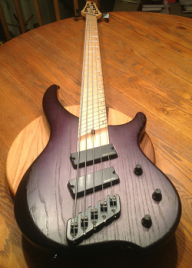
Do your hands look like this?How is the reach for the B string on a 5 or 6 string?
With the fan fret, does it feel "normal"?
I'm thinking of getting my first Dingwall soon so the help is appreciated.
Or like this, with the fingers parallel when spread?
Here are the two situations where I needed the most time to acclimatize:
- When I was staring at the strings.
- Fast fills and solos up in the top octave on the G and D strings.
Where I was initially thrown off while soloing, was that that angle of the frets makes it harder to read the fret markers up in the dusty zone. If you fret a note right across from the side dot for the 17th fret, you'll actually be playing a half-step sharp!
Once again, if you just shut your eyes and play, it's no problem at all...
Once you get over the initial awkwardness, you'll probably find that:
- In general, fanned frets feel more comfortable for any given scale length.
- The benefit is more noticeable near the ends of the fingerboard, where you naturally rotate your hand and spread your fingers to reach for the fret.
This is all dependent on hand size, but for me, a four-fret stretch at the first position on a 35" B string (Dingwall SJ or SP) is easier with fanned frets, than the same stretch on a 34" parallel-fret bass like a Precision or a Jazz.
Long-scale Dingwalls with the 37" B string (like my ABZ) are definitely a little more of a stretch than a Fender, but how often do you ever play a repetitive riff between the low C and the low Eb on any 5-string?
Last edited:







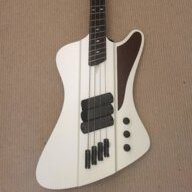
 Had the chance to get my mitts on this puppy today. This is probably the loudest passive bass I've ever heard! This thing cranks. Of course he's not selling it, I was just stoked to actually play one and had to share it.