I’m pretty sure I won’t be the only one getting a replacement for the gold PG, finding one for sale shouldn’t be hard to do.i want white/gold pickguard. :-(

TalkBass has been independent since 1998. Add your voice.
Create a free account to reply to discussions, view embedded media, and browse with fewer display ads.
Join free Log in
Want zero display ads or expanded classifieds tools? Compare plans.
I’m pretty sure I won’t be the only one getting a replacement for the gold PG, finding one for sale shouldn’t be hard to do.i want white/gold pickguard. :-(
Did not know that. Wonder if I could order a Z3 with a walnut/alder body?good call. dingwall uses walnut for the bass side of the prima artist series.
they do dual density ash, i think they did northern ash/alder before. i wet they wont do walnut to protect the prima however. at least i dont see it as an option.Did not know that. Wonder if I could order a Z3 with a walnut/alder body?
Sounds like a happy accident. I’m not a fan of alder. Yes it’s light but I much prefer dense wood for better sustain and punch. A good compromise is the dual density body. Best of both worlds. Another brilliant innovation by Sheldon.the real truth is i assumed i was getting alder (standard ab1 wood), but my original build was for a ab2 (walnut default). when i swapped to ab1/green i assumed the wood would swap… and never looked that close at that part of the build sheet. whoops. it was a busy time in life for me lol.
when i noted the issue of spec, i actually opted not to change it as I was more worried about the small possibility of neck dive with a big f#/wenge six string neck paired with something light like an ash body. I had never heard of a unbalanced dingwall… but for the wait/money paid… neck dive of any sort would be heartbreaking and a massive deal breaker. f# 6’s i dont see much. so keeping walnut was a no brainer.
Dingwall/sheldon liked the combo with walnut as they said the walnut is better for low end tone/sustain of the B/F# strings more than alder or ash. so for my low tuning bass use… it was theoretically the better wood. so my bass was a lucky accident in a way. i will just pretend i was thinking that deeply. lol.
i think dingwall always saw the benefits of the such woods with their z and past super heavy lines (i forget the name). but i dont think the super heavy took off due to player obsession with weight.
i say go for it.
mine remains my #1 bass. i would change nothing.
View attachment 7051831
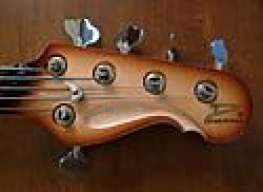



I just purchased a used D-Roc Standard 5. I'm looking for guitar stand recommendations. Thanks
Also, I was wondering for anyone who owns both a Combustion 5 and a D-Roc 5 Standard how easy is it changing between basses (mainly from a neck-feel standpoint) during a show? I know the Combustion 5 has 24 frets and the D-Roc 5 has 20. I know the scale length is the same for both basses...


This one is dopethey do dual density ash, i think they did northern ash/alder before. i wet they wont do walnut to protect the prima however. at least i dont see it as an option.

Hey guys, I'm thinking about buying an NG3 6 string at the beginning of next year, and I have two questions about handling these basses that I haven't seen in any videos I've watched so far.
1. How well do these basses do in the classical guitar position? That is, on your left leg. I imagine the neck will be quite a reach, but what I am worried about is the output jack, or actually the cable that comes out of it getting the short end of the stick when positioning the bass like that. I usually use right angle jacks, and from what I'm told the NGs or Combustions do not particularly like right angles.
2. Palm muting. Like in fingerstyle palm muting (think modern RnB and the like). I don't see it as a problem in itself, but the slanted (individual) bridge may make this quite a bit of a learning curve on multiscales. Does anyone have any input on that?
Thanks in advance for any replies!


Yeah, I like those and still have a couple. Speaking of the 90's, I took the top part and bolted it to the side of my SWR 410 cab (using the handle bracket) which sat on top of my bi-amped rig. Because it was the 90's. I loved being able to hang my bass on there and not take up any precious stage space!I've been rocking Hamilton stands for decades. Back in the early '90s, they were the only stand I could find which worked with my Thunderbird, and I've used them ever since.
Thanks a lot, you definitely gave me much to think about.Speaking strictly in terms of cable plug location, classical guitar position doesn’t present much of an issue with straight plug cables for me with my Z or AB1. This is an observation which would cross over to any NG model. The design allows for an unobtrusive cable situation. It seems to provide a more manageable playing experience than a side-mount jack. I also use a strap during seated playing most of the time. Ultimately, classical position swings the instrument far to the left, which is a long left hand/arm reach. There’s alternative strap pin locations on most 37” scale Dingwalls to help with the reach concern when standing. The longer reach is something to consider when thinking about a 37” scale Dingwall. It’s not a huge hurdle but it can’t be fully ignored.
I’ve been bridge muting for decades - I grew up in the NYC area watching established masters of the technique and asking how they did it, Anthony Jackson included. I mention this because I may hold the sole dissenting opinion that a Dingwall multiscale bass is not the ideal candidate for someone who uses the technique a lot.
It can be done, and the results are musical and usable, but it requires some relatively uncomfortable hand positioning and it makes precise control over degree of muting and note duration noticably harder. It’s difficult to get the flesh of the palm over the nodes of the bridges saddles like you can on a regular bridge.
For me, I reach for another bass with straight frets and a straight bridge when I’m involved with music that needs a lot of palm muting. Every bass has a strong points and weak points. I’ve found that the Dingwall has features that place it considerably ahead of the curve, but there are other concerns where it may not do as well. For a player that does not use palm muting at all, a Dingwall can be an all inclusive solution. A workaround is approaching it with Rocco/Will Lee style left-hand muting, but it’s of course not the same thing - some of the material that some players want to play absolutely requires muting at the bridge.
All this said, you can almost bank on someone posting a video in the next post showing a player with complete mastery of palm muting on a Dingwall. I’m just presenting my findings.
Even if it takes time, expense and a long drive, it’s best to get a Dingwall in your hands and experience the instrument for yourself if you can. This is the best way to tell if it will work for you and your music.
I've heard the build process can take up to three months. You can ask, but they aren't going to have an exact date for you because Sheldon has said before "it is done when it is done right".So my custom Dingwall has been "in production" for over a month. I think all that means is that it is one of several basses that are slotted for the current production cycle. I've got a lot of gigs coming up and would sure like to know when exactly Dingwall will actually start work on my bass. I ordered it through Fretnation. Anyone know how I can find this out? TIA