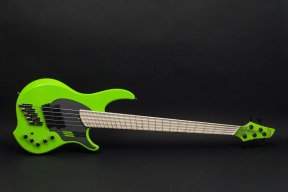
I believe the Super P5 is not very common, and even less so with a bridge pickup, so I thought I would make a brief note of my impressions for anyone that is curious. I got a Super P a few months ago, and recently had a bridge FD3 installed. I ordered both the standard and reverse P pickguards so I could try both configurations.
The P sound is really amazing on these basses, very even over the whole range, with a nice midrange thickness. It sounds like a nice "P", but it's quite different from a Fender. The high end is very smooth and seems to lack the Fender upper-mid bump, so it doesn't have the characteristic "clank" of a Fender P. The low end is very defined, so it doesn't get wooly even with the tone rolled off. These are both good things, but it's a bit unexpected at first, and requires a bit of a different touch than most Fender P's. My impression so far is that overall it's not quite as aggressive as some Fenders can be, due to the smoothness in the high end. The low end is strong, but because of the note definition, it actually sounds less bassy than most Fenders. All round, basically it has a wide frequency range, but because of the warm quasi-vintage sound, it doesn't sound like it.
For my taste, I much prefer the standard P configuration over the reverse-P. This may be because the low end is already tight, and the reverse configuration emphasizes that. The standard configuration just sounds more muscular, and doesn't lose any definition on the low notes. Also, the reverse-P route moves the entire pickup a bit (a bit more than 1/4" maybe) closer to the neck, and I like the sound of the sweet spot. This is also why I'm glad I have the J/P rather than the P/J, which I believe has the P closer to the neck.
That's all just with the P pickup soloed. With the bridge pickup, you get 3 more positions to play with (serial, parallel, and bridge soloed). They all sound great, I so far generally use the P or parallel (I think, it's positions 1 and 3) positions. For a passive bass, the range of tones is amazing, and the tone control is very effective at going from bright to midrangey to thick and dark.
One more note - I just put on my first set of Dingwall strings (the nickels) and they really brought the bass to life. They have enough bite that I can get that Fender "gank" when needed, and the parallel slap and finger tones are great. The parallel slap tone is a bit more "synthy" sounding with the regular P, where the reverse P made it a bit more "open", but they both wound great.
It's currently my #1 player. I might even consider putting in a preamp sometime, but for now it's just about perfect as it is.



 ."
."