• TalkBass has been independent since 1998. Add your voice.
    Create a free account to reply to discussions, view embedded media, and browse with fewer display ads.
    Join freeLog in
    Want zero display ads or expanded classifieds tools? Compare plans.

Dingwall Owners Club

I've got a question for you Dingwall guys. I'm looking to get a Signature NG-2 Combustion soon, and I want to use it as my main bass. Currently, my band tunes to C#, which creates drama with my basses that requires a good deal of tweaking to the truss rods and bridge heights. The 4 strings have to get tuned down from E to C#, and my 5 strings get tuned UP from B to C#. Tuning a 5 string down to C# on the E string creates havoc with what to do with the B string because it just makes it way too floppy. Overall the tension is loose and I end up with the strings set way to high to compensate for the fret buzz.

So what do you guys recommend for a C# tuning on a Combustion? I've got their price list, and I think it's $150 for a custom setup fee. Which I'd love to have them set it up if possible. I don't mind doing it to myself on my own basses, but with the amount I'm spending on this signature, I'd like to get it done right. Any advice?


You need to invest in strings of proper gage. Simply taking a standard set of strings and forcing them to C# is very very wrong of you. Now go to your room, and research balanced tension sets for the scale and tuning you want, and stop abusing your poor basses.

:laugh:
 
  • Like
Reactions: fender68
You need to invest in strings of proper gage. Simply taking a standard set of strings and forcing them to C# is very very wrong of you. Now go to your room, and research balanced tension sets for the scale and tuning you want, and stop abusing your poor basses.

:laugh:


All of my drop/up tuned basses have custom Circle K sets with .124s.(which you can actually read my review explaining it here: 5 String review Link Removed
4 String set review Link Removed )
Tuning up on a 5 string still requires truss rod tweaking. I've done it many times and have got it down to a science. But simply swapping gauges doesn't mean it'll work "right out the box".
I'm very well aware of the situation.
 
All of my drop/up tuned basses have custom Circle K sets with .124s.(which you can actually read my review explaining it here: 5 String review Link Removed
4 String set review Link Removed )
Tuning up on a 5 string still requires truss rod tweaking. I've done it many times and have got it down to a science. But simply swapping gauges doesn't mean it'll work "right out the box".
I'm very well aware of the situation.

Sure you switch string gauges, and you have to re-do your set up. You have to do that with every bass, every time you switch string gauges.

I am confused what your question actually is I guess.
 
Sure you switch string gauges, and you have to re-do your set up. You have to do that with every bass, every time you switch string gauges.

I am confused what your question actually is I guess.

Just asking for input on whether or not to tune the E string down to C#, or the B string up to C#. I know that my 5 string Ibanez BTBs that I've tuned up required the truss rods to be almost maxed to get the action where I wanted. I wouldn't be able to go much more. I'm not sure what kind of relief the Dingwall necks come with standard and how much (reasonable) amount of bow I would have to add to account for the different tuning.

My preference is to use the top string as C#. And I'd rather ask the question and MAYBE get some insight first, since there's almost zero chance I'd be able to test one out locally.
 
Just asking for input on whether or not to tune the E string down to C#, or the B string up to C#. I know that my 5 string Ibanez BTBs that I've tuned up required the truss rods to be almost maxed to get the action where I wanted. I wouldn't be able to go much more. I'm not sure what kind of relief the Dingwall necks come with standard and how much (reasonable) amount of bow I would have to add to account for the different tuning.

My preference is to use the top string as C#. And I'd rather ask the question and MAYBE get some insight first, since there's almost zero chance I'd be able to test one out locally.

You shouldnt do any of that. You should decide if you want to tune C# up, or how every else you want your tuning, then order strings based on that tuning, and the scale length(s) you are using. The standard Dingwall strings may work for you in that tuning, but you would have to ask @Sheldon D.
 
Aren't the Nolly's supposed to go F#-G? Let the shop do it's magic. They do awesome work. You will get the right strings, nut cut, and the set up you want.

What color have you picked? That's the tough question.


Nolly's got several oddball tunings. One completely ignores the top string. I need to watch his rig rundown videos again and see what he's tuned to.
Color, I always dig black. I really dig the carbon fiber pick guard they've got.... but that yellow screams at me. So I'm leaning towards 95% black, 5% yellow (if I spontaneously get a wild choice)
 
BB
Have you tried G#, C#, G#, C#, F#?

Edit: I can't read. They play G# C# F# B E

Between the Buried and Me play in this tuning and personally I love it. Not that downtuning makes you sound heavier or any of that mojo, I just like the way the BEADG sound on the third fret.

I'm using .050 - .135 D'Addario Prosteels on a 34" non-Dingwall and have plenty of tension.
 
AcidBat, If I have this correct, you want to tune every string up one full step higher in pitch?
C# G# D# Bb F

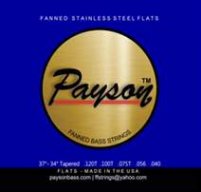
The Payson Fanned Stainless Steel strings sound fantastic tuned up slightly. I did a test a while back when a guy was asking about E-C tuning on a long scale Dingwall and what gauges to use. I strung my bass up E-G with the E in the B position, A in the E position etc... I left out the C for testing. It sounded incredibly piano like, even more so than normal. The gauges are .130, .105,. 085, .065, .045, very close to the Dingwall strings, so no major set up changes. I'm curious to see if it works as well.

I'm one state to the left of you. If you want to try a set purchased direct and they don't work out, you'll get a full refund. It wouldn't be fair to ask my dealers to offer this. I have one personal set left. If you like them, BassStringsOnline has them in stock for future purchases.

What should you expect by using the PFSS set tuned up one step higher is more piano like clarity to cut through the wall of down tuned guitars operating in your frequencies. If you're looking for undefined mud, this might not be your best choice.

I would not try this with my Nickel Steel models as they have a little more tension.

Contact me privately if you're interested.

I've got a question for you Dingwall guys. I'm looking to get a Signature NG-2 Combustion soon, and I want to use it as my main bass. Currently, my band tunes to C#, which creates drama with my basses that requires a good deal of tweaking to the truss rods and bridge heights. The 4 strings have to get tuned down from E to C#, and my 5 strings get tuned UP from B to C#. Tuning a 5 string down to C# on the E string creates havoc with what to do with the B string because it just makes it way too floppy. Overall the tension is loose and I end up with the strings set way to high to compensate for the fret buzz.

So what do you guys recommend for a C# tuning on a Combustion? I've got their price list, and I think it's $150 for a custom setup fee. Which I'd love to have them set it up if possible. I don't mind doing it to myself on my own basses, but with the amount I'm spending on this signature, I'd like to get it done right. Any advice?
 
AcidBat, If I have this correct, you want to tune every string up one full step higher in pitch?
C# G# D# Bb F

The Payson Fanned Stainless Steel strings sound fantastic tuned up slightly. I did a test a while back when a guy was asking about E-C tuning on a long scale Dingwall and what gauges to use. I strung my bass up E-G with the E in the B position, A in the E position etc... I left out the C for testing. It sounded incredibly piano like, even more so than normal. The gauges are .130, .105,. 085, .065, .045, very close to the Dingwall strings, so no major set up changes. I'm curious to see if it works as well.

I'm one state to the left of you. If you want to try a set purchased direct and they don't work out, you'll get a full refund. It wouldn't be fair to ask my dealers to offer this. I have one personal set left. If you like them, BassStringsOnline has them in stock for future purchases.

What should you expect by using the PFSS set tuned up one step higher is more piano like clarity to cut through the wall of down tuned guitars operating in your frequencies. If you're looking for undefined mud, this might not be your best choice.

I would not try this with my Nickel Steel models as they have a little more tension.

Contact me privately if you're interested.


Thanks for the input. We tune C#, F#, B, E, A,
So my 4 strings get tuned down
E -> C#
A -> F#
D -> B
G -> E

And my 5 strings get tuned up
B -> C#
E -> F#
A -> B
D -> E
G -> A

I never use the low A with my band, and my preference is to use the top string as my main string. But the NG-2 comes tuned F#, B, E, A, D... So I'm thinking maybe I'll go G#, C#, F#, B, E. So that would be a set of about .166 .124 .094 .073 .055. Looks like the single review for this set of strings on Circle K's website used this set for tuning to G# and it's working well.
 
Ah, you want to go an octave lower. My bad AcidBat.

Yeah, go with Circle K/Kalium strings for the really large strings.

Thanks for the input. We tune C#, F#, B, E, A,
So my 4 strings get tuned down
E -> C#
A -> F#
D -> B
G -> E

And my 5 strings get tuned up
B -> C#
E -> F#
A -> B
D -> E
G -> A

I never use the low A with my band, and my preference is to use the top string as my main string. But the NG-2 comes tuned F#, B, E, A, D... So I'm thinking maybe I'll go G#, C#, F#, B, E. So that would be a set of about .166 .124 .094 .073 .055. Looks like the single review for this set of strings on Circle K's website used this set for tuning to G# and it's working well.
 
I want this bass.
unnamed (6).jpg
 
So someone educate me on the rotary selector. I was just struck with an idea, and cant go home to pull mine open right now.

How is the lay out on the switch? I know then are set up for Solo/Parallel/Series/Solo, but could you change that to something else easily? As an example, on the three pick up models, could you switch that to something different than the Neck, neck bridge parallel, middle bridge, bridge they come with? Say something silly like all series, then switch between B+M, B+M+N, B+N, M+N?

Just pondering here.
 
ImageUploadedByTalkBass1416579300.090738.jpg
A lot of the switching options are built into the circuit board on the back of the switch.

So, might be easier to look at rotary switches at Stewart McDonald and find one that accommodates 3-pickup wiring.

They have a line that they call "MegaSwitches" and I believe there's a rotary switch a la PRS.

But my favorite so far has been Dingwall's "switch blade" system where you could have different PU selections for BE and ADG.

The demo of the Z3 with that system totally impressed me.
 
  • Like
Reactions: CL400Peavey
View attachment 510656A lot of the switching options are built into the circuit board on the back of the switch.

So, might be easier to look at rotary switches at Stewart McDonald and find one that accommodates 3-pickup wiring.

They have a line that they call "MegaSwitches" and I believe there's a rotary switch a la PRS.

But my favorite so far has been Dingwall's "switch blade" system where you could have different PU selections for BE and ADG.

The demo of the Z3 with that system totally impressed me.

Thanks!
Exactly all the info I needed!
 
Thanks for the input. We tune C#, F#, B, E, A,
So my 4 strings get tuned down
E -> C#
A -> F#
D -> B
G -> E

And my 5 strings get tuned up
B -> C#
E -> F#
A -> B
D -> E
G -> A

I never use the low A with my band, and my preference is to use the top string as my main string. But the NG-2 comes tuned F#, B, E, A, D... So I'm thinking maybe I'll go G#, C#, F#, B, E. So that would be a set of about .166 .124 .094 .073 .055. Looks like the single review for this set of strings on Circle K's website used this set for tuning to G# and it's working well.

Is the altered tuning to be able to play certain passages with open strings? If not, could you not adapt your basslines to standard tuning (B-E-A-D-G)?
 
Is the altered tuning to be able to play certain passages with open strings? If not, could you not adapt your basslines to standard tuning (B-E-A-D-G)?

Not really.

I know this has been a point of contention in this thread before, but there are some genre's of heavy music that rely on drop/open string tunings to make lines playable.

As an example, here is a new Mastodon track. Some of you may be able to play that that on a standard tuned 5 string, but it is much easier in the tuning he is using.

 
Is the altered tuning to be able to play certain passages with open strings? If not, could you not adapt your basslines to standard tuning (B-E-A-D-G)?

Negative Ghostwriter, that's a definite no go in my genre. That open C# is my default. I'd be creating triple the work for myself. For any death metal playing, those open strings are heavily relied on.
 
  • Like
Reactions: CL400Peavey