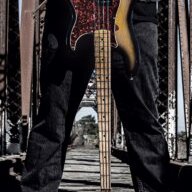
OK, if you insist! My vintage ABII w/ Mahogany body, FD1s and push pull knobs for the Active/Passive and BluEqube.
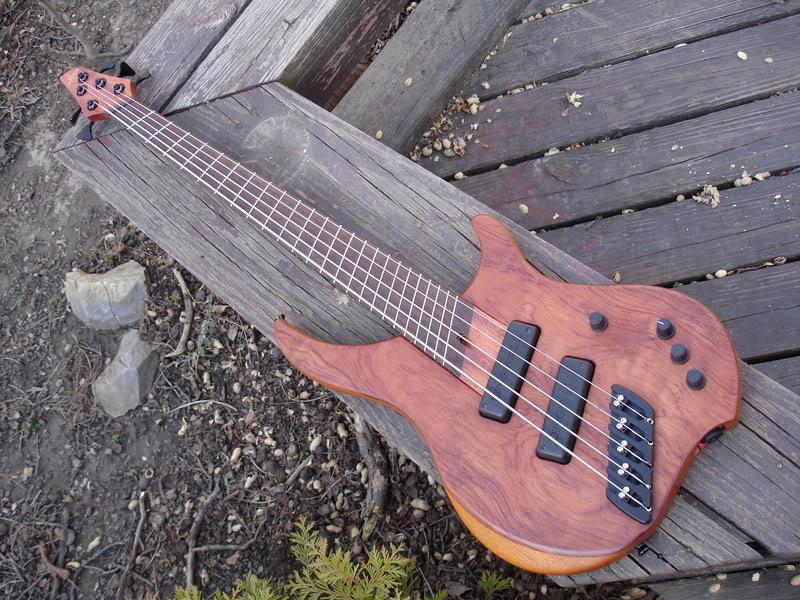


That is very nice Bob! I love it, what is the wood used for the neck and the top?
Randy

TalkBass has been independent since 1998. Add your voice.
Create a free account to reply to discussions, view embedded media, and browse with fewer display ads.
Join free Log in
Want zero display ads or expanded classifieds tools? Compare plans.
OK, if you insist! My vintage ABII w/ Mahogany body, FD1s and push pull knobs for the Active/Passive and BluEqube.

Yeah, that light was kind of subdued, but it shows off the detail of the grain better than bright sunlight, which looks very different:I was thinking that it was, but by not being totally sure, I didn't want to just jump out there and make a guess. I just got a Spector 4 banger with a bubinga top on it. It needs some work, but will be much nicer when I am done with it.
 )
)Yeah, that light was kind of subdued, but it shows off the detail of the grain better than bright sunlight, which looks very different:


Nice grab on the Spector BTW. I don't think I've ever seen one with bubinga (hint, hint

Here is a pic of the Dingwall family when it only had 11 members
More pics when be seen here
http://www.talkbass.com/forum/showthread.php?t=345957
There are few favorites. I will just point out the individual nuances that I like from my very very favorite ones
"Uber Alles": huge tone, very complex mids with great upper mid attack
"Transparent": very airy sounding, cuts through every mix without dominating (unless I choose so)
OMT Z1: most growly Dingwall, yet it can be very smooth and crystaline
Villex-loaded Voodoo: (Villex "Classic" loaded) most huge lows, different timbres accross the strings
"Brazil": Very full and compex mids (more spread than the "Uber Alles"
Emerald Green: (Villex NVT loaded) "wider" sounding than the Villex-loaded Vodoo, yet very versatile and totally different
First ever Prima Artist: it's the most comfortable 6 I've ever tried and the sound is on par with the rest of the herd.
Z2: just had FD3s retrofitted last week and it's the dream MM style bass (growl wise) and then some
Prima Artist 5: a joy to hold, play and listen
Choosing 9 out of 19 proves that it's very hard not be spoiled from the quality of Sheldon's masterpieces of functional high end art
The rest of the Dingwalls (or Done-well as a friend calls them) offer different sounds that I am still applying in different settings and bands. All Dingwalls get their workout in rotation (very few of the conventional basses get as much workout as my Dingwalls)
The AB I's sport FD1's that are more hi-fi and bright sounding.
Please excuse another dumb question that dingwall owners are probably tired of answering. Because of the differing in scale lengths it looks like your right hand ends up much closer to the bridge on the G vs the B if you don't deliberately move towards the neck as you reach for the thin strings. Is it noticeable in practice or do you find you just make automatic adjustments? Ta.
If you start out real close to the bridge when playing the bigger strings, then yes, I have noticed that on a occasion. What I do is play where I want to play with respect to the bridge on the smaller strings, and may end up a bit further away from the bridge on the bigger strings. This works fine and I don't feel the need to consciously move up and down the strings longitudinally as I move up and down the strings vertically.
However, I will say that because I play using the floating thumb technique, the natural motion of my hand as it moves up and down the strings vertically actually follows with the angle of the bridge, so I suspect that I may naturally maintain a fairly constant distance from the bridge without thinking about it.