
Depends on how the spectrum behaves with the levels within the loop. I would choose the pre amp side because you can adjust the gain. I think the parallel side with the lpf wouldn't be the best choice..but experiment...Thanks. klattman! I have a source audio spectrum pedal (envelop, etc.). Would you recommend putting this pedal in the parallel or preamp loop?

Enjoy the benefits of a premium membership!
Upgrade Account
-
TalkBass has been independent since 1998. Add your voice.
Create a free account to reply to discussions, view embedded media, and browse with fewer display ads.
Join free Log in
Want zero display ads or expanded classifieds tools? Compare plans.
You are using an out of date browser. It may not display this or other websites correctly.
You should upgrade or use an alternative browser.
You should upgrade or use an alternative browser.
DSMnoisemaker & Humboldt Electronics Simplifier Bass Station
- Thread starter amper
- Start date
More options
Who Replied?
Well a filter like that needs a consistent clean signal since it triggers off the attack. I put that first in the chain or just after the preamp. But In the parallel loop with the low pass filter on I don’t think it would sound like much. Clean lows in parallel with the envelope on the preamp channel works depending on the blend. Where ever you put it you’ll have to adjust the envelope sensitivity to the level at that point to get it to sweep the range properly.Thanks. klattman! I have a source audio spectrum pedal (envelop, etc.). Would you recommend putting this pedal in the parallel or preamp loop?
Thanks again! One more a bass compressor parallel or preamp loop?My picture several posts back shows my filter pedal. In that case I’m running it in the preamp loop and adding in clean lows from the parallel side. Also works well first in the chain depending on whether you want the clean lows or a more dramatic filter effect.
Depends on what you want to compress.Thanks again! One more a bass compressor parallel or preamp loop?
If you want to compress everything put it first (but it may affect the overdrive and envelope filter).
if you want to compress highs and leave lows less compressed, say for pick or slap etc you could put it in the preamp loop.
I have mine in the parallel loop so I can compress and boost the lows and my mids/highs from the preamp I can control with how hard I play (finger style). Limits boominess but allows me to accent any note instantly.
depends on why you want.
Depends on what you want to compress.
If you want to compress everything put it first (but it may affect the overdrive and envelope filter).
if you want to compress highs and leave lows less compressed, say for pick or slap etc you could put it in the preamp loop.
I have mine in the parallel loop so I can compress and boost the lows and my mids/highs from the preamp I can control with how hard I play (finger style). Limits boominess but allows me to accent any note instantly.
depends on why you want.[/QUOTE
Thanks guys, will carve out sometime this weekend to play around with the pedal to see what’s works best. Appreciate the help and I will keep you posted!
My plans are using one of my Atlas channel for main compression then maybe the second channel in the parallel loop. I just need cables and a better understanding of how to run two separate compression channels on the Atlas.Depends on what you want to compress.
If you want to compress everything put it first (but it may affect the overdrive and envelope filter).
if you want to compress highs and leave lows less compressed, say for pick or slap etc you could put it in the preamp loop.
I have mine in the parallel loop so I can compress and boost the lows and my mids/highs from the preamp I can control with how hard I play (finger style). Limits boominess but allows me to accent any note instantly.
depends on why you want.
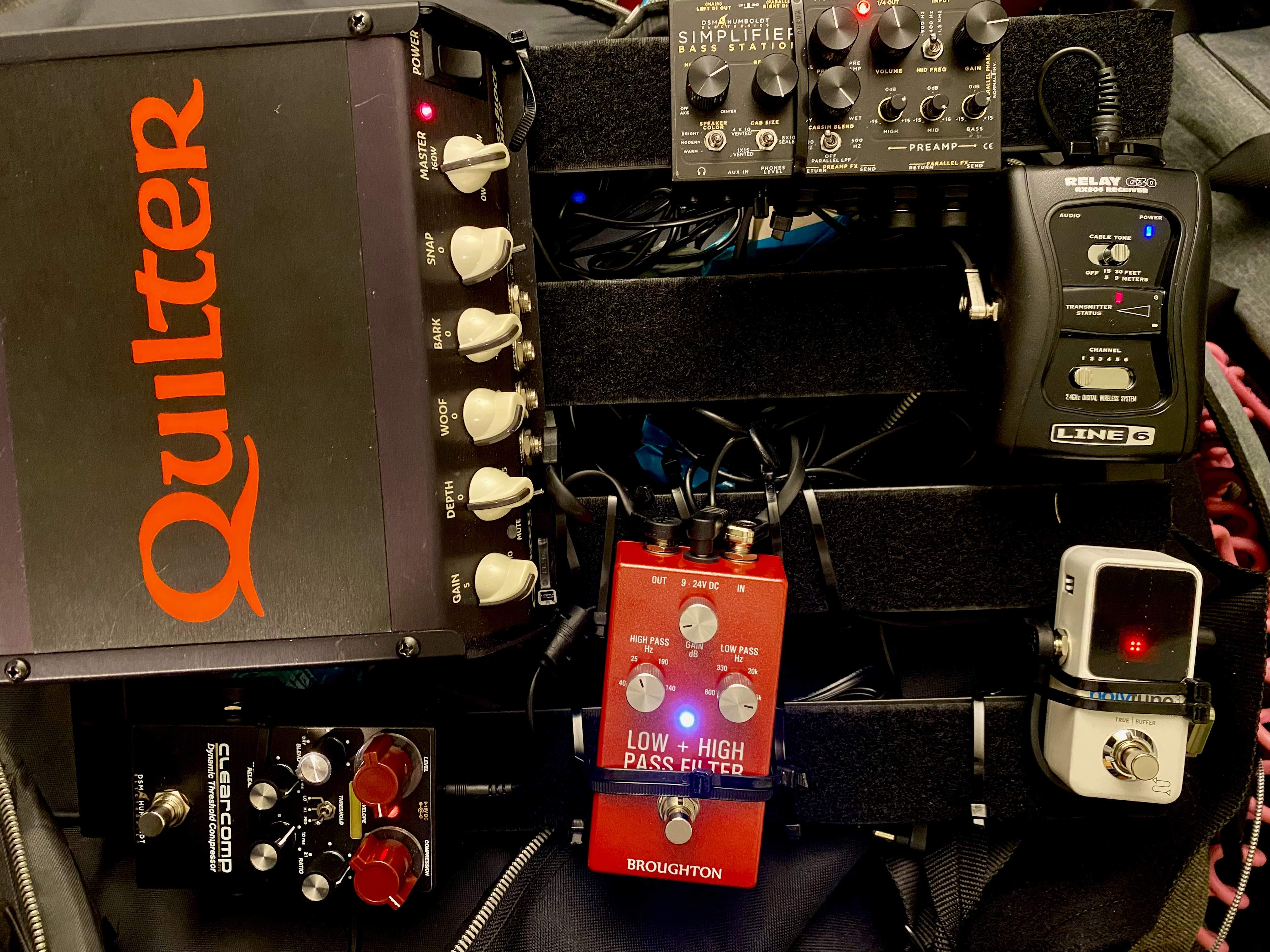
Here’s my basic setup with the bass simplifier I have their compressor in the parallel loop and set the parallel loop to 500hz. I then set the preamp gain and volume and eq how I like it and then compress and boost the parallel loop so that when the blend is at 50% they are about equal in volume.
then I can add more low or more high with the blend control on the simplifier.
the lpf/hpf is at the end after the simplifier and just before the amp. This lets me fix problems with room noise etc. It also happens to have boost I can use if necessary.
Wireless goes to tuner then into the simplifier.
I don’t have anything in the preamp loop but I will throw something in there depending on what the set needs. Sometimes a chorus or envelope filter. Could even use a different OD pedal.
The low signal levels from the simplifier are sort of expected when the lineage of their line is “zero watt preamp”. It’s all about shaping tone and not like a traditional preamp. Think of it as a passive eq system. Having some boost at the end or in one or both loops helps a great deal.
I haven’t tried recording with it but used this set up live with an amp on stage and the simplifier DI out to the PA and it worked great.
then I can add more low or more high with the blend control on the simplifier.
the lpf/hpf is at the end after the simplifier and just before the amp. This lets me fix problems with room noise etc. It also happens to have boost I can use if necessary.
Wireless goes to tuner then into the simplifier.
I don’t have anything in the preamp loop but I will throw something in there depending on what the set needs. Sometimes a chorus or envelope filter. Could even use a different OD pedal.
The low signal levels from the simplifier are sort of expected when the lineage of their line is “zero watt preamp”. It’s all about shaping tone and not like a traditional preamp. Think of it as a passive eq system. Having some boost at the end or in one or both loops helps a great deal.
I haven’t tried recording with it but used this set up live with an amp on stage and the simplifier DI out to the PA and it worked great.
How Do you find having another lpf after the lpf on the simplifier I would think it would be self defeating...Here’s my basic setup with the bass simplifier I have their compressor in the parallel loop and set the parallel loop to 500hz. I then set the preamp gain and volume and eq how I like it and then compress and boost the parallel loop so that when the blend is at 50% they are about equal in volume.
then I can add more low or more high with the blend control on the simplifier.
the lpf/hpf is at the end after the simplifier and just before the amp. This lets me fix problems with room noise etc. It also happens to have boost I can use if necessary.
Wireless goes to tuner then into the simplifier.
I don’t have anything in the preamp loop but I will throw something in there depending on what the set needs. Sometimes a chorus or envelope filter. Could even use a different OD pedal.
The low signal levels from the simplifier are sort of expected when the lineage of their line is “zero watt preamp”. It’s all about shaping tone and not like a traditional preamp. Think of it as a passive eq system. Having some boost at the end or in one or both loops helps a great deal.
I haven’t tried recording with it but used this set up live with an amp on stage and the simplifier DI out to the PA and it worked great.
View attachment 4927298
Lpf/hpf after the simplifier’s combined and optimized blend output works just fine. It is just before the amp not in the loops. It’s used subtly to quell ringing or boominess and keep the power amp/speakers working efficiently.How Do you find having another lpf after the lpf on the simplifier I would think it would be self defeating...
Got it..Lpf/hpf after the simplifier’s combined and optimized blend output works just fine. It is just before the amp not in the loops. It’s used subtly to quell ringing or boominess and keep the power amp/speakers working efficiently.

I just saw there's a Guitar MkII ... could that mean there will be a bass version MkII as well?...
Herwig
Herwig

An interesting question I would have about a Bass Station MkII would be: What would you want, hope, or expect different from it? I don't know what the difference is between the six-string MkI and MkII, so I don't know the kind of level of difference that could be expected. It's a little hard to picture what could be added to the original BS, as an observer, so I'm genuinely curious... perhaps IR loading that bypasses the cab and mic settings?

An interesting question I would have about a Bass Station MkII would be: What would you want, hope, or expect different from it? I don't know what the difference is between the six-string MkI and MkII, so I don't know the kind of level of difference that could be expected. It's a little hard to picture what could be added to the original BS, as an observer, so I'm genuinely curious... perhaps IR loading that bypasses the cab and mic settings?
Maybe 2 bands of variable mids (low mids and high mids) in the pre-amp. Maybe 2 or more selectable pre-amps (Ampeg, Fender and Gallien Krueger).
The guitar MkII also gives a bit more space to the ton of knobs it has and the layout seems like an evolution from the first.
But I don't think IR would/should be included because the analog cab and mic settings is what differentiates the Bass Station from the rest of cabsim-including pedals. My opinion though

Very fair, on the IR point. Stuffing more analog sims in there sounds like an unenviable prospect, but, I can't act like I would say no to a GK or Model T emulation...

I don’t know what I’d want, but I know that I love the original enough to just trust them.
I guess my dream would be a midi controllable version while keeping the circuit all analog.
I guess my dream would be a midi controllable version while keeping the circuit all analog.
Covered earlier in this thread, but extra gain on the clean channel so that when using the filter in a biamp mode, the lows have enough volume to balance the preamp channel (with some extra for insurance).
to use it now I put a boost or compressor in the parallel loop, but it would be nice not to need that.
Since we are asking the only other change would be to have a switch to defeat the cabsim for the line out to an amp (keep it on the DI or maybe add a switch there as well). Most of the time I don’t want cabsim heading to an amp/cab, but I do want it going to the DI.
Otherwise pretty happy with it and I wouldn’t mess with much else.
to use it now I put a boost or compressor in the parallel loop, but it would be nice not to need that.
Since we are asking the only other change would be to have a switch to defeat the cabsim for the line out to an amp (keep it on the DI or maybe add a switch there as well). Most of the time I don’t want cabsim heading to an amp/cab, but I do want it going to the DI.
Otherwise pretty happy with it and I wouldn’t mess with much else.


