• TalkBass has been independent since 1998. Add your voice.
    Create a free account to reply to discussions, view embedded media, and browse with fewer display ads.
    Join freeLog in
    Want zero display ads or expanded classifieds tools? Compare plans.

Elon Musk as educator

You are very misinformed about American Public Education.

The scientific method is the cornerstone of science classes from middle grades on.

Take a read through of the NGSS standards.

Okay.

https://www.nextgenscience.org/sites/default/files/resource/files/Appendix F Science and Engineering Practices in the NGSS - FINAL 060513.pdf

As you said. The current NGSS standards do indeed require that the scientific method be taught in public schools from grades K-12.

Im actually quite impressed with how thorough they are and how well it's integrated into the various scientific disciplines and how it progresses through advancing grade levels.

Question: When was this put in place. Because it wasn't taught in any of the schools I or any of my family and friends ever attended. It wasn't taught in my children's schools. I've never seen anything like these standards applied in any grade school or high school textbook, ever, and I frequently tutor students in science so I see what materials they're working with.

Is this new? If so, then I'm overjoyed that somebody has finally figured this **** out (and maybe we don't need Elon Musk's stupid school after all).

But if this has been the standard for awhile, then what happened? Why have the schools been so grossly unable to follow the standards?

I sincerely want to know the answer to this.
 
Last edited:
  • Like
Reactions: ajkula66
Friends, allow me please a few moments of your time with my TalkBass moderator hat on.
A handful of posts have been deleted that sent us off into the direction of politics, which are entirely forbidden at Talkbass. Not every post that was deleted was political, but other members quoted parts of other members posts that included political commentary, and thus more posts were deleted. Surgical precision is often preferred by us mods, but sometimes we need the snow shovel. :)
Posts about politics are not deleted based on if the moderator team agrees with the opinion, that is not how we operate here. They were deleted because they were political, period.
If you've been closely following this conversation, it's going to look a little different as you catch up since some posts are now missing. The easy answer here was to shut down the entire thread, but it's better for this intelligent conversation to continue and just remove the offending posts.
Please friends, let's continue the respectful conversation while remaining within the guidelines of the TalkBass ToS found here: https://www.talkbass.com/help/terms
Thank you for the last few minutes of your time. Carry on.

-Mike
 
Okay.

https://www.nextgenscience.org/sites/default/files/resource/files/Appendix F Science and Engineering Practices in the NGSS - FINAL 060513.pdf

As you said. The current NGSS standards do indeed require that the scientific method be taught in public schools from grades K-12.

Im actually quite impressed with how thorough they are and how well it's integrated into the various scientific disciplines and how it progresses through advancing grade levels.

Question: When was this put in place. Because it wasn't taught in any of the schools I or any of my family and friends ever attended. It wasn't taught in my children's schools. I've never seen anything like these standards applied in any grade school or high school textbook, ever, and I frequently tutor students in science so I see what materials they're working with.

Is this new? If so, then I'm overjoyed that somebody has finally figured this **** out (and maybe we don't need Elon Musk's stupid school after all).

But if this has been the standard for awhile, then what happened? Why have the schools been so grossly unable to follow the standards?

I sincerely want to know the answer to this.
What happened is that the US lost much of its willpower to sustain quality education, and media distorted wider perceptions of education in many ways.


Also - thank you for your Moderation work MJ5150. I’m sure that took time and effort that was not insignificant. It’s appreciated
 
Last edited:
  • Like
Reactions: MJ5150 and fig
All you need to do is go out and talk to a few random people about any scientific topic that should be relevant to every person to know the fundamentals of scientific inquiry are not taught well, no matter what your NGSS standards say.

I teach medical students. These are some of the brightest individuals coming out of college yet despite four years study in one or another science discipline, many struggle with the concepts of evidence-based medicine. Mostly, those who have actually done research, not just talk about it, are comfortable with the critical thinking skills involved.
The decline you note is inversely proportional to the rise in digital media.

I’d have to do more work to try to prove causation, but common sense should be enough for us to be concerned about that connection.

And that is at the core of why Musk would
make a terrible educator.

Our superintendent just came to my new school. Yoinked the longtime and well liked magnet school principal to put him in a struggling military academy.

She talked about wanting to graduate students “ready to make Teslas for Elon Musk” in her speech to us. :/
 
Came back to this thread to find pages and pages and pages added...

On the issue of schools teaching critical thinking, including the subset of it that is the scientific method:

I think we distort this if we treat is as a simple yes/no question, do they or don't they. I think the question is how much they teach it, crowded in among all the many other mandates teachers have. There's an immense amount of "schools should teach this, schools should teach that" out there and it results in curriculum standards that look great on paper but only leave a teacher room to squeeze one day in, maybe, on a particular topic or skill.

My university has a social studies education major, and our new coordinator has worked really hard to make that program prepare our students for all the demands of the state praxis exam. That means history, sociology, anthropology, political science, economics, and geography, apart from the courses they need on various aspects of pedagogy. Shoehorning all that into a major that can be completed in four years is really difficult. You know those stupid memes that run, "Instead of algebra, schools should teach kids how to balance a checkbook and fill out a tax return" blah blah blah? Actually, all that stuff IS already in the state standards, here in NH at least - it's listed under "economics" and is the responsibility of the social studies teacher... who is also supposed to teach history, and civics, and geography, and... you get the picture.

The other thing is a point I would draw from religious circles I listen in, but I think has a wider application, including to educators. That's a realistic sense of proportion of the inputs in people's perceptions and thinking. What I mean is, a pastor in a church gets twenty minutes, maybe 45 at the outside from a really supportive congregation, to preach a message to them, once a week. Then those people they spoke to for 20 minutes go out and listen to the radio and watch TV and scroll through social media and youtube videos - for hours and hours and hours, every day. Just on the numbers, the odds of that preacher's message significantly impacting people's thinking, relative to the constant barrage they face from mass media, are pretty slim. Of course, you can take to mass media yourself, but then you will only gain profile if you play by mass media's rules, which may themselves negate the message you're trying to send. The medium is the message and all that.

I think something similar applies to schools. K-12 schools have the kids in the building for something like 30-35 hours a week, maybe. But for the most part that time is divided between 6-8 different classes and teachers, plus lunch and gym and study halls, so any given teacher is getting maybe 4-5 hours a week max with the kids. More opportunity for influence than a preacher's 20 minutes, but still only a sliver of the total attention. College classes take 15-16 hours a week in the classroom and then expect (rather desperately) that the 19-year-olds are devoting lots of hours independently to doing the readings and writing papers and all. Again, any given prof gets 3-4 hours a week with a kid. Put that up against the 24/7 availability of social media, that's purposefully engineered for the sole purpose of capturing attention, and you see the uphill battle.

I think what we're missing in the "schools should teach critical thinking" thing is that, chances are, they ARE. But there's a difference between the teacher teaching it, and the student learning it. It's just that the time the teacher gets to present it is swallowed up in the much bigger world of the student's attention, while inputs contrary to critical thinking are much more dominant.

I have been in schools my whole life (well, since I was 5 years old anyway). I would not entrust any school to teach non-biased critical thinking. There are many teachers who could do it, but there are just as many with an agenda that would infiltrate the process. I see this every day at the university. For every professor providing a forum fro open-minded evidence-based inquiry, there's another who is blatantly indoctrinating students with their biased world view.

I can think of a former colleague who matches your description pretty well, of a professor who had an overt agenda and saw her vocation as inculcating it in her students. However, the main reason that I'm aware she was like that, is that I periodically heard complaints from students about her being like that... which implies that, again, there's a gap between what the teacher is teaching and what the students are learning (or indoctrinating, in this case). It seems to me that when a student comes into a class with a sharply different worldview from a doctrinaire professor like that, 99% of the time they don't get indoctrinated, they learn techniques for "surviving" a class with a doctrinaire professor - or pass information around to other students so as to avoid that professor's classes if possible - and then carry on as they were. The experience leaves a bitter taste in their mouths that may have the opposite effect of what the prof hoped for.

I think in reality, what happens in colleges is that students tend to congregate around professors they see as mentors for interests they already have. If the student is inclined to one worldview or ideology, they'll figure out which professors support that view and take as many classes from them as possible, and if they figure out a professor pushes a contradictory ideology, they'll avoid them or, if that's impossible, grit their teeth and "survive" that person's classes. It may look like indoctrination when one sees the troupe of fans of some very ideological prof, and it may be a shock to the kids' families if they hadn't known what their kid was thinking privately and not communicating before, but in my experience it's pretty rare that a college student radically changes their whole worldview because of a class they took.
 
Came back to this thread to find pages and pages and pages added...

On the issue of schools teaching critical thinking, including the subset of it that is the scientific method:

I think we distort this if we treat is as a simple yes/no question, do they or don't they. I think the question is how much they teach it, crowded in among all the many other mandates teachers have. There's an immense amount of "schools should teach this, schools should teach that" out there and it results in curriculum standards that look great on paper but only leave a teacher room to squeeze one day in, maybe, on a particular topic or skill.

My university has a social studies education major, and our new coordinator has worked really hard to make that program prepare our students for all the demands of the state praxis exam. That means history, sociology, anthropology, political science, economics, and geography, apart from the courses they need on various aspects of pedagogy. Shoehorning all that into a major that can be completed in four years is really difficult. You know those stupid memes that run, "Instead of algebra, schools should teach kids how to balance a checkbook and fill out a tax return" blah blah blah? Actually, all that stuff IS already in the state standards, here in NH at least - it's listed under "economics" and is the responsibility of the social studies teacher... who is also supposed to teach history, and civics, and geography, and... you get the picture.

The other thing is a point I would draw from religious circles I listen in, but I think has a wider application, including to educators. That's a realistic sense of proportion of the inputs in people's perceptions and thinking. What I mean is, a pastor in a church gets twenty minutes, maybe 45 at the outside from a really supportive congregation, to preach a message to them, once a week. Then those people they spoke to for 20 minutes go out and listen to the radio and watch TV and scroll through social media and youtube videos - for hours and hours and hours, every day. Just on the numbers, the odds of that preacher's message significantly impacting people's thinking, relative to the constant barrage they face from mass media, are pretty slim. Of course, you can take to mass media yourself, but then you will only gain profile if you play by mass media's rules, which may themselves negate the message you're trying to send. The medium is the message and all that.

I think something similar applies to schools. K-12 schools have the kids in the building for something like 30-35 hours a week, maybe. But for the most part that time is divided between 6-8 different classes and teachers, plus lunch and gym and study halls, so any given teacher is getting maybe 4-5 hours a week max with the kids. More opportunity for influence than a preacher's 20 minutes, but still only a sliver of the total attention. College classes take 15-16 hours a week in the classroom and then expect (rather desperately) that the 19-year-olds are devoting lots of hours independently to doing the readings and writing papers and all. Again, any given prof gets 3-4 hours a week with a kid. Put that up against the 24/7 availability of social media, that's purposefully engineered for the sole purpose of capturing attention, and you see the uphill battle.

I think what we're missing in the "schools should teach critical thinking" thing is that, chances are, they ARE. But there's a difference between the teacher teaching it, and the student learning it. It's just that the time the teacher gets to present it is swallowed up in the much bigger world of the student's attention, while inputs contrary to critical thinking are much more dominant.


I can think of a former colleague who matches your description pretty well, of a professor who had an overt agenda and saw her vocation as inculcating it in her students. However, the main reason that I'm aware she was like that, is that I periodically heard complaints from students about her being like that... which implies that, again, there's a gap between what the teacher is teaching and what the students are learning (or indoctrinating, in this case). It seems to me that when a student comes into a class with a sharply different worldview from a doctrinaire professor like that, 99% of the time they don't get indoctrinated, they learn techniques for "surviving" a class with a doctrinaire professor - or pass information around to other students so as to avoid that professor's classes if possible - and then carry on as they were. The experience leaves a bitter taste in their mouths that may have the opposite effect of what the prof hoped for.

I think in reality, what happens in colleges is that students tend to congregate around professors they see as mentors for interests they already have. If the student is inclined to one worldview or ideology, they'll figure out which professors support that view and take as many classes from them as possible, and if they figure out a professor pushes a contradictory ideology, they'll avoid them or, if that's impossible, grit their teeth and "survive" that person's classes. It may look like indoctrination when one sees the troupe of fans of some very ideological prof, and it may be a shock to the kids' families if they hadn't known what their kid was thinking privately and not communicating before, but in my experience it's pretty rare that a college student radically changes their whole worldview because of a class they took.

Your entire post is exceptionally accurate.
 
On the issue of schools teaching critical thinking, including the subset of it that is the scientific method...
This exposes a good point: I don't think that critical thinking is the exclusive domain of science. It seemed like my kids learned critical thinking from their best teachers, who were scattered throughout a variety of disciplines. Their history and literature courses were taught at a high level. One of the courses was about media, advertising, and propaganda.

In fact I think a problem with learning scientific thinking exclusively from science is that it's too easy. To misquote Einstein, nature is mysterious, but doesn't deliberately lie to us or try to manipulate us. James Randi pointed out that scientists are easily fooled by magicians. Thinking critically within a complex social milieu is different than doing science. Critical thinkers may need multiple modes of expression, including art, music, and literature.

Like you say, the schools are expected to teach everything. Many are barely staying afloat just teaching "the material," and teaching students to actually think beyond "the material" is a luxury. I'm not sure that I learned scientific thinking in science class, though I learned it from scientists -- my parents -- and from doing science.

About the "doctrinaire" professors, a pro tip that I learned from younger friends was that those prof's tend to be easy graders, because they need to be liked. A class with a transparent formula for getting an "A" might have higher attendance. Not every student wanted to take a class like that, but enough did.
 
I believe critical thinking is the role of philosophy. One of my best friends received his undergrad in philosophy from Harvard, and for two decades was impossible to communicate with due to his need to always take counterpoint towards everything lol. But philosophers teach us to think.
A teacher who tells us WHAT to think is only doing half the job.
 
  • Like
Reactions: fig and Standalone
One of my best friends received his undergrad in philosophy from Harvard, and for two decades was impossible to communicate with due to his need to always take counterpoint towards everything lol.
Ah yes, the philosopher’s tone.

Guilty here. I am 1000% this way.

It’s unfortunate that the philosophers and rhetoricians of today are seen as mainly annoying. While the Frederick Douglasses and Socrates of yesteryear were once sought out and heard out.

That shift is probably very relevant to the issues we are discussing in education. The “sage on the stage” is automatically seen as bad (some were and some are, no doubt) but now we have replaced them with the “webpage of the age” and the “thoughts of the bought.”

These new sources get much more airtime than the proverbial preacher and teacher referred to so eloquently in hrodbert696’s post above.
 
Last edited:
Sorry to go back to medical school, but that's my realm. Critical thinking and problem solving skills are essential to diagnosis and treatment. The current teaching paradigm in the basic sciences is to spend class time asking question in the context of a clinical case with information that needs to be parsed. In the most sophisticated of these, irrelevant information and red herrings are thrown in, as will be the case with real world patients. This is in contrast to what we did when I started teaching many years ago. Then, regurgitation of factoids and running formulas was all that was needed. Our incoming students are all over the map in their clinical reasoning ability, but by the time they get through the two years of basic science, they are up to speed. They have to be to pass the first round of board exams.

It would make our job easier and we could accomplish more if all of our students came in with more practical experience in critical thinking. And yes, I agree, that doesn't have to be, or shouldn't be, just in science.
 
How does our society treat the continual questioner? The critical thinker? The noodge who just has to say something and upset the apple cart?

And, on the other hand, how does our society treat the continual offered of the easy answer? The purveyor of passivity? The seller of simple solutions?

Musk and others position themselves as the former, but they are in my view the snakes and the snake oil salesmen of the latter group.

It is the latter group who gets celebrated.

If our society doesn’t value critical thinking, the schools cannot bear the sole responsibility of changing that.
 
I believe critical thinking is the role of philosophy. One of my best friends received his undergrad in philosophy from Harvard, and for two decades was impossible to communicate with due to his need to always take counterpoint towards everything lol. But philosophers teach us to think.
A teacher who tells us WHAT to think is only doing half the job.

I think philosophy specializes in it as a topic unto itself. But it's also worth remembering that the division of subjects into totally different fields is relatively modern. What we now call "science" was once "natural philosophy," and in the Middle Ages the Latin word "scientia" referred to ANY field of study that used a rational methodology - they would have included grammar, music, law, theology, and lots of other fields as forms of "scientia." Philosophers doing epistemology explicitly make the processes of reasoning and belief their topic, but any subject functions as an academic "discipline," meaning precisely that it has a methodology of critical reasoning, and thus can be used to train students in it.

But you're absolutely right, this does require teaching the field AS a discipline - a way of framing questions and analyzing evidence - rather than a pile of facts to accumulate.
 
I think philosophy specializes in it as a topic unto itself. But it's also worth remembering that the division of subjects into totally different fields is relatively modern. What we now call "science" was once "natural philosophy," and in the Middle Ages the Latin word "scientia" referred to ANY field of study that used a rational methodology - they would have included grammar, music, law, theology, and lots of other fields as forms of "scientia." Philosophers doing epistemology explicitly make the processes of reasoning and belief their topic, but any subject functions as an academic "discipline," meaning precisely that it has a methodology of critical reasoning, and thus can be used to train students in it.

But you're absolutely right, this does require teaching the field AS a discipline - a way of framing questions and analyzing evidence - rather than a pile of facts to accumulate.
Yes!

Theatre formed the roots of psychology.

Shakespeare plays read like chapters in a psych textbook.

Not to mention the classic Greek and Roman plays…!

Our brains learn by making connections. The synthesis that happens when students learn multiple subjects creates the opportunity to form these kinds of connections.
 
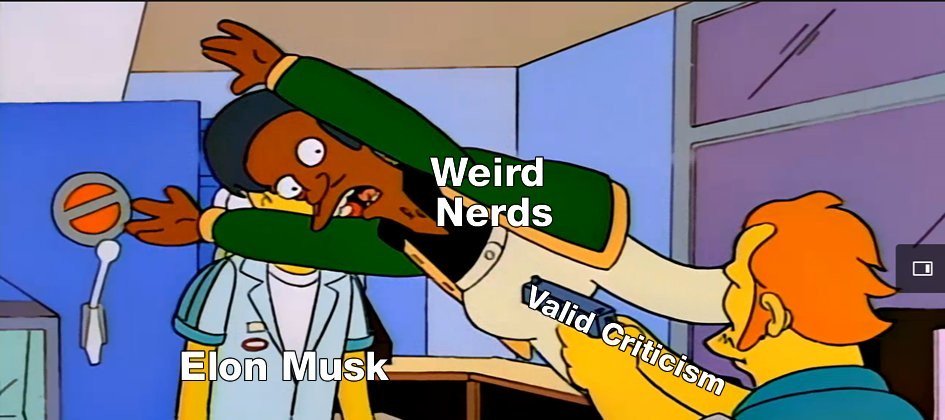
Can't help thinking of these schools catching on fire immediately for no reason, Simpsons style.

weird-nerds-defending-elon-musk.jpg
 
"It is often said that force is powerless to overcome thought; but for this to be true, there must BE thought.
"...Nowadays, every attempt to turn men into brutes finds powerful means at its disposal. On the other hand, one thing is impossible, even were you to dispose of the best of public platforms, and that is to diffuse clear ideas, correct reasoning and sensible views on any wide scale."
Simone Weil, "Sketch of Contemporary Social Life" (1934)
 
  • Like
Reactions: WG Plum and fdeck
"It is often said that force is powerless to overcome thought; but for this to be true, there must BE thought.
"...Nowadays, every attempt to turn men into brutes finds powerful means at its disposal. On the other hand, one thing is impossible, even were you to dispose of the best of public platforms, and that is to diffuse clear ideas, correct reasoning and sensible views on any wide scale."
Simone Weil, "Sketch of Contemporary Social Life" (1934)

That's a fascinating quote. Interesting to draw the parallels between societal issues in 1934 and today - cause and effect is at play, I believe.