Enjoy the benefits of a premium membership!
Upgrade Account
-
TalkBass has been independent since 1998. Add your voice.
Create a free account to reply to discussions, view embedded media, and browse with fewer display ads.
Join free Log in
Want zero display ads or expanded classifieds tools? Compare plans.
You are using an out of date browser. It may not display this or other websites correctly.
You should upgrade or use an alternative browser.
You should upgrade or use an alternative browser.
Exactly how much does your Fender bass really weigh?
- Thread starter Fender32
- Start date
More options
Who Replied?
Current basses
1990 62 AV Jazz- 9.35 lbs
1997 62 AV P-Bass- 9.25 lbs
past basses:
2002 Geddy Lee Jazz- 10 lbs
1998 MIJ 75 RI Jazz- 11.5 lbs
1997 57 AV P-Bass-8.75 lbs
2000 MIM Jazz-9.5 lbs
weight not a big issue for me.....if it sounds and feels good I'm happy.
1990 62 AV Jazz- 9.35 lbs
1997 62 AV P-Bass- 9.25 lbs
past basses:
2002 Geddy Lee Jazz- 10 lbs
1998 MIJ 75 RI Jazz- 11.5 lbs
1997 57 AV P-Bass-8.75 lbs
2000 MIM Jazz-9.5 lbs
weight not a big issue for me.....if it sounds and feels good I'm happy.

My 2011 Fender American Jazz fretless 4 string weighs 9 pounds dead even. From a calibrated scale at my work.
Sorry to dig up an old thread, but seemed the place to ask - does anyone know how the newer American Standard Precision and Deluxe Precision stack up in terms of weight? Seems like most P's come in around 8-9 lbs - is this still the case?
Next - how do they balance? If I set it on my leg and let go, is it going to dive?
Next - how do they balance? If I set it on my leg and let go, is it going to dive?
Here are some weights for my bass, many of which are basses I built myself from scratch:
Chambered P Bass alder body/spruce top, maple neck (the body is strat sized) 6.2lbs
Chambered J Bass swamp ash (the body is strat sized) 6.4lbs
Fender P bass 1969 (I bought it new!) converted to fretless 7.2lbs
Chambered J with graphite neck (the body is strat sized) 7.4lbs
2013 Squire J bass, totally stock 7.4lbs
Carvin 5-string 7.8lbs
Chambered J with graphite neck fretless 8lbs
Fender P bass 1963 8.6lbs
string bass (for comparison) 21.8lbs
The graphite necks are HEAVIER than regular wood necks. I mention that so that none of you think that you can lighten your bass with a graphite neck. The opposite is in fact true.
Chambered P Bass alder body/spruce top, maple neck (the body is strat sized) 6.2lbs
Chambered J Bass swamp ash (the body is strat sized) 6.4lbs
Fender P bass 1969 (I bought it new!) converted to fretless 7.2lbs
Chambered J with graphite neck (the body is strat sized) 7.4lbs
2013 Squire J bass, totally stock 7.4lbs
Carvin 5-string 7.8lbs
Chambered J with graphite neck fretless 8lbs
Fender P bass 1963 8.6lbs
string bass (for comparison) 21.8lbs
The graphite necks are HEAVIER than regular wood necks. I mention that so that none of you think that you can lighten your bass with a graphite neck. The opposite is in fact true.
Last edited:

75 Jazz, no covers, ash, stock everything, 10.3 on my new scale.
'14 Am. Standard P 8.6. I think it's alder. All stock.
'13 Tony Franklin, alder, no mods, 9.5.
'12 Marcus Miller V, alder, stock, no cover, 8.2.
'14 Am. Standard P 8.6. I think it's alder. All stock.
'13 Tony Franklin, alder, no mods, 9.5.
'12 Marcus Miller V, alder, stock, no cover, 8.2.

Do you have some sort of trick for combatting neck dive? I've personally found that my basses that are under 8 lbs start to become a little divey. I'm sure you're using some sort of Ultralite tuners, but still, with bodies that light, it's not much counterweight.Here are some weights for my bass, many of which are basses I built myself from scratch:
Chambered P Bass alder body/spruce top, maple neck (the body is strat sized) 6.2lbs
Chambered J Bass swamp ash (the body is strat sized) 6.4lbs
Fender P bass 1969 (I bought it new!) converted to fretless 7.2lbs
Chambered J with graphite neck (the body is strat sized) 7.4lbs
2013 Squire J bass, totally stock 7.4lbs
Carvin 5-string 7.8lbs
Chambered J with graphite neck fretless 8lbs
Fender P bass 1963 8.6lbs
string bass (for comparison) 21.8lbs
The graphite necks are HEAVIER than regular wood necks. I mention that so that none of you think that you can lighten your bass with a graphite neck. The opposite is in fact true.

Do you have some sort of trick for combatting neck dive? I've personally found that my basses that are under 8 lbs start to become a little divey. I'm sure you're using some sort of Ultralite tuners, but still, with bodies that light, it's not much counterweight.
Most of my basses are light. I use leather straps that are rough on the inside to keep them from diving. I accidentally picked up a high-end strap, glove leather lined, and that was awful. It was slippery as all get out and I was constantly pulling the bass back up. It was like I was fishing. Beautiful craftsmanship on the strap but useless for my light weight basses.



I have a doctor’s scale, the kind with the sliding weights and weighed a couple of my basses.
My MIM Jazz V is an even 10lbs.
My Squier VM P-5 I bought from a music store on-line, and asked them to weight it for me (all I stated was I wanted under 10lbs, preferably closer to 9lbs)
so trusting them it’s 8lbs-6oz, which I kinda believe ‘cause it’s like a feather.
My MIM Jazz V is an even 10lbs.
My Squier VM P-5 I bought from a music store on-line, and asked them to weight it for me (all I stated was I wanted under 10lbs, preferably closer to 9lbs)
so trusting them it’s 8lbs-6oz, which I kinda believe ‘cause it’s like a feather.

AVRI '63 Precision (8.4 lbs)
American Standard Jazz (9.1 lbs)
American Standard Precision (8.10 lbs)
American Standard Jazz (9.1 lbs)
American Standard Precision (8.10 lbs)
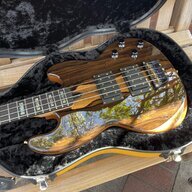
Do you have some sort of trick for combatting neck dive? I've personally found that my basses that are under 8 lbs start to become a little divey. I'm sure you're using some sort of Ultralite tuners, but still, with bodies that light, it's not much counterweight.
My lightest bass (mentioned above, the 6.2lb spruce-topped, chamber p-bass), went on a diet this weekend. I got it down to 5.85lbs. The light-weight it due to several things. One is that the body is strat-sized, which is to say it's like a p-bass, but a little bit smaller. It's chambered. I haven't weighted the body by itself, because I built the bass back in the 90's and haven't had it apart since. The neck is maple. The body is also a little bit thinner than a Fender, but not by much. Plugged, it sounds like a stock p, and that's what counts for me.
As to this weekend's weight loss, I got inspired after having just purchased a digital scale. The bass had a Gotoh 201 bridge on it, and that weights .33lbs. That's a third of a pound! I installed a Gotoh vintage knockoff, the cheap kind with the threaded saddles. That's only .2lb. And the bass sounds great with it, I'm fine with the change.
You asked about tuners. I have been using Gotoh GB7s for decades. I used to buy them by the tray. I probably still have a hundred pieces in my workshop. But they weigh 64 grams, with the bushing and screw. Better that the over 100 grams for a stock Fender gear for sure. The Hipshot Ultra-lites, in the classic Fender design, weight 58 grams. Their GB7-style weighs 44 grams. And the uber-expensive Gotoh Res-o-lites in the GB7 form factor weight 40 grams. I have that beat. A long time ago I bought a bunch of GB7s with white-pearloid plastic buttons. Those tuners weigh 36 grams. I have the pearl buttons on three other instruments (another bass, a Guild 12-string, and a strat clone). No issues. Nice weight loss off the headstock, and thus off the instrument itself. And no neck dive.
I've always had a bad back, so I have made a lifetime of R&D figuring out how to get the weight down. After a while, it becomes a game of ounces and grams. And don't forget plastic knobs! Nice ones of course.


 How much does my Fender really weigh? According to my electronic postal scale, my '78 P-Bass really weighs 11.11 lbs. Which makes it my heaviest bass, and almost exactly a pound heavier than the runner-up; my '78 Kramer 450B lumie (10.05 lbs). As for mojomike001's question about neck dive; how do I fight it? The answer is, I don't; I just live with it. With a notorious 'diver like the Kramer, there isn't much you can do, other than play something else.
Last edited:
That very interesting stuff. You've become quite the weight loss expert. Those are the lightest Fender style basses I've ever heard of.My lightest bass (mentioned above, the 6.2lb spruce-topped, chamber p-bass), went on a diet this weekend. I got it down to 5.85lbs. The light-weight it due to several things. One is that the body is strat-sized, which is to say it's like a p-bass, but a little bit smaller. It's chambered. I haven't weighted the body by itself, because I built the bass back in the 90's and haven't had it apart since. The neck is maple. The body is also a little bit thinner than a Fender, but not by much. Plugged, it sounds like a stock p, and that's what counts for me.
As to this weekend's weight loss, I got inspired after having just purchased a digital scale. The bass had a Gotoh 201 bridge on it, and that weights .33lbs. That's a third of a pound! I installed a Gotoh vintage knockoff, the cheap kind with the threaded saddles. That's only .2lb. And the bass sounds great with it, I'm fine with the change.
You asked about tuners. I have been using Gotoh GB7s for decades. I used to buy them by the tray. I probably still have a hundred pieces in my workshop. But they weigh 64 grams, with the bushing and screw. Better that the over 100 grams for a stock Fender gear for sure. The Hipshot Ultra-lites, in the classic Fender design, weight 58 grams. Their GB7-style weighs 44 grams. And the uber-expensive Gotoh Res-o-lites in the GB7 form factor weight 40 grams. I have that beat. A long time ago I bought a bunch of GB7s with white-pearloid plastic buttons. Those tuners weigh 36 grams. I have the pearl buttons on three other instruments (another bass, a Guild 12-string, and a strat clone). No issues. Nice weight loss off the headstock, and thus off the instrument itself. And no neck dive.
I've always had a bad back, so I have made a lifetime of R&D figuring out how to get the weight down. After a while, it becomes a game of ounces and grams. And don't forget plastic knobs! Nice ones of course.
Have you considered helium-filled basses? (Kidding)
2014 American Standard Precision - Sunburst - Rosewood - Stock 7.2lbs !!!
2013 American Standard Precision - Olympic White - Rosewood - Stock 8.3 lbs
Very accurate digital postal scale used.
Both basses are perfectly balanced. You might think the 2014 was prone to neck dive but it is not even on the verge and I use the comparatively thin and smooth on the inside Fender strap that came with the bass. I can take both hands off the bass on stage and move around freely, mess with a mic cable, whatever, it doesn't move. I feel very lucky to have had a friend that was a Master Fender Dealer who ordered this one for me. This thread has proven to me how special this bass is. RIP Bob T.
Anyone ever see or hear of a stock American Standard P being 7.2 lbs? Wondering how rare it might be.
2013 American Standard Precision - Olympic White - Rosewood - Stock 8.3 lbs
Very accurate digital postal scale used.
Both basses are perfectly balanced. You might think the 2014 was prone to neck dive but it is not even on the verge and I use the comparatively thin and smooth on the inside Fender strap that came with the bass. I can take both hands off the bass on stage and move around freely, mess with a mic cable, whatever, it doesn't move. I feel very lucky to have had a friend that was a Master Fender Dealer who ordered this one for me. This thread has proven to me how special this bass is. RIP Bob T.
Anyone ever see or hear of a stock American Standard P being 7.2 lbs? Wondering how rare it might be.