• TalkBass has been independent since 1998. Add your voice.
    Create a free account to reply to discussions, view embedded media, and browse with fewer display ads.
    Join freeLog in
    Want zero display ads or expanded classifieds tools? Compare plans.

Fender pre-CBS Club: pics mandatory!

This. Assuming it's an all original bass, last dateable component dates it. Neck date, body date, pot codes, pickup dates and - although it's less precise - serial number.

96tbird, your bass is likely a '61 going by the neck date and pots - as thebrian said, check for a body date as well. Three-knobs started around August/September that year. (Not an exact science, of course.)

Take a look at this one, for example:

Andy Baxter Bass & Guitars Ltd

9-61 neck, 8/61 body, 6120 pots.

Here's my 3-knob Blonde:

1962%20blond%20Jazz_zpszhsaakdo.jpg


1 62 neck, 6143 pots, 70XXX serial number. It's a '62.
.
That's beautiful!! drooldrooldrool I had a Jazz just like that, (sold it like a dummy in '69) and my very first amp was a twin of that (bought from the original owner in '64 - sold in'66/'67)
 
  • Like
Reactions: liverbird
That's actually a bit backwards. A 3-knob with a '62 neck and '63 pots wouldn't have left the factory until '63 - so it's a '63. That's why original solder joints are important... to know that no one replaced the pots at another point in time. The year of the bass is always considered to be the year that it most likely left the factory, according to the last original date you can find on it.

And likewise, based on the info you gave us, you can call your own bass a '61 "because of three ['61] pots"... because you also have a '61 neck date... and a ser # that is still in the '61 range (if that is in fact the case). To get even more definitive, pull the pickups out... my guess is (based on the neck date and those early '61 pots), you'll probably find a '61 body date too!

The concensus is really that 3-knobs are actually a late '61 feature, with some stack knob overlap into '62, while most '62s were 3-knob. I suspect any misinfo going around about 3-knobs being a '63 feature were a resuklt of Fender reissuing the "62 Jazz" with stack knobs - it made most people assume all '62s have stack knobs.
All I was saying is that IMO, IMO mind you, the neck is more important to Some.

Pot codes of '63 could easily show up on a bass completed in 1965. With a 1964 neck date. So which is it?
 
Pot codes of '63 could easily show up on a bass completed in 1965. With a 1964 neck date. So which is it?

So how would you be able to tell that it was completed in 1965?

1964 neck date and 1963 pots, if there are no further dated (original) parts, would make it a '64 - unless the serial number is wildly off perhaps.

I have a P bass with a November 1963 neck and 6403 pots - I would call that a '64.

Sometimes you also have to take the finish into account, as in was a specific colour already offered that year?

And so on... I think we can all agree that it's not an exact science. In absence of a time machine, however, it does make sense to use what can be found on an original instrument and date it by its latest component.
 
So how would you be able to tell that it was completed in 1965?

1964 neck date and 1963 pots, if there are no further dated (original) parts, would make it a '64 - unless the serial number is wildly off perhaps.

I have a P bass with a November 1963 neck and 6403 pots - I would call that a '64.

Sometimes you also have to take the finish into account, as in was a specific colour already offered that year?

And so on... I think we can all agree that it's not an exact science. In absence of a time machine, however, it does make sense to use what can be found on an original instrument and date it by its latest component.
That's why the neck, the heart and soul of a bass might be the lynchpin in situations like that. IMO.
IMO. IMO.

I know folks don't see it that way, but I see dabbing some solder and putting it in a box as secondary to the neck date.

It isn't the pots that play like butter. Zero craftsmanship in soldering a pot. People learn that in a day.

It's no secret that Fender didn't track parts inventory (even completed neck stockpiles) back then and it was a crapshoot what would end up on instruments. Otherwise there would be no issues with dating old Fenders.

Just playing devils advocate, going against the grain for the sake of entertainment.
 
  • Like
Reactions: Arrow
That's why the neck, the heart and soul of a bass might be the lynchpin in situations like that. IMO.
IMO. IMO.

I know folks don't see it that way, but I see dabbing some solder and putting it in a box as secondary to the neck date.

It isn't the pots that play like butter. Zero craftsmanship in soldering a pot. People learn that in a day.

It's no secret that Fender didn't track parts inventory (even completed neck stockpiles) back then and it was a crapshoot what would end up on instruments. Otherwise there would be no issues with dating old Fenders.

Just playing devils advocate, going against the grain for the sake of entertainment.

The importance of the neck as it pertains to the overall bass, or the craftsmanship that goes into making it, compared to the skill of the guy soldering the electronics doesn't have anything to do with the year the bass actually left the factory. That's what I'm saying. If a bass has a 62 dated neck, but 63 dated pots and original solder joints, you might find yourself in "hot water" if you tried to sell that bass as a 62 because it couldn't possibly have left the factory until 63 - therefore it is a 63. There's no debating that it left the factory in 62 because the only way that could have happened is if it traveled back in time, right? The method of dating by the LAST original dated part or feature is the standard method of dating that all vintage experts and guitar dealers adhere to the world over.

Now, you could always say a bass has an earlier neck, etc... than the rest of the bass, which may appeal to some perspective buyers, but I don't agree that it's a "lynchpin" that helps makes the whole bass considered to be that year. It only makes that part from that year. Feel free to disagree, no worries here. I'm not trying to argue either, I'm just making the point that your way isn't how anyone who makes a living in this field dates vintage instruments.
 
This. Assuming it's an all original bass, last dateable component dates it. Neck date, body date, pot codes, pickup dates and - although it's less precise - serial number.

96tbird, your bass is likely a '61 going by the neck date and pots - as thebrian said, check for a body date as well. Three-knobs started around August/September that year. (Not an exact science, of course.)

Take a look at this one, for example:

Andy Baxter Bass & Guitars Ltd

9-61 neck, 8/61 body, 6120 pots.

Here's my 3-knob Blonde:

1962%20blond%20Jazz_zpszhsaakdo.jpg


1 62 neck, 6143 pots, 70XXX serial number. It's a '62.
Wow that's nice! I've never seen a blonde Jazz before.
 
The importance of the neck as it pertains to the overall bass, or the craftsmanship that goes into making it, compared to the skill of the guy soldering the electronics doesn't have anything to do with the year the bass actually left the factory. That's what I'm saying. If a bass has a 62 dated neck, but 63 dated pots and original solder joints, you might find yourself in "hot water" if you tried to sell that bass as a 62 because it couldn't possibly have left the factory until 63 - therefore it is a 63. There's no debating that it left the factory in 62 because the only way that could have happened is if it traveled back in time, right? The method of dating by the LAST original dated part or feature is the standard method of dating that all vintage experts and guitar dealers adhere to the world over.

Now, you could always say a bass has an earlier neck, etc... than the rest of the bass, which may appeal to some perspective buyers, but I don't agree that it's a "lynchpin" that helps makes the whole bass considered to be that year. It only makes that part from that year. Feel free to disagree, no worries here. I'm not trying to argue either, I'm just making the point that your way isn't how anyone who makes a living in this field dates vintage instruments.
Out of curiosity...if the neck and body were definitively made in 62 (all features and dates correct) but it had 63 pots and pickups. What would you consider it? Would it be a late 62/early 63 transitional model, or just a 63?

Edit: I'm going pretty deep here, but could the neck have been made in say 62, but then stamped and completed in 63? This isn't about a specific bass just about Fender in general.
 
Last edited:
Out of curiosity...if the neck and body were definitively made in 62 (all features and dates correct) but it had 63 pots and pickups. What would you consider it? Would it be a late 62/early 63 transitional model, or just a 63?

Edit: I'm going pretty deep here, but could the neck have been made in say 62, but then stamped and completed in 63? This isn't about a specific bass just about Fender in general.

The year the bass left the factory is what matters (as far as what year you "call" the bass). There's nothing wrong with mentioning that some of the parts are from '62 (and may make for an easier sell even), but I know a lot of people that would not be happy if they shelled out the money for a bonafide "62", and then opened it up to find '63 pots.

To answer you other question, there's no way to know if a neck that has a '63 stamp was actually shaped/manufactured in '62. It's possible, and likely happened, but the stamp is definitive. There's no way to prove that it WAS made earlier, unless it had a specific feature that was discontinued well before '63 (like a slab fretboard for instance). And in that particular instance, you could probably make a case that it's a "62", but you'd still have to disclose the '63 neck stamp, and then explain that it's probably older stock.

Here's a personal example for you... I've sold a lot of early '65 Fenders that have 100% pre-CBS features... even clay dot necks with '65 stamps. I don't call them '64s tho. I call them '65s that happened to make it out of the factory before any CBS changes took place. That info still made those basses more desirable (and valuable) than a mid/late '65 bass, but I'm not "stretching" any truths by calling it a '64 just because it had clay dots.
 
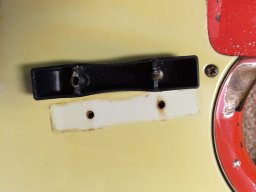
I found a (supposed to be) 1960 P bass
Original finish on the neck and neck hardware seems correct.
The body is in question though It has been refinished which does not bother me but there are markings in the neck pocket which I have never seen before.
I am offering a picture of the neck pocket in hopes that someone can enlighten me.
Thanks as always
 

Attachments

  • 20161025_195851[1].jpg
    20161025_195851[1].jpg
    196.8 KB · Views: 95
  • 20161025_195902[1].jpg
    20161025_195902[1].jpg
    277.6 KB · Views: 91
The year the bass left the factory is what matters (as far as what year you "call" the bass). There's nothing wrong with mentioning that some of the parts are from '62 (and may make for an easier sell even), but I know a lot of people that would not be happy if they shelled out the money for a bonafide "62", and then opened it up to find '63 pots.

To answer you other question, there's no way to know if a neck that has a '63 stamp was actually shaped/manufactured in '62. It's possible, and likely happened, but the stamp is definitive. There's no way to prove that it WAS made earlier, unless it had a specific feature that was discontinued well before '63 (like a slab fretboard for instance). And in that particular instance, you could probably make a case that it's a "62", but you'd still have to disclose the '63 neck stamp, and then explain that it's probably older stock.

Here's a personal example for you... I've sold a lot of early '65 Fenders that have 100% pre-CBS features... even clay dot necks with '65 stamps. I don't call them '64s tho. I call them '65s that happened to make it out of the factory before any CBS changes took place. That info still made those basses more desirable (and valuable) than a mid/late '65 bass, but I'm not "stretching" any truths by calling it a '64 just because it had clay dots.
Yup. my neck date May 65 Jazz has clay dots, no binding but I don't call it a '64 even though it looks like one.
 
  • Like
Reactions: ExaltBass
I found a (supposed to be) 1960 P bass
Original finish on the neck and neck hardware seems correct.
The body is in question though It has been refinished which does not bother me but there are markings in the neck pocket which I have never seen before.
I am offering a picture of the neck pocket in hopes that someone can enlighten me.
Thanks as always

I think the factory refinishing number was located on the body under the pickgurd.
It seems strange that the number is done in a series of dots rather than in normal written or stamped numbers

Mine has something similar under the pickguard. No idea what it means.
IMG_2221.JPG
 
  • Like
Reactions: ExaltBass
Do you know what production year your body is?
No. The experts here have narrowed it down to pre '64. I am guessing it is between '59 & '63 but I have been unable to confirm that. Other that the tuning machines that came with it, not much else was vintage on this poor thing. I am working on a nice slab rosewood neck (with Pat Wilkins right now) for this and plan to build it into bass that is as period correct as I can afford. That is to say, I will use a color that is appropriate in nitro, a celluloid PG, the neck mentioned above, the vintage machines, etc. Other than the slight gouging in that control cavity and the extra thumbrest holes, the body is in pretty nice shape with an excellent neck pocket and only a couple ounces of 4lbs.
 
  • Like
Reactions: ExaltBass
Late to this thread... My early '59:
IMG_5708.jpg


IMG_5726.jpg


So there were no neck variations on the Jazz bass in the pre-CBS days, maple wasn't even an option until '68.

All this is true - though there were a few one off exceptions. The great "one that got away" bass for me was one of the Buck Owens special orders: an original 1964 silver sparkle Jazz Bass with matching headstock and maple cap neck (same construction as the rosewood board necks - no skunk stripe on the back/walnut plug on the headstock). I also saw an early '60s tele with maple cap (no skunk stripe) neck.

I agree with thebrain completely. his statement is 100% accurate, but with one exception. back in the late 70's, a good friend of mine showed me his 100% stock and all original 1959 jazz bass (and yes, I know that they are not supposed to exist), but the strangest thing was that it had a one-piece maple neck and fiesta red painted body. I couldn't believe it when I saw it. all of the numbers (penciled dates 1959) matched as well as the pot date codes. the craziest thing about it is that it had the narrowest nut width as well as the thinnest front to back profile of any J bass I've ever seen. it was so thin in the first position, looked like the headstock might fall off if just you looked at it funny. the neck and body had the original finish, and the bass even still had its original strings on it.

believe it or not, and I definitely don't want to add any misinformation about the jazz bass's history, but I saw it with my own eyes and played it. this happened in whittier at the time which is almost a stone's throw from fullerton, and I've always just assumed that it had to be a very early prototype that they used a '58 maple p neck and re-profiled it super slim.

I know there's also photos out there of that 3-knob prototype Jazz with the soapbar P/Us from circa 1959 (which is also mentioned in at least one of the Fender Bass books). I'll bet Fender had to have made more than just one Jazz prototype before they put the model into production in '60. The one your friend had must be worth a fortune if it's still around!

My understanding was that there were two of the prototypes with the Jazzmaster type pickups. We had one of them at Real Guitars in San Francisco in the early '90s (I worked there at the time). Very skinny/thin neck.

Further, I understand there were 5 or 6 sales sample Jazz Basses made in '59. I've seen/played one of these in the flesh (belongs to Jeff Ament).

Another odd-ball Jazz I've seen was from Norm Harris' collection (I was there when the shop was closed and he pulled out some of his personal stash) was a very early one he got from Freddie Tavares which had an ebony fingerboard (not dark Brazilian rosewood). He also had Jazzmaster from Tavares with black anodized aluminum pg, large aluminum radio type knobs and a one-piece maple neck as johnk describes on the '59 Jazz he saw.
 
Last edited: