• TalkBass has been independent since 1998. Add your voice.
    Create a free account to reply to discussions, view embedded media, and browse with fewer display ads.
    Join freeLog in
    Want zero display ads or expanded classifieds tools? Compare plans.

Fender Rumble Club

Not 100% sure of what it would take, but I would think you would need the following components to build a stomp box to do this...

#1. A click on / click off footswitch. SPST most likely.
#2. 1/4" (6.5mm) TS jack.
#3. A properly sized electrical project box / chassis.
#4. "Sufficiently sized" wire, say 16 gauge in red and black or whatever colors you so choose, red and black are the typical for power / ground although other colors can be used, as long as YOU know what is going on...
#5. Crimp on female blade connectors OR NON ACID solder and soldering iron. The latter is the FAR better method.
#6. Electrical tape to manage your wire.
#7. A surface mountable LED to indicate active / inactive for the circuit.
#8. A wiring diagram of what you are trying to accomplish, or not...
#9. A 1/4" (6.5mm) instrument cable to connect switch to amp)

I would think, unless you have those parts in your inventory already, you might be better off money wise just buying the switch.

Doesn't need to be that complicated.

#1 SPST switch
#2 1/4" jack
#3 Box...could be a project box (I used a 1590a), could be an old bean dip can
#4 Pedal wire. Any light gauge electric wire will do (battery snap leads, wire pulled from home electronics).
#5 Regular guitar cable

No wiring diagram needed. Connect one lug on the jack to one lug on the switch; connect the other lug on the jack to the other lug on the switch. Soldering should go without saying, but there's not a lot of current here, so you could just wrap the wire into the lugs and tape it up, I reckon.

LED is interesting, I'm still trying to wrap my head around how the Fender switches work, because it would have to be that the cable is carrying some amount of current to power the light. Otherwise, you could of course put in a DPST switch and a battery to power it locally in the box.
 
  • Like
Reactions: JACink
11035462_10203952519395588_3128213698077781209_n.jpg
Photo0072.jpg
 
Doesn't need to be that complicated.

#1 SPST switch
#2 1/4" jack
#3 Box...could be a project box (I used a 1590a), could be an old bean dip can
#4 Pedal wire. Any light gauge electric wire will do (battery snap leads, wire pulled from home electronics).
#5 Regular guitar cable

No wiring diagram needed. Connect one lug on the jack to one lug on the switch; connect the other lug on the jack to the other lug on the switch. Soldering should go without saying, but there's not a lot of current here, so you could just wrap the wire into the lugs and tape it up, I reckon.

LED is interesting, I'm still trying to wrap my head around how the Fender switches work, because it would have to be that the cable is carrying some amount of current to power the light. Otherwise, you could of course put in a DPST switch and a battery to power it locally in the box.

Could simplify it even more...

#1 SPST switch push down locking type.
#2 1/4" cable grommet. (instead of jack, simply route the cable through the box / can and grommet it to protect from edges. Could be just about anything out of rubber or plastic, just something to keep from cutting the cable on the hole in the box / can.
#3 Box...could be a project box, could be an old bean dip, or even Tuna can. Could be an Altoids tin. As long as you have enough surface to mount, and enough interior volume to allow for the connections you are good to go.
#4 Regular guitar cable. Snip one end off and strip the insulation back on the conductors to allow you enough to make your connections.
 
Could simplify it even more...

#1 SPST switch push down locking type.
#2 1/4" cable grommet. (instead of jack, simply route the cable through the box / can and grommet it to protect from edges. Could be just about anything out of rubber or plastic, just something to keep from cutting the cable on the hole in the box / can.
#3 Box...could be a project box, could be an old bean dip, or even Tuna can. Could be an Altoids tin. As long as you have enough surface to mount, and enough interior volume to allow for the connections you are good to go.
#4 Regular guitar cable. Snip one end off and strip the insulation back on the conductors to allow you enough to make your connections.

Yup...I just picked up a patch cable with one end cut off that someone was throwing out. Was going to use it as a pedal circuit test probe, but might just make my own integrated footswitch per this setup instead.
 
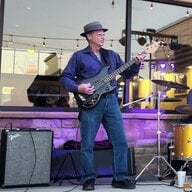
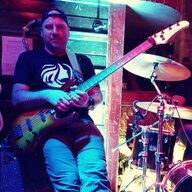
Interesting gig pics... I like the last one aside from the focus issue... Awesome composition for sure... Was this just prior to the show? Crowd seems pretty thin...
Yes this is just after set up at Kountry Club in Midlothian. George Strait filmed dance scenes in ''Pure Country'' movie here. Its always packed by beginning 1st set. One of my favorite gigs as it seems family oriented tho its byob and focus is on dancing to the music more than anything. This is Chris Kyles (American Sniper) hometown and was so cool cause last time we played they sang national anthem and pledged allegiance to the flag. Felt like a VFW. Tho im an old burned out hippie I love my country and its military and feel real at home with these folk. The owner/manager always complements my Rumble bass amp tone.
 
Yes this is just after set up at Kountry Club in Midlothian. George Strait filmed dance scenes in ''Pure Country'' movie here. Its always packed by beginning 1st set. One of my favorite gigs as it seems family oriented tho its byob and focus is on dancing to the music more than anything. This is Chris Kyles (American Sniper) hometown and was so cool cause last time we played they sang national anthem and pledged allegiance to the flag. Felt like a VFW. Tho im an old burned out hippie I love my country and its military and feel real at home with these folk. The owner/manager always complements my Rumble bass amp tone.

Small world. I went to school in Midlothian from kindergarten right on through high school. Graduated in 2002.
 
  • Like
Reactions: Gary Poe
Tight and punchy = GK or Ampeg
Dark and muddy = Rumble
This is exactly and precisely the opposite of my experience with:
GK MB800: great amp, more modern sound
Ampeg PF800: breaks a lot, more low end than anything if you can keep it working. Weird form factor. Mine went back in less than a week. But it does have the ampeg sound, if that's your thing. not a fan of its midrange.
Rumble 500 Combo: low end is tighter than the aforementioned, eg, low B is very distinct and not muddy. Ultra punchy when set up right, very important for me as I play fingerstyle funk a LOT. 210s in the combo do not hold it back from doing anything. It can do boom-boom country all night long. If you want modern, this isn't your amp, but you can sort of get there by cutting the mid and switching on the bright switch. I play outdoor gigs all the time with no PA support. It's an exceptional amp.
Rumble 500 head: see above, but with tonal variation based on whatever cab it's going through. But the basic essential tone remains there.
 
I'm originally from Southern California. Orange County, to be exact. In the shadow of Angel Stadium to put a finer point on it.

I lived near by in the 70's and early 80's, about 7 miles west of Angels stadium, the corner of W. Cerritos and Magnolia, to give you an idea. Went to Angels games frequently.

^^
I agree. I'd rather be able to turn the vintage on and off rather that an overdrive I have no intention of using. Just not my thing on bass.

I would love to have all of those controls footswtichable, though I think I understand Fender's reasoning in how it's designed, that the overdrive would get the most constant on/off use due to how it can be used, though it might also be just a cost cutting measure. I read someplace (maybe here, don't recall) that in order to cut costs, they left some stuff out, like a dedicated tuner out for example.
 

Latest posts