• TalkBass has been independent since 1998. Add your voice.
    Create a free account to reply to discussions, view embedded media, and browse with fewer display ads.
    Join freeLog in
    Want zero display ads or expanded classifieds tools? Compare plans.

Fender Rumble Club

Side by side placement forces LESS sound coupling on the sides of the stage and it throws the sound coupling forwards. As you move sideways from the speakers, you lose coupling because the delay between one speaker and the next reaches its maximum. When you stack them up, you move this effect to the ceiling and floor, effectively giving you less low frequency coupling out front, but better dispersion side to side because respective to the cabinet stack no matter where you move in your listening position the speakers will couple more effectively. If you were to hover over the stage on a stacked setup, you could hear the cancellation, but as you stand in front of it there is less cancellation with a stack of speaker but 1/2 the coupling with the floor

in side by side, if your sitting in front of each stack, aside from moving one cabinet farther from your ears you couple with the floor with both cabinets better so this would be null and void if you dial in rounder tones. If you like the highs, id stick to a stack setup. YMMV, rock on.
So, in doing a bit more research on this, I came across this article from our friends at Invalid Link Removed:

Invalid Link Removed

According to that blog post, at lower frequencies, like 98Hz and below, the speakers will couple creating a unified wavefront. Won't that eliminate the side-by-side, or Top-to-bottom cancellation you mention in your explanation? Certainly for higher frequencies it's still valid. I wonder how that affects the sound overall for bass, which is composed of both lower and higher frequencies. As I mentioned, I didn't hear a difference, and neither did my husband.
 
I was originally planning on buying a 100 but after reading this thread, I ordered an 800 today
I know the feeling. I had a perfectly fine 500 with 2 210 cabs. Except for an occasional jam it only gets used for 'practice'. The minute that 800 head came out I wanted it. It did new things, new capabilities etc. I got it for a good price (around 600 I think). No regrets. I can use it as 'quiet' as a 15, 40 or 100 or just rattle the windows (which the 500 certainly did also) The 800 doesn't care. The 40 is probably all I need but...
 
That's the spirit! Glad we could help. ;)

I know the feeling. I had a perfectly fine 500 with 2 210 cabs. Except for an occasional jam it only gets used for 'practice'. The minute that 800 head came out I wanted it. It did new things, new capabilities etc. I got it for a good price (around 600 I think). No regrets. I can use it as 'quiet' as a 15, 40 or 100 or just rattle the windows (which the 500 certainly did also) The 800 doesn't care. The 40 is probably all I need but...
I have a 40. A 100 would've been a waste of money if it couldn't be used with a drummer so I was looking into the 500 but figure, more headroom, lighter weight... why not
 
I was originally planning on buying a 100 but after reading this thread, I ordered an 800 today
I know the feeling . ... ... ... The minute that 800 head came out I wanted it. It did new things, new capabilities etc. ... ... ...
I have a 40. A 100 would've been a waste of money if it couldn't be used with a drummer so I was looking into the 500 but figure, more headroom, lighter weight... why not

Well, the R100 could certainly be used with a drummer! That's not a problem, at all. But, I get it.

Once you start looking at something bigger ... 100 200, 500, 800 ... the mind begins to boggle! How big is too big? Where does it end? I sometimes feel that I never get to 'unleash' my R500c anymore since my loud band broke up. The R800c has 400 watts that can command almost any stage by itself. And, with an 8 ohm cab, or two(!), the Rumble 800 combo can really "tear the house down." But, it can seem like the beast is always chained up!

However, the Rumble 800 combo also has a ¼ Output switch! A "soft side", if you will. One flick to Low and it's a 100 watt combo that can be cranked for 'that grind' without demolishing any architecture (well, maybe just a little). Or, with a cab, or two, it's 200 watts for more 'oomph' thru the extra speakers to fill a medium venue.

It's really the best of both worlds. 😉

upload_2022-9-8_15-21-2-01.jpeg
 
Last edited:
For the folks that primarily use there Rumble (500c in my case) as a platform for pedals/effects a couple of questions:

- where do you typically keep your gain?
- do you use "Vintage"?
- do you go in through the FX loop or the preamp input?

I typically go into the preamp (stacking with the preamps on my board), set Rumble eq flat 10/2/2/10, set gain at noon, and go back and forth on "Vintage".

Curious how other people run their rig
 
For the folks that primarily use there Rumble (500c in my case) as a platform for pedals/effects a couple of questions:

- where do you typically keep your gain?
- do you use "Vintage"?
- do you go in through the FX loop or the preamp input?

I typically go into the preamp (stacking with the preamps on my board), set Rumble eq flat 10/2/2/10, set gain at noon, and go back and forth on "Vintage".

Curious how other people run their rig
I use one or two Rumble 100's (V3). I use the effects loop for daisy chaining the two combos together.

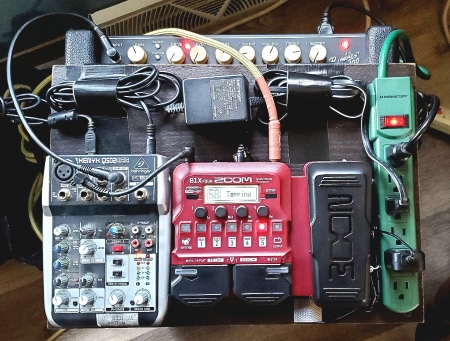
I run my Zoom 1BX FOUR into a 4 channel Xenyx USB mixer and then to the Rumble instrument input. This gives me plenty of options, but most of all I can use my customized presets on the Zoom for any scenario, whether it's to my laptop (via USB) for recording, or the use my combo(s), monitor mix or FOH.

I keep pretty much the same setting on my Rumble for everything. I don't use the Vintage button, but I do use the Contour and blend the low and high mids back in as needed. Gain is typically around 11-12 o'clock.

I find my Rumbles already have a bit of that low Vintage tone baked in, so that's set lower as is the lo-mid.

pedalboard-web-amp.jpg
 
Last edited:
I know the feeling. I had a perfectly fine 500 with 2 210 cabs. Except for an occasional jam it only gets used for 'practice'. The minute that 800 head came out I wanted it. It did new things, new capabilities etc. I got it for a good price (around 600 I think). No regrets. I can use it as 'quiet' as a 15, 40 or 100 or just rattle the windows (which the 500 certainly did also) The 800 doesn't care. The 40 is probably all I need but...
I rarely run my pair of 100s beyond 10-20 watts, but there have been times, like playing in a 5 piece band at an outdoor setting in the woods…
 
For the folks that primarily use there Rumble (500c in my case) as a platform for pedals/effects a couple of questions:

- where do you typically keep your gain?
- do you use "Vintage"?
- do you go in through the FX loop or the preamp input?

I typically go into the preamp (stacking with the preamps on my board), set Rumble eq flat 10/2/2/10, set gain at noon, and go back and forth on "Vintage".

Curious how other people run their rig
Pretty much just that! Although with daisy chained 100s, running into the preamp is the only option.
 
Others here can confirm, but if you're talking about the combos, I believe the 800 is lighter weight than the 500. If it was me, and I had the dough, that would be worth it to me.
Likewise-if we were still playing. The bookings have gotten so sparse I'm selling my 200c 'cos I haven't taken it out in over a year.
 
I'm either going to be buying a Rumble 500 or 800. I probably won't be using an extension cabinet with either. Is the extra $200 worth it for the 800?
If the weight difference isn't important, then I'd suggest you try both - some have owned both and prefer one over the other tone-wise in a live band mix.

Without extension cabs the difference in power is only 350W to 400W, not enough be be able to tell.

The Neo drivers are the real difference in tone between the two and as I said, some prefer one, some the other.
 
I'm either going to be buying a Rumble 500 or 800. I probably won't be using an extension cabinet with either. Is the extra $200 worth it for the 800?
Others here can confirm, but if you're talking about the combos, I believe the 800 is lighter weight than the 500. If it was me, and I had the dough, that would be worth it to me.

Yes, the R500c weighs 36.5 lb.s and the R800c weighs 29 lb.s. Those who have lifted both say that 7.5 lb.s is quite noticeable. Especially, if weight is a particular concern for you! I'm old, and lazy, so I would definitely get the R800c if I didn't already have a near 12-year-old, tried & true R500c.​

If the weight difference isn't important, then I'd suggest you try both - some have owned both and prefer one over the other tone-wise in a live band mix. ... Without extension cabs the difference in power is only 350W to 400W, not enough be be able to tell. ... The Neo drivers are the real difference in tone between the two and as I said, some prefer one, some the other.

Yes I believe the consensus I've read is that the Neo speakers of the R800c are more articulate and modern sounding than the ceramic ferrite speakers of the R500c. But, yes, you should try both to see which you prefer.​
ALSO, the R800c has an Output switch that let's your reduce the power to ¼ the normal 400W alone/800W with an 8 ohm cab to just 100W alone/200W with cab. The R800c can also run two 8 ohm cabs, if you want (still 800W either way). But the R500c can run only one 8 ohm cab for 500W. I like this feature very much for home practice versus a loud gig.​
Please come back and tell us which you get, preferably with pix, to get your free membership to The Club.​