• TalkBass has been independent since 1998. Add your voice.
    Create a free account to reply to discussions, view embedded media, and browse with fewer display ads.
    Join freeLog in
    Want zero display ads or expanded classifieds tools? Compare plans.

Fodera Club Part VI

Status
Not open for further replies.
Talking about fretless: I'm playing fretless for more than 20 years now, but I never went for a fivestring. I can't really imagine a great sounding B string on a fretless. What are your experiences? Can you recommend some recordings on which a great sounding B string on a fretless can be heard?

I think I would prefer a high C.


most of things by alain caron... =D... his Fbass kills it!!
 
What are the reasons,for choosing titanium as the bridge and truss rod material on some basses and what are , in your view, the benefits that set it apart from other materials?(aluminium comes to mind as one other lighter than brass material...in case weight is amongst the reasons)?

Afaik, aluminum is way too soft. On the bridge it will swallow a good amount of the vibration of the string.

And if you ever had a mountain bike with an aluminum frame you know what metal fatigue means.
 
Afaik, aluminum is way too soft. On the bridge it will swallow a good amount of the vibration of the string.

And if you ever had a mountain bike with an aluminum frame you know what metal fatigue means.

Thanks!
I have heard pretty much the same things about titanium, hence the question. :confused:
 
The obvious benefit is a weight savings although Ti parts in these two places definitely also impact the tone of the instrument. I do not personally have a wealth of experience comparing the same instrument with a Ti bridge / trussrod to a brass bridge and our conventional truss rod. That said, Anthony Jackson (who has a good a set of ears as anyone playing our instrument) has been the driving force behind our development of these Ti parts and I know that he personally prefers what they do tonally for the AJ Presentation...

Ti is obviously much lighter in weight than brass and yet it is still 60% more dense than aluminum and does not thin out the tone to the degree that an Aluminum Bridge does...

Wish that I could be more specific...

What are the reasons,for choosing titanium as the bridge and truss rod material on some basses and what are , in your view, the benefits that set it apart from other materials?(aluminium comes to mind as one other lighter than brass material...in case weight is amongst the reasons)?
 
The obvious benefit is a weight savings although Ti parts in these two places definitely also impact the tone of the instrument. I do not personally have a wealth of experience comparing the same instrument with a Ti bridge / trussrod to a brass bridge and our conventional truss rod. That said, Anthony Jackson (who has a good a set of ears as anyone playing our instrument) has been the driving force behind our development of these Ti parts and I know that he personally prefers what they do tonally for the AJ Presentation...

Ti is obviously much lighter in weight than brass and yet it is still 60% more dense than aluminum and does not thin out the tone to the degree that an Aluminum Bridge does...

Wish that I could be more specific...

Thanks very much!:)
I appreciate any input on this as one hears sooo many different and sometimes conflicting things about this.
 
Talking about fretless: I'm playing fretless for more than 20 years now, but I never went for a fivestring. I can't really imagine a great sounding B string on a fretless. What are your experiences? Can you recommend some recordings on which a great sounding B string on a fretless can be heard?

I think I would prefer a high C.

My Imperial is tuned E-C with a D-Tuner - so it should work nicely :)

...if I would do it..... let's see
 
my fretless is a 5er ,tuned B-G ( a simple zebrano body with maple /zebrano neck),and the B fits in very well with the other strings which all sound very good.
I use the B string just as much as all the others.
If the bass is a good instrument and well built, which i am sure is the case with yours, and the pickups are right ,all should be well I recon!:)
After that it's all down to taste.

In the case of my bass it took a pickup change(well, two actually) to get it right.
 
Talking about fretless: I'm playing fretless for more than 20 years now, but I never went for a fivestring. I can't really imagine a great sounding B string on a fretless. What are your experiences? Can you recommend some recordings on which a great sounding B string on a fretless can be heard?

I think I would prefer a high C.

I get what you're saying here about the low B. To me, though, the high C on a fretless can wind up sounding like a slide whistle or something. Especially if it's a thin little .028" gauge string. Yates' bass is a 5 with a low B and it's nice. The B is not the most earth shattering you've ever heard, but it's good and the bass is even so it feels natural and musical.
 
Afaik, aluminum is way too soft. On the bridge it will swallow a good amount of the vibration of the string.

And if you ever had a mountain bike with an aluminum frame you know what metal fatigue means.

Nah, you are confusing things here- hardness (being soft or hard) is not the same thing that drives metal fatigue. You aren't going to see fatigue in a bass bridge. Hardness is also not what would lead to "soaking up vibrations"- which is something that titanium does do really, really well.

Aluminum is perfectly fine and is not too soft for bridge applications- it is substantially harder than zinc but nobody complains about their Fender bridges being too soft.

That said I still prefer brass for sure.
 
Nah, you are confusing things here- hardness (being soft or hard) is not the same thing that drives metal fatigue. You aren't going to see fatigue in a bass bridge. Hardness is also not what would lead to "soaking up vibrations"- which is something that titanium does do really, really well.

Aluminum is perfectly fine and is not too soft for bridge applications- it is substantially harder than zinc but nobody complains about their Fender bridges being too soft.

That said I still prefer brass for sure.

I didn't mean that metal fatigue has something to do with hardness. It's just one bad characteristic of aluminum. It wouldn't play a role on a bass bridge but I would not want to have a trussrod made of aluminum.
 
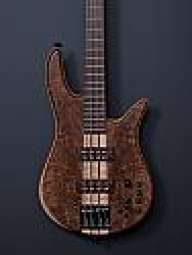
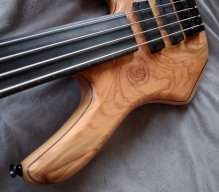
Maybe I missed something. The top is holly and the neck is three pieces of ash. What is the fingerboard and the body? Is it ebony and walnut? Thanks for posting. I would love to play that instrument.

Hi !

34"
Ebony Fingerboard / maple lines / side dots in standard position
Walnut body with Alder heelblock
Duncan PU
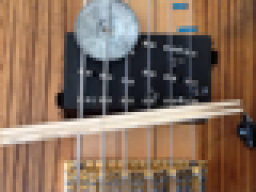
09 pope Pre amp ( I guess the first fretless with this new pre amp ? ) Half Round strings 040-130
Cheers.
JL.
 
Is there anyone youtube-able who goes B-G.(in the case of a 5 string instrument).
Just wondering how the bottom B sounds on such a bass as compared to, say a 35" or 36" equivalent?

i have three fretless 6-strings (all 34-inch scale). two are B-C (one rounds/one flats), one is D-Eb.

i like the low (B/D) strings on all of them.

i like the high C because you can do different things with it, plus it's great intonation practice to play chords up there (and humiliating at times). in fact, i have a plain on the Eb and i really like that because you can get some nice middle-eastern inflections out of it.

i tend to play with a less "modern" sound than many of my compatriots, so i don't really feel like the high strings are "too thin."

you asked youtube? hmm, dunno, there's a mess of stuff up there, but (in my case) a lot of it won't help you.
 
Thank you very much!
You also made me realise that I reposted incorrectly.
The original question from which I forgot the "important bit" in the repost, was:

Just a question about short scale basses(33".32"):
Is there anyone youtube-able who goes B-G.(in the case of a 5 string instrument).
Just wondering how the bottom B sounds on such a bass as compared to, say, a 35" or a 36" equivalent.

Thanks again!:)
 
Thanks very much!:)
I appreciate any input on this as one hears sooo many different and sometimes conflicting things about this.

For some background regarding some of the specific properties of Titanium, see my Previous post.

In summary: Besides the fact that a Titanium bridge of the same design weighs only half compared to a brass or steel bridge, the resonance frequencies are expected to be similar to that of brass, while the speed of sound is more like that of steel. Of course, the reality is more complex than this (if starting to take into account the crystal structure of the metal, directional dependencies etc.), but the above could indicate that Titanium has some special sonic properties.


Since I play Fodera and also manufacture these pieces I have personally A/B:d Titanium and Brass bridges on my own Fodera. Although I may be somewhat partial... , there is a noticeable difference, to me that is in favor of Titanium.

My opinion is that it gives a richer sound of each note without compromising the fundamental, especially for the lower strings. My guess is that more of the higher frequencies (overtones) created in the instrument are let through. Of course this is an extremely subjective matter, and may also be influenced by wood choices etc. The bass I have it on is a 36" scale, Emp II, with Walnut body and Kingwood fingerboard.
 
  • Like
Reactions: jsxtal
I didn't mean that metal fatigue has something to do with hardness. It's just one bad characteristic of aluminum. It wouldn't play a role on a bass bridge but I would not want to have a trussrod made of aluminum.

Same thing here- fatigue has nothing to do with the appropriateness of aluminum for a truss rod. In that application, it would never fatigue.
 
For some background regarding some of the specific properties of Titanium, see my Previous post.

In summary: Besides the fact that a Titanium bridge of the same design weighs only half compared to a brass or steel bridge, the resonance frequencies are expected to be similar to that of brass, while the speed of sound is more like that of steel. Of course, the reality is more complex than this (if starting to take into account the crystal structure of the metal, directional dependencies etc.), but the above could indicate that Titanium has some special sonic properties.


Since I play Fodera and also manufacture these pieces I have personally A/B:d Titanium and Brass bridges on my own Fodera. Although I may be somewhat partial... , there is a noticeable difference, to me that is in favor of Titanium.

My opinion is that it gives a richer sound of each note without compromising the fundamental, especially for the lower strings. My guess is that more of the higher frequencies (overtones) created in the instrument are let through. Of course this is an extremely subjective matter, and may also be influenced by wood choices etc. The bass I have it on is a 36" scale, Emp II, with Walnut body and Kingwood fingerboard.


Thanks very much!
I can't remember seeing that previous post.
Have you compared Titanium with Aluminium also?
As the other -lighter than Brass- metal a comparison with it would be rather interesting!
I'd be rather tempted to try a titanium bridge at this point!
Thanks again!
 
Status
Not open for further replies.