• TalkBass has been independent since 1998. Add your voice.
    Create a free account to reply to discussions, view embedded media, and browse with fewer display ads.
    Join freeLog in
    Want zero display ads or expanded classifieds tools? Compare plans.

Fretless-Lined or unlined?

I'm not sure about the epoxy coating..
On one hand,I want the bass to cost me as less as possible,because I want to buy a new amp/effects.

On the other hand,like we all know-the fingerboard will get wear,but then what I do?
Because if I have the epoxy coating,then all I'll probably need to do is just get a new coating.

And I REALLY want to use Flatwounds because I hate the noise my Roundwound make.
It just drives me CrAaAaAzY!

Even though they cost a little bit more than Roundwounds,I don't want to spend money for the epoxy AND Flatwounds,lol.

Thanks guys :).
 
Now I'm less scared than befor about unlined fretless.

Only 2 more things:
If I get an unlined fretless,and in the future I would like it to be lined...
Is that possible?

And should I get my fingerboard epoxy covered to make sure it won't get destroyed?
If I use Flatwound strings,is that ok enough?

There is really nothing to be scared of!

Yes you can put lines on an unlined fretless but it's not especially recommended. What is done is fretlines are done just as you would installing frets by using a fret saw to cut channels in the fingerboard. But instead of installing frets you install some filler, typically a veneer in a contrasting color. The whole neck is then planed smooth. The reason I would not do this is that it would be expensive, plus it would ruin the nice look, plus the sawed channels weaken the neck so one has to be sure the the filler (usually wood) restores the strength properly. It is sort of a tricky project. It's better to just start lined where you can see the final result in your hands and can decide if it's OK or not before you buy it.


As for epoxy coating, I would NOT do it unless you are REALLY looking for that tone. As a noob I'd start with the tone of just plain wood first. Flat wounds will not chew the neck of any fretless especially ebony. Also great are nylon wrapped strings. They have a wonderful feel under my hands to me. But many people like a bit brighter fretless tone. My typical fretless string choice is ground rounds. These are GHS "brite flats" or D'Addario "half-round". They also do not chew the neck but are brighter than flats. If you want to go still brighter try GHS compression wounds. These are rounds put through rollers to make them flattened. They do chew the neck slightly but not as badly as rounds. And lastly there are people who simply must have the sound of rounds. If that is you then expect the neck to get chewed over time (depending on how you play it can be reasonably rapid). At that point you simply go get the fingerboard replaned. You just consider it the "cost" of having the tone you love. It's usually not that often or that big a deal.

I repeat: As for epoxy or other coatings, I would NOT do it unless you are really into a Jaco sound or something. Coatings are brighter for sure but the tone is well, "different". Try to find one to play to see what I mean. You may love it. You may hate it. But what you do NOT want is to coat your bass and then hate it. Removing that coating can be a bear! Be sure you want that tone FIRST.

Good Luck! :bassist:
 
Unlined, it improves your ear.

No, it doesn't. It can't. If you're using your ear more on an unlined, it just means you're failing at using your ear well on a lined. Not the fault of the bass.
 
There is really nothing to be scared of!

Yes you can put lines on an unlined fretless but it's not especially recommended. What is done is fretlines are done just as you would installing frets by using a fret saw to cut channels in the fingerboard. But instead of installing frets you install some filler, typically a veneer in a contrasting color. The whole neck is then planed smooth. The reason I would not do this is that it would be expensive, plus it would ruin the nice look, plus the sawed channels weaken the neck so one has to be sure the the filler (usually wood) restores the strength properly. It is sort of a tricky project. It's better to just start lined where you can see the final result in your hands and can decide if it's OK or not before you buy it.


As for epoxy coating, I would NOT do it unless you are REALLY looking for that tone. As a noob I'd start with the tone of just plain wood first. Flat wounds will not chew the neck of any fretless especially ebony. Also great are nylon wrapped strings. They have a wonderful feel under my hands to me. But many people like a bit brighter fretless tone. My typical fretless string choice is ground rounds. These are GHS "brite flats" or D'Addario "half-round". They also do not chew the neck but are brighter than flats. If you want to go still brighter try GHS compression wounds. These are rounds put through rollers to make them flattened. They do chew the neck slightly but not as badly as rounds. And lastly there are people who simply must have the sound of rounds. If that is you then expect the neck to get chewed over time (depending on how you play it can be reasonably rapid). At that point you simply go get the fingerboard replaned. You just consider it the "cost" of having the tone you love. It's usually not that often or that big a deal.

I repeat: As for epoxy or other coatings, I would NOT do it unless you are really into a Jaco sound or something. Coatings are brighter for sure but the tone is well, "different". Try to find one to play to see what I mean. You may love it. You may hate it. But what you do NOT want is to coat your bass and then hate it. Removing that coating can be a bear! Be sure you want that tone FIRST.

Good Luck! :bassist:

I sort of want to get the Jaco sound...
But I'm not going to get epoxy coating for that.
;)

And after I talked with my bass teacher,I now don't care if it will be lined or unlined-either way,I'm going to have fun with it and if its unlined,I'll just work my ears to get the right notes.

:hyper: I LOVE TB!!!
 
The idea of wear is an entirely different subject. Personally, for roundwounds, I think semisynthetic or epoxied fingerboards are a good option since they're very durable AND work well with the usual desired tones. Flats on wood is also fine, but an opposite tonal vibe, which is often the point.

A lot of the durability depends on how much you use it.
 
SCMan88, I've done a couple of custom-bass projects before (including a Warmoth build) and here is my advice: It's a wonderful and fun project if you know exactly what you want AND you've done the research and know the particular options you want aren't available "off the shelf" AND you are confident in your instrument-building and setup abilities (or pay a luthier to do this for you).

In your case ("I am curious to try fretless") I really think you can save a lot of time and money by purchasing one of the popular factory-made models like the Invalid Link Removed. For a very low price (less than a finished Warmoth neck!), you could have a nice introduction to playing fretless, then when the time comes to order a custom instrument someday, you'll have the experience to answer the 1,000 questions that inevitably come up with a custom design.

Just my opinion, of course. :)
 
A lot of the durability depends on how much you use it.

And also how you use it. Players who have a heavy touch and use a vibrato technique suitable for fretted (ie vertical bends) will wear a fingerboard. If you have a lighter touch and use traditional string bass vibrato (horizontal) it is less of an issue. But unless you're playing the crap out of the bass you might see marks but won't get any actual issues until years of use. Seeing marks on the fingerboard does *not* mean that you have to get it planed.
 
Um...Change in plans.
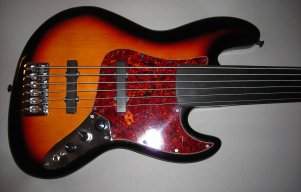
I'm probably getting a 6 string fretless bass.
As I love both 6 string and fretless,I feel like I should mix the two.
Call me crazy,I don't really care :)...
And it will be less expansive than $1000..
 
SCMan88,
Your teacher has the right idea!
In the long run, fret lines or no fret lines will not make a huge difference. You need to rely on your ears more with a fretless, and your visual cues will come from what you have available - edge dots, fret lines - you'll ultimately learn to use what you have to play in tune. Mostly, that will be your ears.

It is harder to play fretless than fretted, so expect to move backwards a little before moving forwards again, but it's really not that hard. If it was, there wouldn't be thousands of grade-school kids playing cellos and violins in tune in school orchestras. I was up and running and ready to play shows in a couple of months, and I had only been playing about a year when I got my first fretless.

That first fretless was lined. Personally, I found it more distracting than helpful and I switched to unlined, which I have used exclusively for over 20 years. That's just my experience... there are certainly some amazing bassists out there who prefer lines. It's all what you like, and you won't know that until you've played fretless for a while.

As far as strings and coatings, I prefer the tone of rounds on a fretless - just my preference - and I've only had one bass with a coated board. I still had to maintain it like any other bass, and I've never had any big issues with wear on ebony, pau ferro or rosewood boards, coated or not. I doubt you'll have any wear troubles for many years if you're planning to use flats.

If the unlined neck is in your budget, just go ahead and pull the trigger, don't bother with a coating (you can always add one later) and have fun.

If you do end up wanting lines, it would probably be more expensive to add them to an existing neck than to just get a new, lined neck. Just a thought.

Best of luck with your new neck!
 
Honestly, you posting that you want the "Jaco" sound screams roundwounds. Flats are more old school thumpy. Sure you can try and force them to do something different, but why go against the strings nature. If you want thump, use flats. If you want more singing upper mid range, use rounds. Once again, wear is virtually a non-issue. You can always start on bare wood, then have epoxy applied later if you so decide. Any previous wear will be covered in the process.

Note: String noise is extremely different on a fretless than a fretted bass IMO. I'd slap some basic rounds on whatever bass you get and try that first. If it still irks you, go flats. Then again that's just me.
 
By the way,are there any other tips for helping me play in tune on a fretless,and well,generally to get used to fretless?

I know only 2 tips:
1-To try to play open strings as much as I can to be 100% in tune.
2-To try and play with my eyes closed/in the dark so I won't be looking on my fingerboard(lined or unlined,doesn't really matter).


Thanks :)

Kael,getting to a Jaco sound is impossible(even though I try to get to that sound-lol).
Because you will never have the "Jaco Touch",and never be able to play like him,even if you've got the same 60's Jazz basses he had,the same strings,amps,effects...

I'm more of trying to get as close as I can to Jaco sound,then change a few things and get my own Jazzy-Jaco-style-sort-of-fretless-sound.
:)
 
Kael,getting to a Jaco sound is impossible(even though I try to get to that sound-lol).
Because you will never have the "Jaco Touch",and never be able to play like him,even if you've got the same 60's Jazz basses he had,the same strings,amps,effects...

I'm more of trying to get as close as I can to Jaco sound,then change a few things and get my own Jazzy-Jaco-style-sort-of-fretless-sound.
:)

Actually, people nail the Jaco sound all the time. His sound wasn't so intrinsic to his playing style that you can never get it.
 
Actually, people nail the Jaco sound all the time. His sound wasn't so intrinsic to his playing style that you can never get it.
+1

IMO Jaco had outstanding tone.

Some people prefer to go for a "woodier" sound.

Some people need to differentiate themselves from Jaco just on general principles.

Fender Jazz + Epoxy board + RW strings will get you pretty close.

BTW, the Warmoth necks have substantial steel reinforcement beams, and this has a pronounced effect on the tone. If I were going for Jaco sound, I would stick close to the Fender J basis.
 

Latest posts