• TalkBass has been independent since 1998. Add your voice.
    Create a free account to reply to discussions, view embedded media, and browse with fewer display ads.
    Join freeLog in
    Want zero display ads or expanded classifieds tools? Compare plans.

G&L Club Part 4

Status
Not open for further replies.
That's very weird because people have been calling log taper pots "audio taper" for half a century at least. :)

Utter baloney.

Well... Obviously you're the expert, so no need for the rest of us to offer any assistance on this...

But in your own way you are confirming what I'm saying: The pots that are called audio taper are in fact pots with a logarithmic taper. Meaning: Audio taper = Log taper. Meaning, the person I was in fact trying to help on the ''audio taper'' vs ''log taper'' pot question has his answer.
 
Morten_B said:
Well... Obviously you're the expert, so no need for the rest of us to offer any assistance on this...
:rolleyes: Shall I call the waaaambulance for you?

I make no claim to knowing more about pots than the average electronics hack. The fact is I'm pretty sure most average hacks out there know what you apparently did not, that audio=log, and all different pot tapers are found in audio circuits.
 
This pot thing has caught me out a couple of times.

This is my take on them. Any corrections and additions greatly appreciated.

UK and Europe designations

A - linear
B - log. (logarithmic)
C - reverse log

USA and probably a lot more countries (not sure of the actual pot markings for these).

Linear - linear
A or Audio - log.
Reverse Audio - reverse log.


These are by no means the only designations I am sure.

It depends on the age and country of manufacture how they are marked. I usually end up putting a meter on them to see what they are.
 
Forget it... I'm trying to help a TB member who is asking if he should use an ''audio taper'' or a ''log taper'' pot, and he got his answer... You seem to be on a different mission, not being here to help others, but to make others look like idiots. Best of luck with that...

I think it was because you prefaced your first post with "I have x amount of years experience in x, ad have NEVER heard of x". In forum speak, that is a common way for people to try to show that they are an authority on a subject in a way that belittles any opposition. It was probably not intended that way by you (maybe just different use of language), but that FWIW that is how I read it as well... Simple misunderstanding. Let's go on about our bass talk!
 
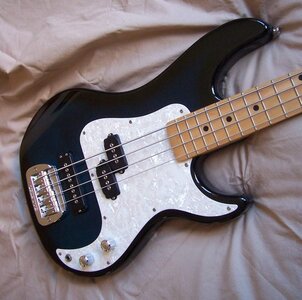
I would love to introduce you to my baby. I bet she could change your mind;)
GLL1505Front.jpg

That is a sweet looking bass!
 
Here's the L2000 wiring diagram:

l2k_wiring_diagram.gif


What's the purpose of the .0002 mfd capacitor between the outer and middle volume pot lug? I ask because I rewired my L2000 Tribute without the preamp and replaced the stock volume with a 250k push/pull for activating the K-mode, but I didn't put in that cap. Now the volume doesn't control the volume but acts like a tone control. Is it that missing cap or did I do something else wrong?
 
That capacitor acts as a high-pass filter that is meant to help you retain treble when lowering the volume control (otherwise treble fequencies are more quickly rolled off than other frequencies, and rolling off the volume will tend to make the tone sound much darker as well as quiet)- it isn't necessary to the function of the Volume control. When you removed the preamp, what did you leave connected to the middle lug of the volume control? To wire it as in this diagram, but without the preamp, you should just have a single wire from the middle lug of the volume control to the hot output lug of the Output jack (the white wire in this diagram). This way the signal passes from the pickup selector-tone control-bass control-volume control-output jack. I am guessing you just didn't follow the path of the signal at the active/passive switch correctly when removing the preamp...
 
That capacitor acts as a high-pass filter that is meant to help you retain treble when lowering the volume control (otherwise treble fequencies are more quickly rolled off than other frequencies, and rolling off the volume will tend to make the tone sound much darker as well as quiet)- it isn't necessary to the function of the Volume control. When you removed the preamp, what did you leave connected to the middle lug of the volume control? To wire it as in this diagram, but without the preamp, you should just have a single wire from the middle lug of the volume control to the hot output lug of the Output jack (the white wire in this diagram). This way the signal passes from the pickup selector-tone control-bass control-volume control-output jack. I am guessing you just didn't follow the path of the signal at the active/passive switch correctly when removing the preamp...

I had it all wired up correctly before I removed it all to try and install an Audere preamp (which I'm going to try again with all new switches) but when I put things back I must have made a mistake. I'll see what I can do.
 
Seperate switches for each pickup

+1. If you want a separate switch for each pickup you'll need to either drill and extra switch hole or eliminate something that takes up a switch hole, like ditching the preamp. If you want to do that and want to go for maximum versatility without changing the look of your bass sunbeast or myself can help you with that.
 
+1. If you want a separate switch for each pickup you'll need to either drill and extra switch hole or eliminate something that takes up a switch hole, like ditching the preamp. If you want to do that and want to go for maximum versatility without changing the look of your bass sunbeast or myself can help you with that.

What I have had done thus far is to replace the middle switch with a 4 pole on/on/on and it is wired SC outters/Full/SC inners. I run mostly SC outters in passive.
So if I was to remove the active passive switch I would have a passive bass, but seperate pickup control? Giving me the option of a PJ sound, reverse PJ, Etc.???
thanks:help:
 
Status
Not open for further replies.